Breville electric kettles are not universally interchangeable, but certain models share compatible parts like lids, filters, and bases. Understanding model-specific design differences is key to avoiding damage or safety risks when swapping components.
Key Takeaways
- Model-specific designs limit interchangeability: Breville kettles vary in shape, size, and internal wiring, making cross-model part swaps risky.
- Some accessories are compatible: Filters, lids, and water level indicators may work across similar models, especially within the same product line.
- Electrical components rarely interchangeable: Heating elements, thermostats, and power bases are built for specific wattage and voltage requirements.
- Warranty and safety concerns: Using non-compatible parts can void your warranty and pose electrical or fire hazards.
- Check serial numbers and manuals: Always verify compatibility using your model number before attempting any part replacement.
- Third-party parts are not recommended: Generic replacements often lack safety certifications and may damage your kettle.
- Contact Breville support for guidance: Their customer service can confirm which parts are safe to use with your specific model.
📑 Table of Contents
- Understanding Breville Electric Kettle Design and Compatibility
- Why Interchangeability Isn’t Universal Across Breville Kettles
- When Are Breville Kettle Parts Interchangeable?
- Risks of Using Non-Compatible Parts
- How to Safely Replace Parts on Your Breville Kettle
- Real-World Examples and User Experiences
- Conclusion: Interchangeability Is Limited—But Not Impossible
Understanding Breville Electric Kettle Design and Compatibility
When it comes to kitchen appliances, few brands blend style, innovation, and performance like Breville. Their electric kettles are no exception—sleek, fast-boiling, and packed with smart features like temperature control, keep-warm functions, and precision pour spouts. But if you own more than one Breville kettle—or are considering replacing a broken part—you might wonder: Are Breville electric kettles interchangeable?
The short answer? Not really. While Breville designs its kettles with a consistent aesthetic and user-friendly interface, the internal engineering varies significantly between models. This means that even if two kettles look similar on the outside, their components are often built to fit specific designs, electrical systems, and safety standards. Swapping parts between models without proper knowledge can lead to malfunctions, reduced performance, or even safety hazards.
Breville offers a wide range of electric kettles, from the classic Breville BKE820XL IQ Electric Kettle to the high-tech Breville BKE830XL Smart Kettle and the compact Breville BKE700XL Variable Temperature Kettle. Each model serves different needs—some prioritize speed, others offer precise temperature settings for tea or coffee, and a few include built-in scales or gooseneck spouts for pour-over brewing. Because of these differences, Breville engineers each kettle as a complete system, where every part works in harmony with the others.
This holistic design philosophy ensures optimal performance and safety, but it also means that interchangeability is limited. You can’t simply take the lid from one model and expect it to fit another, nor can you swap heating elements without risking electrical issues. That said, there are exceptions—especially with accessories and non-electrical components—which we’ll explore in detail.
Why Interchangeability Isn’t Universal Across Breville Kettles
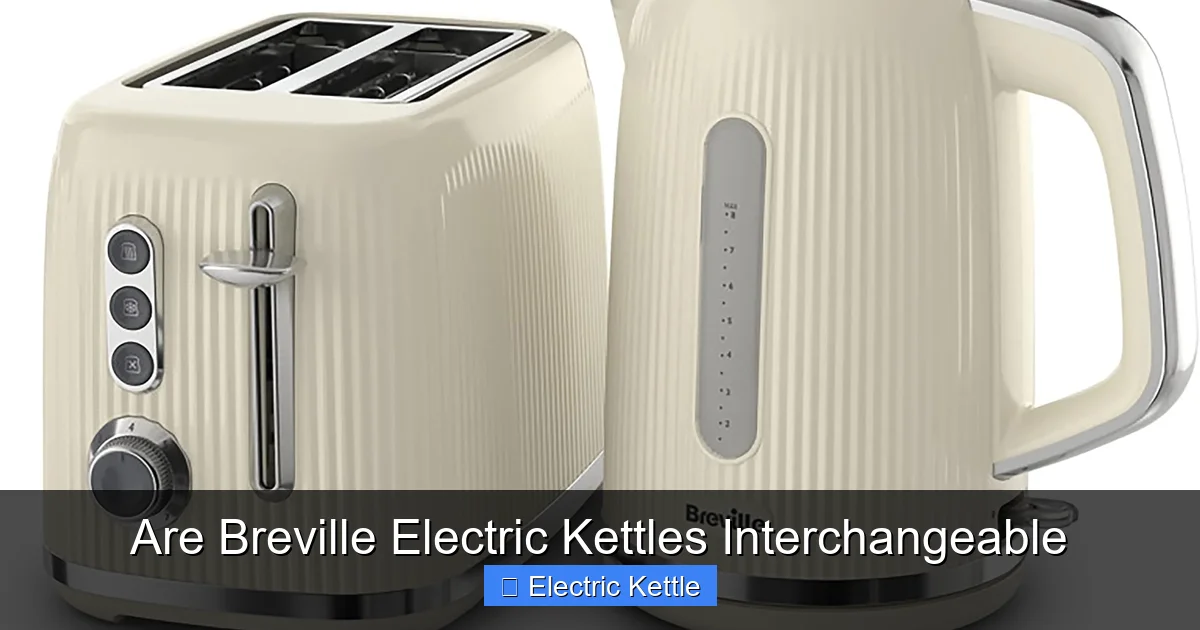
Visual guide about Are Breville Electric Kettles Interchangeable
Image source: m.media-amazon.com
To understand why Breville kettles aren’t fully interchangeable, it helps to look at the key components that make up these appliances. Each part is carefully engineered to work within a specific system, and altering that system can disrupt functionality.
1. Model-Specific Dimensions and Shapes
One of the most obvious barriers to interchangeability is physical design. Breville kettles come in various sizes, from 1-liter compact models to 1.7-liter family-sized versions. The diameter of the base, the height of the kettle body, and the curvature of the handle all differ between models. For example, the Breville Smart Kettle has a wider base and a more angular body compared to the rounded silhouette of the IQ Kettle. These differences mean that even non-electrical parts like lids or filters may not fit properly if swapped between models.
Imagine trying to put a lid from a small kettle onto a larger one—it might sit loosely, fail to seal, or not attach at all. A poor seal can lead to steam leaks, reduced boiling efficiency, or even burns from escaping hot vapor. Similarly, a filter designed for a narrow spout won’t function correctly in a wider opening, potentially allowing limescale or debris to pass through.
2. Electrical and Wiring Differences
The heart of any electric kettle is its heating element and electrical system. Breville kettles use different wattage ratings—typically between 1200W and 1500W—depending on the model. The Smart Kettle, for instance, runs at 1500W for rapid boiling, while some older models may use 1200W. The power base, internal wiring, and thermostat are all calibrated to match these specifications.
Swapping a heating element from a 1200W kettle into a 1500W model could result in underperformance—water taking longer to boil—or worse, overheating due to mismatched electrical loads. Conversely, installing a higher-wattage element into a lower-capacity kettle might overload the circuitry, trip your home’s breaker, or even cause a fire.
Additionally, many Breville kettles feature advanced temperature control systems. The Variable Temperature Kettle, for example, allows users to select precise temperatures (e.g., 160°F for green tea, 200°F for French press coffee). These systems rely on specific thermostats and sensors that are not compatible with simpler models that only boil to 212°F. Mixing these components could disable temperature settings or cause inaccurate readings.
3. Safety Mechanisms and Certifications
Breville kettles are designed with multiple safety features, including automatic shut-off, boil-dry protection, and cool-touch exteriors. These mechanisms are integrated into the kettle’s design and are not easily transferable. For instance, the automatic shut-off relies on a thermal fuse and sensor that communicate with the heating element. If you replace the element with one from another model, the sensor may not detect temperature changes correctly, disabling the shut-off function.
Moreover, Breville kettles undergo rigorous testing to meet international safety standards such as UL (Underwriters Laboratories) and ETL (Intertek). Using non-compatible parts—especially third-party or salvaged components—can compromise these certifications. This not only voids your warranty but also increases the risk of electrical shock or fire.
4. Proprietary Design Elements
Breville often includes unique features that are model-specific. The Smart Kettle, for example, has a built-in LCD screen that displays water temperature and brewing time. This screen is connected to internal circuitry that isn’t present in other models. Similarly, the Precision Pour Kettle includes a gooseneck spout designed for controlled pouring, which requires a specific lid and filter assembly.
These proprietary elements are not just cosmetic—they’re integral to the kettle’s function. Attempting to retrofit a gooseneck spout onto a standard kettle, for instance, would require modifying the body and lid, which is neither practical nor safe.
When Are Breville Kettle Parts Interchangeable?
While full interchangeability isn’t possible, there are situations where certain parts can be safely swapped—especially within the same product line or generation.
Accessories and Non-Electrical Components
Some accessories are designed to be compatible across multiple models. For example, Breville often uses standardized water filters and lids within similar product families. The Breville BKE820XL IQ Kettle and the BKE830XL Smart Kettle, for instance, share a similar lid design and filter size. If you own both models, you might be able to use the same filter in either kettle—though it’s always best to double-check the model number.
Similarly, water level indicators and removable lids may be interchangeable if they share the same mounting mechanism and dimensions. However, even small differences—like a slightly different hinge or seal—can affect performance. Always inspect the part closely before use.
Replacement Parts from Breville
Breville offers official replacement parts for many of its kettles, including lids, filters, and power bases. These parts are designed to match the original specifications and are the safest option for repairs. For example, if the lid on your Breville Variable Temperature Kettle cracks, you can order a direct replacement from Breville’s website or authorized retailers.
When purchasing replacement parts, always use your kettle’s model number (found on the base or in the manual) to ensure compatibility. Breville’s customer support team can also help identify the correct part for your model.
Cross-Model Compatibility Within Product Lines
Some Breville kettle lines share more similarities than others. The IQ and Smart series, for example, were released around the same time and share design elements. In some cases, users have reported success swapping filters or lids between these models. However, this is not guaranteed and should be approached with caution.
A safer approach is to stick to parts from the same model or confirmed compatible variants. For instance, if you have a BKE820XL and a BKE825XL (a regional variant), they may share more compatibility than a BKE820XL and a BKE700XL, which belongs to a different product tier.
Risks of Using Non-Compatible Parts
Attempting to interchange parts between Breville kettles can lead to several problems, ranging from minor inconveniences to serious safety risks.
Voided Warranty
Breville’s warranty typically covers defects in materials and workmanship but does not extend to damage caused by unauthorized modifications or part replacements. If you install a non-compatible lid or heating element and the kettle malfunctions, Breville may refuse to honor the warranty. This could leave you paying for a full replacement out of pocket.
Reduced Performance and Efficiency
Even if a part fits physically, it may not function as intended. A filter from a different model might not trap limescale effectively, leading to buildup in your kettle and affecting water taste. A mismatched lid could allow heat to escape, increasing boiling time and energy consumption.
Safety Hazards
The most serious risk is electrical or fire hazards. Using a heating element with the wrong wattage can cause overheating, melting internal components, or igniting nearby materials. Faulty wiring or poor connections can also lead to electrical shocks, especially if the kettle is used near water.
Additionally, if the automatic shut-off fails due to a mismatched thermostat, the kettle could continue heating even after the water has boiled away—a condition known as “boil-dry.” This can damage the heating element and pose a fire risk.
Voided Safety Certifications
As mentioned earlier, Breville kettles are certified by safety organizations like UL and ETL. These certifications are based on the kettle being used as designed. Modifying the appliance with non-compatible parts invalidates these certifications, meaning the product no longer meets official safety standards.
How to Safely Replace Parts on Your Breville Kettle
If your Breville kettle needs a repair or replacement part, follow these steps to ensure safety and compatibility.
1. Identify Your Model Number
The model number is usually printed on a label on the base of the kettle. It typically starts with “BKE” followed by numbers and letters (e.g., BKE820XL). This number is essential for finding the correct replacement part.
2. Consult the User Manual
The manual often includes a parts diagram and list of replaceable components. Some manuals even specify which parts are user-serviceable and which require professional repair.
3. Purchase Genuine Breville Parts
Avoid third-party or generic replacements. While they may be cheaper, they often lack the quality control and safety testing of genuine parts. Breville’s official website, authorized retailers, or customer service can help you source authentic components.
4. Follow Installation Instructions
Even simple replacements, like a new lid or filter, should be installed according to the manufacturer’s guidelines. Improper installation can lead to leaks, poor sealing, or electrical issues.
5. Test the Kettle After Replacement
Before regular use, run a test cycle with water (no tea or coffee) to ensure the kettle heats properly, shuts off automatically, and doesn’t leak. Monitor for unusual noises, smells, or sparks.
6. Contact Breville Support if Unsure
If you’re uncertain about compatibility or installation, reach out to Breville’s customer service. They can confirm whether a part is safe to use and may offer repair services or guidance.
Real-World Examples and User Experiences
Many Breville owners have shared their experiences with part replacements online. Here are a few common scenarios:
– A user with a cracked lid on their BKE820XL IQ Kettle successfully replaced it with a genuine Breville lid and reported no issues.
– Another owner tried using a filter from a BKE700XL in their BKE830XL Smart Kettle but found it didn’t fit snugly, leading to minor leaks.
– A third user attempted to replace a faulty heating element with one from an older model. The kettle overheated and tripped the circuit breaker, requiring professional repair.
These examples highlight the importance of using compatible parts and following manufacturer guidelines.
Conclusion: Interchangeability Is Limited—But Not Impossible
So, are Breville electric kettles interchangeable? The answer is nuanced. While you can’t mix and match parts freely across all models, there are limited cases where certain accessories—like filters or lids—may work between similar kettles. However, electrical components such as heating elements, thermostats, and power bases are almost never interchangeable due to differences in wattage, wiring, and safety systems.
The safest and most reliable approach is to use only genuine Breville replacement parts designed for your specific model. This ensures optimal performance, maintains your warranty, and protects your safety. When in doubt, consult the user manual or contact Breville support for guidance.
Breville kettles are built to last, and with proper care and correct part replacements, they can serve you well for many years. But remember: when it comes to kitchen appliances, especially those involving electricity and heat, precision and compatibility matter more than convenience.
Frequently Asked Questions
Can I use a lid from one Breville kettle on another model?
It depends on the models. Some lids from similar Breville kettles (like the IQ and Smart series) may fit, but differences in size, hinge design, or seal can affect performance. Always check dimensions and compatibility before swapping.
Are Breville kettle filters interchangeable?
Filters may be interchangeable between models with similar spout and lid designs, especially within the same product line. However, using a mismatched filter can lead to leaks or poor filtration. Verify compatibility using your model number.
Can I replace the heating element in my Breville kettle with one from another model?
No, heating elements are not interchangeable. They are designed for specific wattage and voltage requirements. Swapping elements can cause overheating, electrical faults, or fire hazards.
Will using non-Breville parts void my warranty?
Yes, using unauthorized or third-party parts typically voids Breville’s warranty. The company only covers damage from defects, not modifications or improper repairs.
Where can I buy genuine Breville replacement parts?
Genuine parts are available through Breville’s official website, authorized retailers, or customer service. Always use your model number to ensure you get the correct component.
What should I do if my Breville kettle stops working?
First, check the power source and ensure the kettle is properly seated on the base. If the issue persists, consult the user manual or contact Breville support. Avoid DIY repairs on electrical components unless you’re qualified.