Plugging an electric kettle into a power strip is generally not recommended due to high power demands and fire risks. Most kettles draw more current than standard power strips can safely handle, especially when other devices are connected. Always check your kettle’s wattage and use a dedicated outlet or heavy-duty surge protector if absolutely necessary.
Key Takeaways
- Electric kettles draw high wattage: Most kettles use between 1,500 and 3,000 watts, which can overload standard power strips.
- Standard power strips aren’t built for high-load appliances: They’re designed for low-power devices like lamps, phones, and computers—not heating appliances.
- Overloading causes overheating and fire hazards: Plugging a kettle into a daisy-chained or multi-device power strip increases the risk of melting, sparks, or electrical fires.
- Use a heavy-duty power strip or dedicated outlet: If you must use a power strip, choose one rated for 15 amps or higher with built-in overload protection.
- Check manufacturer guidelines: Always follow the kettle and power strip manufacturer’s instructions to ensure safe operation.
- Avoid daisy-chaining power strips: Connecting multiple strips together creates a dangerous setup that can easily overload circuits.
- Consider upgrading your kitchen outlets: If you frequently use high-wattage appliances, consult an electrician about dedicated circuits.
📑 Table of Contents
- Can I Plug an Electric Kettle into a Power Strip? The Short Answer
- Understanding Electric Kettle Power Requirements
- How Power Strips Work and Their Limitations
- Safety Risks of Plugging a Kettle into a Power Strip
- When Is It Safe to Use a Power Strip with a Kettle?
- Safer Alternatives to Using a Power Strip
- Best Practices for Safe Electric Kettle Use
- Conclusion: Prioritize Safety Over Convenience
Can I Plug an Electric Kettle into a Power Strip? The Short Answer
If you’ve ever stood in your kitchen with a boiling kettle in hand and only a crowded power strip available, you’ve probably asked yourself: *Can I plug an electric kettle into a power strip?* It seems like a simple solution—just plug it in and get your tea brewing. But the truth is, this common convenience could come with serious risks.
Electric kettles are among the most power-hungry appliances in the average home. They heat water quickly by drawing a large amount of electrical current—often between 1,500 and 3,000 watts. That’s more than most space heaters, microwaves, or hair dryers. Standard power strips, on the other hand, are typically rated for much lower loads—usually around 10 to 13 amps, or about 1,200 to 1,560 watts. When you plug a high-wattage kettle into a strip not designed for such demand, you’re asking for trouble.
The short answer? **It’s generally not safe to plug an electric kettle into a standard power strip.** While it might work temporarily, doing so regularly increases the risk of overheating, electrical fires, and damage to both the kettle and the power strip. In this article, we’ll break down why this is the case, explore safer alternatives, and give you practical tips to keep your kitchen both convenient and safe.
Understanding Electric Kettle Power Requirements
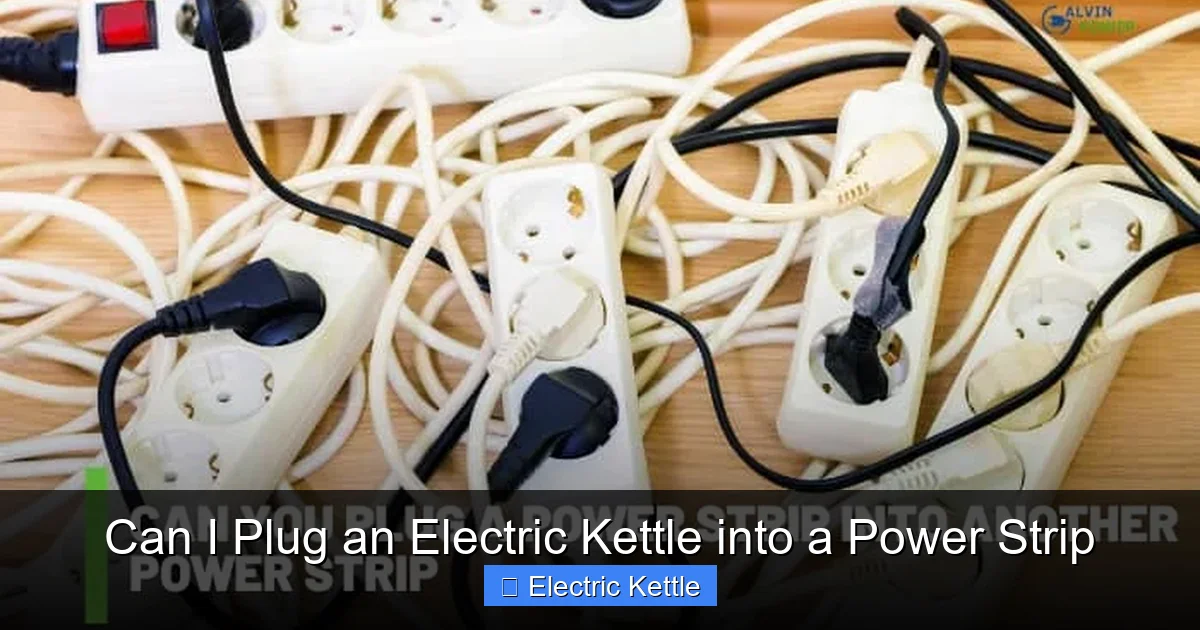
Visual guide about Can I Plug an Electric Kettle into a Power Strip
Image source: galvinpower.org
To understand why power strips and electric kettles don’t always mix, you first need to know how much power these appliances actually use. Most electric kettles are designed for speed—boiling a full liter of water in just a few minutes. To do that, they need serious electrical muscle.
Typical Wattage and Amperage of Electric Kettles
The average electric kettle operates at **1,500 to 3,000 watts**, with most household models falling between 1,800 and 2,200 watts. To put that in perspective, a typical laptop uses about 65 watts, and a desk lamp uses around 10–60 watts. Even a toaster or microwave usually tops out around 1,200 watts. Your kettle is pulling nearly double that.
Let’s look at amperage, which measures electrical current. In the U.S., standard household outlets provide 120 volts. Using the formula:
> **Amps = Watts ÷ Volts**
A 1,800-watt kettle draws about **15 amps** (1,800 ÷ 120 = 15). A 2,200-watt model pulls nearly **18.3 amps**. That’s already pushing or exceeding the capacity of many standard power strips, which are usually rated for 10–13 amps.
Why High Wattage Matters for Safety
High wattage means high heat—not just in the water, but in the electrical components. When a kettle draws more current than a power strip is designed to handle, the internal wiring and outlets can overheat. This heat buildup can melt plastic casings, damage insulation, and in worst-case scenarios, ignite a fire.
Even if the power strip doesn’t immediately fail, repeated use under overload conditions weakens its internal components over time. What starts as a minor spark could escalate into a dangerous situation, especially if the strip is hidden under a counter or behind furniture where smoke or flames might go unnoticed.
Real-World Example: The Overloaded Strip
Imagine this scenario: You’ve got your coffee maker, phone charger, laptop, and a small lamp all plugged into a single power strip. Then you plug in your 2,000-watt electric kettle. That’s a total load of roughly 2,300+ watts—far beyond what most strips can safely manage. The strip’s circuit breaker might trip, or worse, it might not, allowing dangerous levels of current to flow unchecked.
This is why manufacturers often warn against using high-wattage appliances with power strips. It’s not just about the kettle—it’s about the entire electrical load on that circuit.
How Power Strips Work and Their Limitations
To make an informed decision, it helps to understand what power strips are actually designed for—and what they’re not.
What Is a Power Strip?
A power strip is essentially an extension of your wall outlet. It has multiple sockets so you can plug in several devices at once. Most also include a built-in circuit breaker or fuse that trips if the current exceeds a safe level. Some models offer surge protection, which guards against voltage spikes from lightning or power grid issues.
But here’s the key point: **Power strips are not the same as extension cords or heavy-duty power distribution units.** They’re meant for convenience, not for handling high-load appliances.
Standard vs. Heavy-Duty Power Strips
Standard power strips are built for low- to medium-power devices. Think:
– Laptops (65W)
– Phone chargers (10–20W)
– Tablets (10–30W)
– LED lamps (5–15W)
– Routers and smart speakers (5–20W)
These devices draw very little current and generate minimal heat. A standard strip can handle several of them at once without issue.
Heavy-duty power strips, on the other hand, are built with thicker internal wiring, higher amp ratings (often 15A or more), and better heat dissipation. They’re designed for tools, medical equipment, or industrial use—not typical kitchen appliances.
Surge Protectors vs. Basic Power Strips
Many people assume all power strips offer surge protection, but that’s not always true. A basic power strip is just a splitter—no protection against power surges. A surge protector includes components like metal oxide varistors (MOVs) that absorb excess voltage.
However, even surge protectors have limits. Most consumer-grade models are rated for 600 to 2,000 joules of surge absorption. Once that capacity is used up (from repeated surges), the protection fails—even if the strip still powers devices.
More importantly, **surge protection doesn’t increase the strip’s ability to handle high wattage.** A 1,000-joule surge protector rated for 10 amps still can’t safely power a 15-amp kettle.
The Danger of Daisy-Chaining
One of the riskiest things you can do is plug a power strip into another power strip—a practice known as daisy-chaining. This creates a long chain of electrical connections, each adding resistance and heat. It also makes it harder for circuit breakers to detect overloads.
Imagine plugging your kettle into Strip A, which is plugged into Strip B, which is plugged into the wall. Even if each strip is rated for 13 amps, the cumulative load can easily exceed safe limits. The result? Overheating, melted plugs, or fire.
The National Fire Protection Association (NFPA) reports that daisy-chaining power strips is a leading cause of electrical fires in homes. It’s a habit that seems harmless but can have deadly consequences.
Safety Risks of Plugging a Kettle into a Power Strip
Now that we understand the power demands and limitations, let’s look at the real dangers of combining an electric kettle with a standard power strip.
Overheating and Fire Hazards
The most serious risk is fire. When a kettle draws more current than a power strip can handle, the internal wires heat up. If the strip lacks proper overload protection, this heat can melt the plastic housing, damage insulation, and ignite nearby materials.
Even if the strip has a circuit breaker, it may not trip fast enough to prevent damage. Some breakers are designed to allow brief overloads (like when a motor starts), but a kettle runs continuously for several minutes—long enough to cause significant heat buildup.
In rare cases, overheating can cause arcing—sparks inside the strip. Arcing generates intense heat and can ignite flammable materials like paper, curtains, or wooden cabinets.
Damage to the Kettle and Other Devices
Using an overloaded power strip can also damage your kettle. Voltage drops or inconsistent power delivery may cause the heating element to work harder, shortening its lifespan. In extreme cases, the kettle’s internal thermostat or safety switch could fail, leading to overheating or boiling dry.
Other devices plugged into the same strip are also at risk. Power fluctuations can damage sensitive electronics like laptops, phones, or smart home devices.
Tripped Breakers and Power Outages
If your home’s circuit breaker is sensitive, plugging in a high-wattage kettle—even into a wall outlet—can trip the breaker, especially if other appliances are running. But when you use a power strip, the trip might happen at the strip level, cutting power to all connected devices.
This isn’t just inconvenient—it can disrupt work, damage data, or ruin food in a smart fridge. Repeated tripping also wears out the breaker, reducing its effectiveness over time.
Insurance and Warranty Implications
Many home insurance policies exclude coverage for fires caused by improper electrical use. If a fire starts because you plugged a kettle into an overloaded power strip, your claim might be denied.
Similarly, using a kettle in a way that violates the manufacturer’s instructions (like plugging it into an unsuitable power source) can void the warranty. If your kettle fails prematurely, you may be left without coverage.
When Is It Safe to Use a Power Strip with a Kettle?
So, is it *ever* safe to plug an electric kettle into a power strip? The answer is: **only under very specific conditions.**
Use a Heavy-Duty, High-Amp Power Strip
If you absolutely must use a power strip, choose one rated for **15 amps or higher**. Look for labels like “heavy-duty,” “industrial,” or “high-load.” These strips have thicker internal wiring (usually 14-gauge or 12-gauge copper) and better heat resistance.
Check the packaging or product description for:
– Maximum wattage (should be at least 1,800W)
– Amp rating (15A or higher)
– Built-in circuit breaker or overload protection
– UL (Underwriters Laboratories) or ETL certification
Avoid cheap, unbranded strips sold in bulk packs. They often lack proper safety features and may not meet electrical standards.
Plug the Kettle Alone—No Other Devices
Even with a heavy-duty strip, only plug the kettle into it. Don’t add a coffee maker, toaster, or phone charger. The kettle should be the only device drawing power. This reduces the risk of cumulative overload.
Use a Dedicated Outlet Whenever Possible
The safest option is to plug your kettle directly into a wall outlet. This ensures it gets full power without straining a power strip. If your kitchen lacks enough outlets, consider hiring an electrician to install additional ones.
Check the Kettle’s Power Rating
Before plugging in, check the label on your kettle (usually on the base or bottom). It should list the voltage (120V in the U.S.) and wattage. If it’s over 1,500 watts, treat it as a high-load appliance.
If your kettle is 1,200 watts or less (rare, but some compact models exist), it may be safer to use with a high-quality power strip—but still, avoid daisy-chaining or adding other devices.
Monitor for Warning Signs
Even with precautions, stay alert. If the power strip feels warm, emits a burning smell, or shows scorch marks, unplug everything immediately. These are signs of overload or internal damage.
Also, avoid using power strips that are old, cracked, or missing their safety covers. Wear and tear reduces their effectiveness and increases risk.
Safer Alternatives to Using a Power Strip
Instead of risking a power strip, consider these safer, long-term solutions.
Install Additional Wall Outlets
If your kitchen is short on outlets, hire a licensed electrician to install new ones. This is the most reliable way to support high-wattage appliances. You can even request outlets with built-in USB ports or smart controls.
Use a Dedicated Circuit for High-Load Appliances
In modern kitchens, high-wattage appliances like kettles, microwaves, and toaster ovens should ideally run on dedicated circuits. This prevents overloading and ensures consistent power.
An electrician can assess your current setup and recommend upgrades. While it involves upfront cost, it enhances safety and adds value to your home.
Choose a Kettle with Lower Wattage
If you’re in a small space with limited outlets, consider a lower-wattage kettle. Some travel or compact models use 800–1,200 watts and still boil water reasonably fast. They’re safer for use with power strips, though still not ideal.
Use a Timer or Smart Plug (With Caution)
Smart plugs allow you to control appliances remotely or set timers. However, most standard smart plugs are rated for 15 amps—right at the limit for a kettle. Only use them if:
– The smart plug is specifically rated for high-wattage appliances
– The kettle is the only device plugged in
– You monitor usage closely
Never use a smart plug to “automate” a kettle that’s already overloading a circuit.
Keep Cords Organized and Accessible
Use cord organizers or clips to keep kettle cords tidy and away from heat sources. A tangled cord can overheat or get damaged, increasing fire risk. Always unplug the kettle after use—don’t leave it connected unnecessarily.
Best Practices for Safe Electric Kettle Use
Beyond power sources, safe kettle use involves good habits and maintenance.
Never Leave a Kettle Unattended
Always stay nearby while the kettle is heating. If it boils dry or malfunctions, you can respond quickly. Modern kettles have auto-shutoff features, but they’re not foolproof.
Clean and Maintain Your Kettle
Mineral buildup from hard water can insulate the heating element, causing it to overheat. Clean your kettle regularly with vinegar or a descaling solution. A well-maintained kettle runs more efficiently and safely.
Inspect Cords and Plugs Regularly
Check for frayed wires, loose plugs, or discoloration. Damaged cords can cause shocks or fires. Replace the kettle if the cord is compromised.
Use on a Stable, Heat-Resistant Surface
Place your kettle on a flat, non-flammable surface like ceramic or stone. Avoid wooden tables or plastic trays that could melt or catch fire.
Follow Manufacturer Instructions
Every kettle is different. Read the user manual for specific safety guidelines, wattage info, and usage tips. Ignoring instructions can void warranties and increase risks.
Conclusion: Prioritize Safety Over Convenience
So, can you plug an electric kettle into a power strip? Technically, yes—but it’s rarely a good idea. The high power demands of most kettles exceed the safe capacity of standard power strips, creating serious fire and electrical hazards.
While it might seem like a small convenience, the risks far outweigh the benefits. Overheating, damaged devices, tripped breakers, and even house fires are real possibilities—especially if you’re daisy-chaining strips or plugging in multiple devices.
The safest approach is to plug your kettle directly into a wall outlet. If that’s not possible, use a heavy-duty, high-amp power strip rated for at least 15 amps—and only for the kettle alone. Better yet, invest in additional outlets or a dedicated circuit to future-proof your kitchen.
Remember: electrical safety isn’t about fear—it’s about smart choices. By understanding your appliances’ power needs and respecting the limits of your electrical setup, you can enjoy your morning tea without worry. Your safety, your devices, and your peace of mind are worth the extra effort.
Frequently Asked Questions
Can I plug a 1,500-watt kettle into a 10-amp power strip?
No, it’s not safe. A 10-amp power strip can handle up to 1,200 watts (10A × 120V). A 1,500-watt kettle exceeds that limit, risking overheating and fire. Always use a strip rated for at least 15 amps.
Is it safe to use a surge protector with an electric kettle?
Only if the surge protector is heavy-duty and rated for high-wattage appliances. Most consumer surge protectors are not designed for kettles. Check the wattage and amp rating before use.
What happens if I overload a power strip with a kettle?
The strip may overheat, melt, or catch fire. The circuit breaker might trip, cutting power to all devices. In worst cases, it can cause an electrical fire, especially if the strip is hidden or near flammable materials.
Can I use an extension cord instead of a power strip?
Only if it’s a heavy-duty, outdoor-rated extension cord with a 15-amp rating. Never use lightweight or indoor extension cords, as they can overheat and pose a fire hazard.
Why do some people say it’s okay to plug a kettle into a power strip?
Some may have used it without issues, but that doesn’t mean it’s safe. Electrical fires can occur even after months of “successful” use. Safety standards exist to prevent rare but deadly incidents.
What should I do if my power strip feels hot when using the kettle?
Unplug everything immediately. A warm strip is a warning sign of overload. Stop using the strip and replace it with a heavy-duty model or plug the kettle directly into a wall outlet.