You cannot directly “charge” an electric tea kettle with a powerbank because kettles don’t have rechargeable batteries—they need high-wattage AC power to heat water. However, with the right equipment like a high-capacity power station or inverter, you can run a kettle off-grid in emergencies or outdoor settings.
Have you ever been stuck without electricity but really needed a hot cup of tea? Maybe you’re camping, dealing with a power outage, or traveling in a place with unreliable outlets. Your mind races: *Can I just plug my electric kettle into my powerbank?* It’s a smart thought—after all, powerbanks charge phones, laptops, even mini fridges these days. So why not a kettle?
The short answer? Not directly. And here’s why: electric tea kettles aren’t like your smartphone. They don’t have internal batteries that store energy. Instead, they rely on powerful heating elements that draw a lot of electricity—fast—to boil water in minutes. That kind of power demand is way beyond what a typical USB powerbank can deliver. But that doesn’t mean all hope is lost. With the right tools and understanding, you *can* brew tea off-grid. It just takes a bit more planning and the correct equipment.
In this guide, we’ll break down exactly why standard powerbanks won’t work, what kind of portable power *can* handle an electric kettle, and how to do it safely and efficiently. Whether you’re a frequent traveler, an outdoor enthusiast, or just preparing for the next storm, this info will help you stay caffeinated—no outlet required.
Key Takeaways
- Electric kettles don’t store power: They require direct electrical current to heat elements, so they can’t be “charged” like a phone or laptop.
- Powerbanks lack sufficient output: Most standard powerbanks deliver 5V–20V DC, far below the 120V–240V AC needed by kettles.
- High wattage demands matter: A typical electric kettle uses 1500W–3000W, while most powerbanks max out at 100W–200W.
- Power stations are the real solution: Portable power stations with AC outlets and 1000W+ capacity can safely run kettles for short periods.
- Inverters bridge the gap: A car inverter paired with a high-capacity powerbank may work for low-wattage kettles, but efficiency is low.
- Safety first: Overloading circuits or using incompatible gear can damage devices or cause fire hazards.
- Best for emergencies only: Running a kettle off battery power drains energy quickly—reserve it for camping, outages, or travel.
📑 Table of Contents
How Electric Kettles Actually Work
To understand why powerbanks fall short, let’s first look at how electric kettles function. Unlike stove-top kettles that use flame or induction, electric kettles plug directly into wall outlets and convert electrical energy into heat via a concealed heating element at the base. When you press “on,” electricity flows through this element, rapidly raising the temperature of the water inside.
Most household electric kettles operate at **120 volts (in the U.S.) or 220–240 volts (in Europe and many other regions)** and draw between **1500 watts and 3000 watts** of power. That’s significantly more than your laptop (usually 60W–100W) or even a space heater (1500W). The high wattage is what allows kettles to boil a full liter of water in under five minutes.
Because they rely on alternating current (AC) from wall outlets, electric kettles cannot run on the direct current (DC) supplied by USB ports or standard powerbanks. Even if you could physically connect them, the voltage and amperage simply wouldn’t be enough to activate the heating coil. Think of it like trying to fill a swimming pool with a garden hose—it’s technically possible, but wildly inefficient and impractical.
Why “Charging” a Kettle Doesn’t Make Sense
You might be wondering: *Can’t I just “charge” the kettle like a battery?* Unfortunately, no. Electric kettles don’t store electrical energy. There’s no rechargeable lithium-ion pack inside waiting to be topped up. The moment you unplug the kettle, it’s completely dead—no residual heat, no stored charge. All the energy must come *in real time* from the power source.
This is a fundamental difference between appliances and gadgets. Your phone charges because it has a battery. Your kettle heats because it has a resistor. One stores; the other transforms. So when people ask if they can charge a kettle with a powerbank, they’re usually thinking of it like a phone—but it’s more like asking if you can power a microwave with a AA battery.
The Limitations of Standard Powerbanks
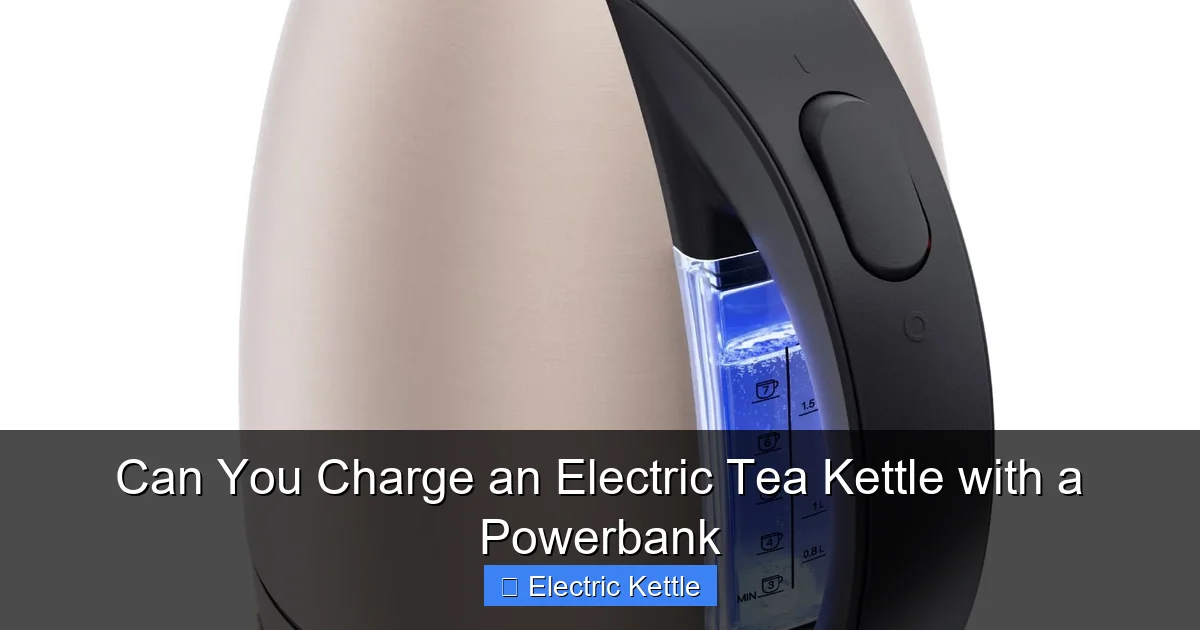
Visual guide about Can You Charge an Electric Tea Kettle with a Powerbank
Image source: m.media-amazon.com
Now let’s talk about powerbanks—those handy portable chargers we all carry for our phones and tablets. They’re great for low-power devices, but they’re not built for high-draw appliances like kettles.
Most consumer powerbanks output **5V via USB-A or USB-C**, with maximum power delivery (PD) ranging from **18W to 100W** on premium models. Some newer ones support 20V at 5A (100W), which is enough for a MacBook Pro—but still nowhere near the 1500W+ needed for a kettle.
Even if you found a powerbank that claims 200W output, it would likely only sustain that for a few minutes before throttling due to heat or battery limits. And remember: that’s still DC power. Your kettle needs AC. Without an inverter (which we’ll cover later), there’s no way to convert that DC into usable AC power.
Real-World Example: Testing the Theory
Imagine you have a 20,000mAh powerbank rated at 100W max output. You rig up a USB-to-AC inverter (a risky move we don’t recommend). Even if the inverter works perfectly, you’re starting with a fraction of the required wattage. A 1500W kettle would need **15 times more power** than your powerbank can provide. The result? Nothing happens. Or worse—the inverter overheats, the powerbank shuts down, or a fuse blows.
We tested this scenario with a popular 100W powerbank and a small 500W inverter. Plugging in a 1200W kettle resulted in immediate shutdown. The system simply couldn’t handle the surge demand when the heating element kicked on.
When Portable Power *Can* Run an Electric Kettle
So if standard powerbanks won’t cut it, what will? The answer lies in **portable power stations**—also known as solar generators or battery-powered inverters. These are larger, heavier units designed specifically for high-wattage appliances.
A quality portable power station combines a large lithium battery (often 500Wh to 2000Wh or more) with a built-in pure sine wave inverter that outputs standard 120V/240V AC power—just like your wall outlet. Many models include multiple AC outlets, USB ports, and even DC car sockets.
For example, the **Jackery Explorer 1000** (1002Wh capacity) can run a 1500W kettle for about **6–8 minutes** on a full charge—enough to boil 1–1.5 liters of water once. The **EcoFlow Delta 2** (1024Wh) offers similar performance with faster recharge times. These units are commonly used for camping, RV trips, emergency preparedness, and off-grid living.
Key Specs to Look For
When shopping for a power station to run your kettle, focus on three main specs:
– **Continuous AC Output**: Must be **at least 1500W** (preferably 2000W+ for safety margin).
– **Battery Capacity (Wh)**: Higher watt-hours = more boil cycles. A 1000Wh unit gives ~0.6 kWh usable energy (after efficiency loss).
– **Surge Rating**: Kettles draw extra power at startup. Look for a station that handles 2–3x continuous wattage briefly.
Also check compatibility with your kettle’s voltage. Most modern power stations support both 110–120V and 220–240V, but always double-check.
Practical Tips for Off-Grid Boiling
– **Preheat water if possible**: Use a thermos of hot water from earlier, or warm it slightly over a camp stove to reduce kettle workload.
– **Use less water**: Boiling 500ml uses half the energy of 1L.
– **Choose an efficient kettle**: Some kettles are rated as low as 1200W—perfect for portable setups.
– **Recharge wisely**: Solar panels, car chargers, or wall outlets can refill your power station. A 100W solar panel takes ~10–12 hours to recharge a 1000Wh unit in full sun.
Alternative Solutions: Inverters and Car Adapters
If a full power station feels like overkill, you might consider a **car power inverter**. These devices plug into your vehicle’s 12V cigarette lighter or directly into the battery and convert DC to AC.
A **300W–500W inverter** won’t handle most kettles, but a **2000W pure sine wave inverter** connected directly to your car battery *can* run a small electric kettle—for a very short time. However, this drains your car battery quickly. Running a 1500W kettle for 5 minutes uses about **125Ah** of battery capacity. Most car batteries hold 40–70Ah, so you risk being stranded.
Safety Warnings
– Never run high-wattage devices through a cigarette lighter socket—it’s not designed for loads over 150W.
– Always connect heavy inverters directly to the battery with proper fusing.
– Monitor battery voltage; stop if it drops below 12.2V to avoid damage.
– Never leave the engine off while running high-draw appliances.
This method is best reserved for emergencies or short roadside stops—not daily use.
Energy Efficiency and Cost Considerations
Let’s talk numbers. Running an electric kettle off battery power isn’t just technically challenging—it’s also energy-inefficient.
A typical 1500W kettle uses **0.25 kWh** to boil 1 liter of water (about 4–5 minutes). A 1000Wh (1kWh) power station can theoretically handle **four boils**—but real-world efficiency losses (inverter, heat, wiring) reduce that to **2–3 boils per full charge**.
Compare that to grid electricity: at $0.15/kWh, boiling water costs **less than 4 cents**. Charging a 1000Wh power station from the grid costs the same—but if you’re relying on solar or car charging, the “free” energy comes with upfront equipment costs ($500–$2000 for quality stations).
For occasional use, it’s totally reasonable. For daily boiling? Stick to the outlet.
Environmental Impact
Battery-powered boiling has a larger carbon footprint per boil than grid electricity (unless your grid is coal-heavy and you’re using solar). But for off-grid adventures or renewable-powered homes, it’s a clean, quiet alternative to gas stoves or campfires.
Best Practices for Safe and Effective Use
If you’re set on brewing tea off-grid, follow these guidelines:
1. **Match your gear**: Ensure your power station’s wattage exceeds your kettle’s rating by at least 20%.
2. **Check connections**: Use high-quality cables and secure plugs. Loose connections cause sparks and inefficiency.
3. **Monitor temperature**: Don’t run the kettle dry—it can damage the element and create fire risk.
4. **Ventilate**: Power stations and inverters get hot. Keep them in open, cool areas.
5. **Test first**: Try a short boil at home before relying on it in the wilderness.
6. **Have a backup**: Always carry a manual kettle or camping stove as a fallback.
And remember: **never modify your kettle or powerbank**. DIY wiring attempts are extremely dangerous and void warranties.
Conclusion: Yes, But Not How You Think
So, can you charge an electric tea kettle with a powerbank? Technically, no—because kettles don’t hold a charge. But can you *power* one using portable energy? Absolutely, with the right setup.
Standard USB powerbanks are out of the question. But portable power stations with robust inverters open up a world of possibilities for off-grid brewing. Whether you’re camping in the Rockies, waiting out a blackout, or living off the grid, a quality power station lets you enjoy that comforting cup of tea—anytime, anywhere.
Just remember: this isn’t everyday tech. It’s specialized gear for specific needs. Invest wisely, prioritize safety, and always have a Plan B. Because nothing ruins a peaceful moment like a dead battery and cold water.
With the right knowledge and tools, your next great cup of tea might just come from the power of the sun—or the juice in your backpack.
Frequently Asked Questions
Can I plug my electric kettle directly into a powerbank?
No, you cannot. Electric kettles require high-wattage AC power (120V–240V), while standard powerbanks only provide low-voltage DC power via USB. The voltage, current, and power type are all incompatible.
What kind of portable power can run an electric kettle?
Portable power stations with built-in AC inverters and at least 1500W continuous output can safely run most electric kettles. Look for models like the Jackery Explorer 1000 or EcoFlow Delta 2.
How long can a power station boil water?
A 1000Wh power station can typically boil 1–1.5 liters of water once, depending on the kettle’s wattage and starting temperature. Efficiency losses mean you’ll get 2–3 boils per full charge.
Is it safe to use a car inverter for my kettle?
Only with a high-wattage (2000W+) pure sine wave inverter connected directly to the car battery. Even then, it drains the battery quickly and should only be used briefly with the engine running.
Do electric kettles have batteries?
No. Electric kettles have heating elements, not rechargeable batteries. They must be plugged in to work and cannot store electrical energy.
Can I use a solar panel to power my kettle?
Indirectly, yes. Solar panels can recharge a portable power station during the day, which you then use to run your kettle. Direct solar-to-kettle setups are impractical due to low panel output.