Not all electric kettles use induction heating—only specific models feature induction technology. While most rely on traditional heating elements, induction kettles offer faster boiling, better energy efficiency, and safer operation. Understanding the difference helps you choose the right kettle for your kitchen.
Key Takeaways
- Induction heating is not standard in all electric kettles: Most electric kettles use resistive heating elements, not induction.
- Induction kettles use electromagnetic fields: They heat water by creating eddy currents in a ferromagnetic base, not direct contact with a heating coil.
- Faster and more efficient boiling: Induction kettles can boil water quicker and use less energy than traditional models.
- Safer operation with no exposed heating elements: Since the heat is generated in the base, there’s less risk of burns or overheating.
- Requires compatible cookware or built-in induction base: Induction kettles need a magnetic base to function properly.
- Higher upfront cost but long-term savings: Induction kettles are typically more expensive but offer energy efficiency and durability.
- Growing popularity in modern kitchens: As smart appliances rise, induction kettles are becoming more common in high-end and eco-conscious homes.
📑 Table of Contents
- Do Electric Kettles Use Induction? Understanding the Technology Behind Your Kettle
- How Do Traditional Electric Kettles Work?
- What Is Induction Heating and How Does It Work?
- Do Electric Kettles Use Induction? The Truth About Market Availability
- Pros and Cons of Induction Electric Kettles
- How to Choose Between Induction and Traditional Electric Kettles
- The Future of Electric Kettles: Will Induction Become the Standard?
- Conclusion: Making the Right Choice for Your Kitchen
Do Electric Kettles Use Induction? Understanding the Technology Behind Your Kettle
If you’ve ever stood in the kitchen waiting for your electric kettle to boil, you might have wondered: *How does this thing actually work?* And more specifically, *Do electric kettles use induction?* It’s a great question—one that gets to the heart of modern kitchen innovation. With so many appliances now boasting “smart” features and energy-efficient designs, it’s natural to assume that something as common as an electric kettle might be using cutting-edge induction technology. But the truth is a bit more nuanced.
Most electric kettles you’ll find on store shelves or in homes today do **not** use induction heating. Instead, they rely on a more traditional method called **resistive heating**, where an electric current passes through a metal coil (the heating element), which then heats up and transfers that heat directly to the water. This method has been around for decades and is reliable, simple, and affordable. However, it’s not the most efficient or fastest way to boil water.
Induction heating, on the other hand, is a more advanced technology that uses electromagnetic fields to generate heat directly in the base of the kettle—without any physical contact between the heat source and the water. This method is commonly used in induction cooktops, where a magnetic field heats only the pan, not the stove surface. Some modern electric kettles have adopted this same principle, offering faster boiling times, improved safety, and better energy efficiency.
So, while **not all electric kettles use induction**, the ones that do represent a significant upgrade in performance and design. In this article, we’ll explore how induction kettles work, how they differ from traditional models, and whether investing in one is worth it for your daily tea or coffee routine.
How Do Traditional Electric Kettles Work?
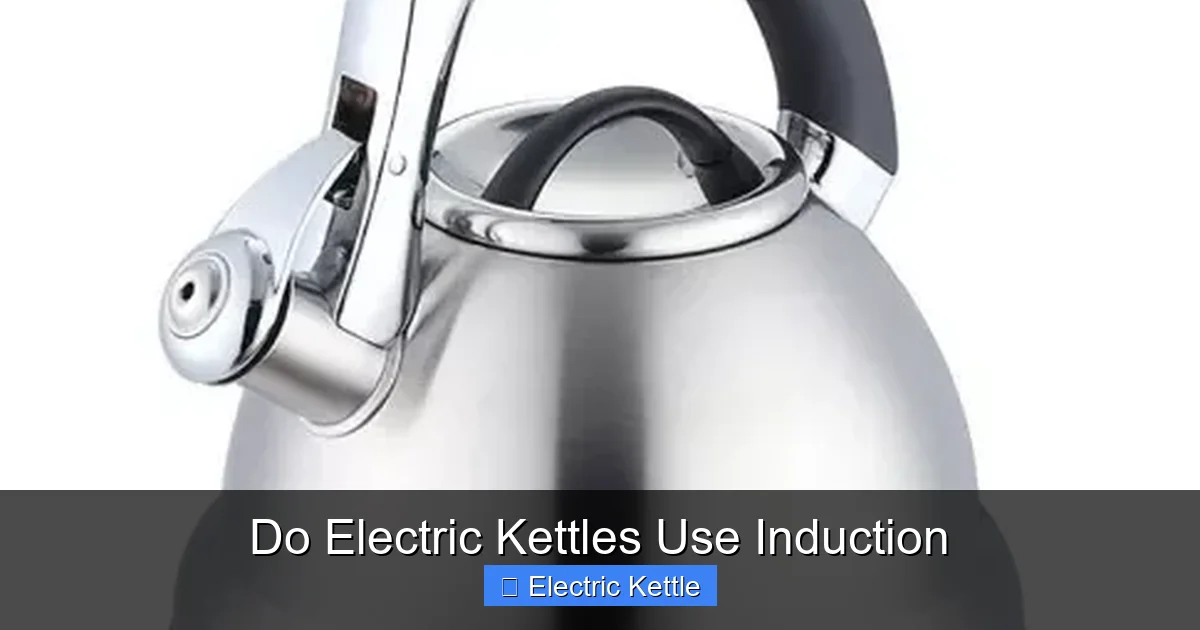
Visual guide about Do Electric Kettles Use Induction
Image source: irrorwxhiqijjr5q.ldycdn.com
To understand whether electric kettles use induction, it helps to first grasp how the majority of them actually function. The most common type of electric kettle—found in homes, offices, and dorm rooms worldwide—uses **resistive heating**. This method is straightforward and has been the standard for decades.
Inside a traditional electric kettle, you’ll find a **heating element**, usually a coiled metal wire made of materials like nichrome (an alloy of nickel and chromium). When you plug in the kettle and turn it on, electricity flows through this coil. Because the metal resists the flow of electricity, it heats up—much like the filament in an old-fashioned light bulb. This heat is then transferred directly to the water through conduction.
The heating element is typically located at the bottom of the kettle, either fully submerged or enclosed in a protective metal sheath. As the element warms up, it raises the temperature of the surrounding water. Most kettles include a **thermostat** that detects when the water reaches boiling point (around 100°C or 212°F) and automatically shuts off the power to prevent overheating.
One advantage of resistive heating is its simplicity. These kettles are easy to manufacture, affordable, and compatible with any power outlet. They also don’t require special materials—glass, plastic, or stainless steel kettles can all use this method.
However, there are some downsides. Resistive heating can be slower than induction, especially in larger kettles. The heating element can also accumulate **limescale** over time, especially in areas with hard water, which reduces efficiency and may affect taste. Additionally, because the element gets extremely hot, there’s a slight risk of burns if the kettle is mishandled—though most modern models include safety features like automatic shut-off and cool-touch exteriors.
Common Features of Resistive Heating Kettles
- Heating element at the base: Usually visible or enclosed in a metal plate.
- Automatic shut-off: Turns off when water boils to prevent damage.
- Boil-dry protection: Shuts off if no water is detected.
- Variable temperature settings: Found in premium models for different teas or coffees.
- Keep-warm function: Maintains temperature after boiling.
While these features make resistive kettles reliable and user-friendly, they don’t offer the speed or efficiency of induction technology. So, if you’re looking for a faster, smarter way to boil water, you might want to consider whether your next kettle should use induction.
What Is Induction Heating and How Does It Work?
Now that we’ve covered how traditional electric kettles work, let’s dive into the science behind **induction heating**—the technology that powers a growing number of modern appliances, including some electric kettles.
Induction heating is based on **electromagnetic induction**, a principle discovered by Michael Faraday in the 19th century. In simple terms, it involves using a magnetic field to generate heat directly in a conductive material—like the base of a kettle—without any physical contact with a heat source.
Here’s how it works in an induction kettle:
Inside the base of the appliance, there’s a copper coil connected to an electronic circuit. When you turn on the kettle, an alternating electric current flows through this coil, creating a rapidly changing magnetic field. This magnetic field penetrates the bottom of the kettle (which must be made of a **ferromagnetic material**, like certain types of stainless steel or iron). The changing magnetic field induces **eddy currents**—small electrical currents—within the metal base. These currents encounter resistance in the metal, which causes the base to heat up almost instantly.
The heat is then transferred directly to the water through conduction, just like in a traditional kettle—but the key difference is that the heat is generated *inside* the base material itself, not from an external heating element. This makes the process much more efficient, as less heat is lost to the surrounding air.
One of the biggest advantages of induction heating is **speed**. Because the heat is generated directly in the base, there’s minimal delay between turning on the kettle and the water starting to warm up. In fact, induction kettles can boil water up to **30–50% faster** than traditional models, depending on the design and power output.
Another benefit is **energy efficiency**. Since the heat is produced only where it’s needed—in the base of the kettle—there’s very little wasted energy. Traditional kettles lose some heat through the heating element and the surrounding housing, but induction minimizes this loss. This means lower electricity bills and a smaller carbon footprint over time.
Key Components of an Induction Kettle
- Induction coil: A copper wire coil that generates the magnetic field.
- Ferromagnetic base: The bottom of the kettle must be magnetic to respond to the field.
- Power inverter: Converts standard AC power into high-frequency alternating current.
- Control circuitry: Regulates temperature, timing, and safety features.
- Thermal sensors: Monitor water temperature and prevent overheating.
It’s important to note that not all stainless steel kettles are compatible with induction. Only those with a **magnetic base** will work. You can test this with a simple kitchen magnet—if it sticks firmly to the bottom, the kettle is induction-ready.
Do Electric Kettles Use Induction? The Truth About Market Availability
So, do electric kettles use induction? The short answer is: **some do, but most don’t.**
As of 2024, the majority of electric kettles on the market still rely on resistive heating. This is due to several factors, including cost, manufacturing simplicity, and consumer familiarity. Resistive kettles are cheaper to produce, widely available, and work with any type of kettle material—glass, plastic, ceramic, or stainless steel.
However, **induction electric kettles are becoming more common**, especially in the premium and smart appliance segments. Brands like **Breville, Smeg, and Xiaomi** have introduced models that use induction technology, often marketed as “rapid boil” or “energy-efficient” kettles. These models are typically more expensive, ranging from $100 to $300, compared to $20–$80 for traditional kettles.
One reason for the slower adoption of induction kettles is the requirement for a **ferromagnetic base**. Unlike resistive kettles, which can be made from almost any material, induction kettles must have a magnetic bottom to function. This limits design flexibility and can increase production costs.
Additionally, induction kettles often require a **dedicated base unit** that contains the induction coil and electronics. The kettle itself is placed on this base, similar to how an induction cooktop works. This two-part design can be less convenient for some users, especially if counter space is limited.
Despite these challenges, the benefits of induction kettles are driving their growing popularity. Consumers are increasingly looking for appliances that save time, reduce energy use, and offer advanced features like precise temperature control and app connectivity. Induction kettles check all these boxes.
Examples of Induction Electric Kettles
- Breville Smart Kettle Pro: Features induction heating, variable temperature settings, and a keep-warm function. Boils water in under 4 minutes.
- Xiaomi Mijia Induction Kettle: Sleek design with app control, rapid boiling, and energy monitoring. Popular in Asian markets.
- Smeg KLF04 Induction Kettle: Combines retro styling with modern induction tech. Includes a magnetic base and automatic shut-off.
These models demonstrate that induction kettles are not just functional—they’re also stylish and packed with smart features. As technology improves and production costs decrease, we can expect to see more induction kettles entering the mainstream market.
Pros and Cons of Induction Electric Kettles
Like any appliance, induction electric kettles come with their own set of advantages and disadvantages. Whether they’re right for you depends on your priorities—speed, safety, cost, or convenience.
Advantages of Induction Kettles
- Faster boiling: Induction heating generates heat almost instantly, reducing wait time. Ideal for busy mornings or offices.
- Energy efficient: Up to 30% more efficient than resistive kettles, saving on electricity over time.
- Safer operation: No exposed heating elements. The base stays cooler, reducing burn risks.
- Longer lifespan: No heating coil to degrade or scale up, leading to fewer maintenance issues.
- Precise temperature control: Many models offer multiple heat settings for different beverages (e.g., green tea at 80°C, French press at 95°C).
- Modern design: Often feature sleek, minimalist aesthetics with LED displays and touch controls.
Disadvantages of Induction Kettles
- Higher upfront cost: Induction kettles are significantly more expensive than traditional models.
- Requires compatible base: The kettle must sit on a special induction base, which takes up counter space.
- Limited material options: Only works with kettles that have a magnetic base—no glass or non-magnetic stainless steel.
- Complex electronics: More components mean more potential points of failure. Repairs can be costly.
- Not universally compatible: Some models may not work with all power outlets or voltage standards.
For many users, the benefits outweigh the drawbacks—especially if you value speed, efficiency, and safety. However, if you’re on a tight budget or prefer a simple, no-frills appliance, a traditional electric kettle may still be the better choice.
How to Choose Between Induction and Traditional Electric Kettles
Deciding whether to buy an induction or traditional electric kettle comes down to your lifestyle, budget, and kitchen needs. Here are some practical tips to help you make the right choice.
Choose an Induction Kettle If:
- You want the fastest boiling time possible.
- Energy efficiency is a priority (e.g., you boil water multiple times a day).
- You’re willing to invest in a premium appliance with smart features.
- You value safety and want to minimize burn risks.
- You already use induction cooktops and want a matching kitchen setup.
Choose a Traditional Electric Kettle If:
- You’re on a budget and want an affordable, reliable option.
- You prefer a simple design without extra electronics.
- You want a lightweight kettle that’s easy to lift and pour.
- You live in an area with hard water and want to avoid complex maintenance.
- You don’t mind waiting an extra minute or two for water to boil.
It’s also worth considering **hybrid models**—some kettles combine resistive heating with induction-like features, such as rapid boil modes or magnetic bases. These can offer a middle ground between performance and cost.
Tips for Buying Any Electric Kettle
- Check the wattage: Higher wattage (1500W–3000W) means faster boiling.
- Look for safety certifications: Ensure the kettle meets standards like UL, CE, or ETL.
- Consider capacity: 1.5–1.7 liters is ideal for most households.
- Test the handle and spout: Make sure it’s comfortable to hold and pours without dripping.
- Read reviews: Real user feedback can reveal issues not mentioned in product descriptions.
Ultimately, the best kettle is the one that fits your daily routine and makes your morning cup of tea or coffee a little easier.
The Future of Electric Kettles: Will Induction Become the Standard?
As technology continues to evolve, the question isn’t just *do electric kettles use induction?*—it’s *will they all use induction in the future?*
The answer leans toward **yes**, but gradually. Induction technology offers clear advantages in speed, efficiency, and safety, and as production costs decrease, we can expect more manufacturers to adopt it. Smart home integration is also driving demand—imagine a kettle that starts boiling when your alarm goes off, or one that syncs with your coffee maker for a perfectly timed brew.
However, traditional resistive kettles aren’t going away anytime soon. They remain the most accessible and affordable option for millions of households. For many people, the extra cost and complexity of induction aren’t justified by the benefits.
What’s more likely is a **dual-market future**, where induction kettles dominate the premium segment while resistive models continue to serve budget-conscious consumers. Over time, as induction becomes more affordable and user-friendly, it may eventually become the new standard—just as LED bulbs replaced incandescent lights.
In the meantime, if you’re in the market for a new electric kettle, consider your priorities. If you value innovation and performance, an induction model could be a worthwhile investment. But if simplicity and cost matter more, a traditional kettle will still serve you well.
Conclusion: Making the Right Choice for Your Kitchen
So, do electric kettles use induction? The answer is: **some do, and they’re worth considering if you want faster, safer, and more efficient boiling.** While most electric kettles still rely on traditional resistive heating, induction technology is gaining ground—especially in high-end and smart appliances.
Induction kettles offer undeniable benefits: quicker boiling times, lower energy consumption, and enhanced safety. They’re ideal for tech-savvy users, busy professionals, or anyone who wants to upgrade their kitchen experience. However, they come with a higher price tag and some design limitations.
On the other hand, traditional electric kettles remain a reliable, affordable, and widely available option. They’re perfect for everyday use and require minimal maintenance.
The key is to choose the kettle that best fits your needs, budget, and lifestyle. Whether you go induction or stick with the classics, the goal is the same: a perfect cup of tea or coffee, ready when you are.
As kitchen technology advances, we may see induction become the norm. But for now, both types of kettles have their place—and both can make your mornings a little brighter.
Frequently Asked Questions
Do all electric kettles use induction?
No, most electric kettles use resistive heating, not induction. Only specific high-end models feature induction technology.
How can I tell if my electric kettle uses induction?
Check if the kettle requires a special base unit and has a magnetic bottom. If it boils without a heating element inside, it likely uses induction.
Are induction kettles safer than traditional ones?
Yes, induction kettles are generally safer because they don’t have exposed heating elements and stay cooler to the touch.
Can I use any kettle with an induction base?
No, only kettles with a ferromagnetic (magnetic) base will work with induction technology.
Do induction kettles use more electricity?
No, they’re actually more energy-efficient, using up to 30% less electricity than traditional kettles.
Are induction kettles worth the extra cost?
If you value speed, efficiency, and safety, yes. But if you’re on a budget, a traditional kettle may be a better fit.