When it comes to heating water or food, many wonder: does a kettle or microwave use more electricity? The answer isn’t always straightforward—it depends on what you’re heating, how much, and how often. Generally, electric kettles are more energy-efficient for boiling water, while microwaves win for reheating small portions.
Key Takeaways
- Electric kettles are more efficient for boiling water: They heat water faster and use less energy per boil compared to microwaves, especially for full or half-full kettles.
- Microwaves excel at reheating food: For small portions of leftovers or beverages, microwaves use less electricity than heating a full kettle just for one cup.
- Overfilling increases energy waste: Boiling more water than needed in a kettle significantly increases electricity use, making portion control key.
- Standby power matters: Microwaves often consume more energy on standby, while most kettles use zero power when off.
- Frequency of use affects total cost: Daily tea drinkers save more with a kettle, while occasional reheaters may prefer the microwave.
- Modern appliances vary in efficiency: Energy ratings, insulation, and design impact real-world electricity consumption—check labels before buying.
- Combining both appliances wisely saves energy: Use a kettle for tea, coffee, or cooking, and a microwave for reheating—maximizing efficiency in both cases.
📑 Table of Contents
- Does a Kettle or Microwave Use More Electricity? The Real Answer
- Understanding How Kettles and Microwaves Work
- Energy Consumption: Kettle vs. Microwave
- Real-World Scenarios: When to Use Which Appliance
- Factors That Affect Energy Efficiency
- Cost Comparison: Which Is Cheaper to Run?
- Environmental Impact: Beyond the Bill
- Conclusion: Which Should You Use?
Does a Kettle or Microwave Use More Electricity? The Real Answer
We’ve all been there—standing in the kitchen, staring at the kettle and the microwave, wondering which one will get the job done faster and cheaper. Whether you’re making your morning tea, reheating last night’s pasta, or boiling water for instant noodles, the question pops up: does a kettle or microwave use more electricity?
It’s a fair question, especially with rising energy bills and growing awareness about household energy use. We want convenience, but we also want to be smart about how we use power. The good news? There’s a clear answer—but it depends on what you’re doing. In general, electric kettles are more energy-efficient when it comes to boiling water. Microwaves, on the other hand, shine when reheating small amounts of food or liquid. But the real story is in the details: how much you’re heating, how often, and even the type of appliance you own.
Let’s break it down so you can make the best choice for your kitchen—and your wallet.
Understanding How Kettles and Microwaves Work
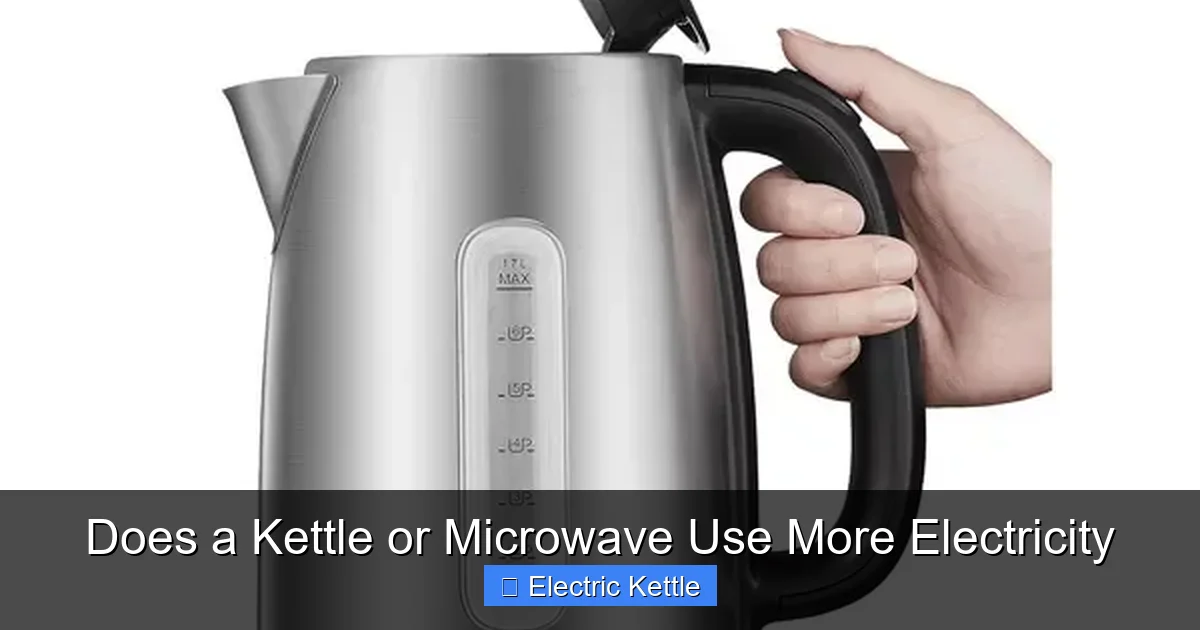
Visual guide about Does a Kettle or Microwave Use More Electricity
Image source: irrorwxhiqijjr5q.ldycdn.com
Before we compare electricity use, it helps to understand how each appliance heats your food or water. This isn’t just technical trivia—it explains why one might be more efficient than the other in certain situations.
How Electric Kettles Heat Water
An electric kettle works by passing an electric current through a heating element, usually located at the base of the kettle. This element gets extremely hot and transfers that heat directly to the water inside. Because the element is submerged or in direct contact with the water, very little energy is lost to the air. Most of the electricity goes straight into heating the water.
Modern kettles are designed to be fast and efficient. Many can boil a full liter of water in under four minutes. They also often have automatic shut-off features that turn the kettle off once the water reaches boiling point, preventing unnecessary energy use.
How Microwaves Heat Food and Liquids
Microwaves, on the other hand, use electromagnetic waves—specifically microwaves—to agitate water molecules in food or liquid. This molecular movement creates heat, warming the contents from the inside out. Unlike kettles, microwaves don’t heat the container directly (unless it’s microwave-safe and absorbs some energy). Instead, they target the food itself.
This method is great for reheating leftovers quickly, but it’s less efficient when it comes to heating large volumes of water. Why? Because microwaves distribute energy unevenly and require more time and power to heat water to the same temperature as a kettle.
Key Differences in Energy Transfer
The main difference lies in energy transfer efficiency. Kettles convert about 80–90% of electrical energy into heat that goes directly into the water. Microwaves are slightly less efficient, converting around 50–60% of energy into usable heat, with some lost to the magnetron (the part that generates microwaves) and the surrounding air.
This means that for the same amount of water, a kettle typically uses less electricity to reach boiling point than a microwave. But again, context matters—especially when you’re not boiling a full kettle.
Energy Consumption: Kettle vs. Microwave
Now let’s get into the numbers. How much electricity do these appliances actually use? And which one comes out on top in terms of efficiency?
Typical Power Ratings
Most electric kettles in the U.S. and Europe operate at around 1500 to 3000 watts. A standard 1500-watt kettle is common in many homes. Microwaves, depending on size and model, usually range from 600 to 1200 watts. A typical countertop microwave runs at about 1000 watts.
At first glance, it might seem like the microwave uses less power—but wattage alone doesn’t tell the whole story. What matters is how long each appliance runs and how much energy is actually used to complete the task.
Energy Use for Boiling Water
Let’s say you want to boil 500ml (about two cups) of water. Here’s how the numbers stack up:
– A 1500-watt kettle takes about 2–3 minutes to boil 500ml. That’s roughly 0.05 to 0.075 kilowatt-hours (kWh) of electricity.
– A 1000-watt microwave takes about 4–5 minutes to heat the same amount of water to boiling. That’s around 0.067 to 0.083 kWh.
So even though the microwave uses less power (watts), it takes longer, which can make it use more total energy. In this case, the kettle is slightly more efficient.
But what if you’re only heating one cup (250ml)? The kettle still takes nearly the same amount of time and energy—because it heats the entire element, not just the water. The microwave, however, can heat one cup faster and with less total energy. For small amounts, the microwave may actually be more efficient.
Energy Use for Reheating Food
Now consider reheating a plate of leftovers. A microwave can reheat a meal in 1–2 minutes using about 0.017 to 0.033 kWh. Trying to reheat food in a kettle? Well, you can’t—unless it’s soup or liquid, and even then, it’s impractical and potentially unsafe.
For reheating, the microwave is clearly the winner. It’s designed for this purpose, and it does it quickly and efficiently. Using a kettle to heat water just to warm up food would be wildly inefficient.
Standby Power and Phantom Load
Another factor often overlooked: standby power. Many microwaves have digital clocks, timers, or display panels that stay on even when not in use. This “phantom load” can add up over time—some models use 3–5 watts continuously. Over a year, that’s 26–44 kWh, enough to power a small appliance for weeks.
Most electric kettles, especially basic models, have no standby power consumption. Once they’re off, they’re off. Some smart kettles with LED displays or Wi-Fi may use a small amount of standby power, but it’s usually minimal.
So if you’re trying to minimize energy use 24/7, a simple kettle has an edge.
Real-World Scenarios: When to Use Which Appliance
Theory is great, but how does this play out in everyday life? Let’s look at common kitchen tasks and see which appliance makes the most sense.
Making Tea or Coffee
If you’re brewing a cup of tea or making coffee with a French press or pour-over, you need hot water. Here, the electric kettle wins hands down. It heats water faster, uses less energy per boil (especially if you’re making multiple cups), and gives you precise temperature control on some models.
Tip: Only boil the amount of water you need. If you’re making one cup, don’t fill the kettle to the max. Overfilling wastes energy and increases heating time.
Reheating Leftovers
Got last night’s stir-fry? Pop it in the microwave. It’ll be ready in under two minutes, and you’ll use far less energy than boiling water just to warm it up. The microwave heats food directly and quickly, making it ideal for small portions.
Bonus: Use microwave-safe covers to trap steam and heat food more evenly—this reduces cooking time and energy use.
Boiling Water for Cooking
Need hot water for pasta, oatmeal, or instant noodles? Again, the kettle is your friend. It’s faster and more efficient than heating water in a pot on the stove or in the microwave. Plus, many kettles have boil-dry protection and auto-shutoff, making them safer.
Pro tip: If you’re cooking frequently, consider a kettle with variable temperature settings. Some teas and delicate grains require water below boiling point—using a kettle lets you avoid overheating.
Heating a Single Cup of Water
This is where things get interesting. If you only need one cup of hot water—say, for instant coffee or a hot drink—the microwave might actually be more efficient. Why? Because a kettle still uses nearly the same amount of energy whether it’s half-full or full.
For example, boiling one cup in a kettle might take 1.5 minutes and use about 0.0375 kWh. Heating the same cup in a microwave might take 2 minutes and use 0.033 kWh. In this case, the microwave wins—by a small margin.
But remember: this only applies if you’re heating a small amount. For two or more cups, the kettle becomes more efficient again.
Frequent Use vs. Occasional Use
If you drink tea or coffee multiple times a day, a kettle is a no-brainer. The cumulative energy savings add up. But if you only heat water once in a while, and mostly reheat food, the microwave might be the better overall choice.
Also consider convenience. Do you want to wait for a kettle to boil every time? Or do you prefer the quick zap of the microwave? Your lifestyle matters.
Factors That Affect Energy Efficiency
Not all kettles and microwaves are created equal. Several factors influence how much electricity they use in real life.
Appliance Age and Condition
Older appliances tend to be less efficient. A 10-year-old kettle with mineral buildup on the heating element will take longer to boil water and use more energy. Similarly, an aging microwave with a weak magnetron may require longer cooking times.
Regular maintenance helps. Descale your kettle every few months to remove limescale. Clean your microwave interior to ensure even heating.
Energy Ratings and Certifications
Look for energy-efficient models. In the EU, appliances have energy labels from A (most efficient) to G. In the U.S., look for ENERGY STAR certification. These labels help you compare efficiency across brands.
Some modern kettles have insulated walls or double-wall designs that retain heat longer, reducing the need to reboil. Smart microwaves may have eco-modes that reduce standby power.
Water Temperature and Starting Point
Cold water takes longer to heat than warm. If you’re using water from the tap in winter, it might start at 10°C (50°F). In summer, it could be 20°C (68°F). That 10-degree difference can affect heating time and energy use.
Some kettles have “boil from cold” settings, but they don’t adjust for starting temperature. Using warmer water (e.g., from the hot tap) can save a few seconds and a bit of energy—though not recommended if your hot water isn’t safe to drink.
Altitude and Boiling Point
At higher altitudes, water boils at a lower temperature. This means it takes less energy to reach boiling point. If you live in the mountains, your kettle might use slightly less electricity than someone at sea level. The difference is small, but it’s there.
User Habits Matter Most
No matter how efficient your appliance is, your habits determine your energy use. Boiling a full kettle for one cup? That’s wasted energy. Leaving the microwave on with nothing inside? That’s phantom load.
Small changes make a big difference:
– Only boil the water you need.
– Use the right appliance for the job.
– Unplug appliances when not in use (or use smart plugs).
– Choose energy-efficient models when upgrading.
Cost Comparison: Which Is Cheaper to Run?
Let’s talk money. How much does it actually cost to use a kettle versus a microwave?
Calculating Electricity Costs
Electricity is billed per kilowatt-hour (kWh). In the U.S., the average cost is about $0.15 per kWh. In the UK, it’s around £0.30 per kWh (as of 2024). Prices vary by region and provider.
Let’s assume $0.15/kWh for this example.
– Boiling 500ml in a kettle: ~0.06 kWh → $0.009 per use.
– Heating 500ml in a microwave: ~0.075 kWh → $0.011 per use.
– Reheating a meal in a microwave: ~0.025 kWh → $0.004 per use.
Now multiply by frequency. If you boil water twice a day:
– Kettle: $0.009 x 2 x 365 = $6.57 per year.
– Microwave (same task): $0.011 x 2 x 365 = $8.03 per year.
That’s a $1.46 difference—not huge, but over time, it adds up. And if you’re reheating food daily, the microwave’s lower cost per use makes it the economical choice.
Long-Term Savings
Over 10 years, using a kettle for boiling water could save you around $15 compared to a microwave. That might not sound like much, but consider the environmental impact too. Less energy use means lower carbon emissions.
And if you’re using renewable energy (like solar), the savings are even greater—because you’re maximizing the efficiency of your self-generated power.
Environmental Impact: Beyond the Bill
Energy use isn’t just about cost—it’s about sustainability. The more electricity we use, the more demand we place on power grids, which often rely on fossil fuels.
Carbon Footprint
In regions where electricity comes from coal or natural gas, every kWh generates CO₂. Using a more efficient appliance reduces your household’s carbon footprint.
For example, boiling water in a kettle instead of a microwave for a year could save about 1.5 kg of CO₂ emissions (assuming U.S. grid averages). It’s a small step, but millions of households doing the same adds up.
Resource Use and Manufacturing
Both appliances require materials and energy to manufacture. Kettles are often simpler, with fewer electronic components, which can mean lower environmental impact over their lifetime. Microwaves have more complex parts, including the magnetron and control boards, which can be harder to recycle.
Choosing durable, repairable models helps reduce waste. Look for brands with good warranties and repair programs.
Smart Choices for a Greener Kitchen
– Use the right tool for the job.
– Maintain your appliances.
– Upgrade to energy-efficient models.
– Avoid overfilling or overheating.
– Unplug when not in use.
Small changes, big impact.
Conclusion: Which Should You Use?
So, does a kettle or microwave use more electricity? The answer is: it depends.
For boiling water—especially in larger amounts—the electric kettle is more energy-efficient, faster, and cheaper to run. It’s the best choice for tea, coffee, cooking, and any task that requires hot water.
For reheating food or heating small amounts of liquid, the microwave wins. It’s designed for this purpose, uses less energy for small portions, and saves time.
The key is to use both appliances wisely. Don’t boil a full kettle for one cup. Don’t use the microwave to heat water for pasta. Match the tool to the task.
And remember: your habits matter most. Being mindful of how much you heat, how often, and which appliance you use can make a real difference in your energy bills and environmental impact.
In the end, you don’t have to choose one over the other. Most kitchens benefit from having both—just use them smartly. Your wallet, your taste buds, and the planet will thank you.
Frequently Asked Questions
Which uses more electricity: boiling water in a kettle or microwave?
Generally, an electric kettle uses less electricity to boil water than a microwave, especially for larger amounts. Kettles are more energy-efficient because they transfer heat directly to water with minimal loss.
Is it cheaper to heat water in a kettle or microwave?
For boiling water, a kettle is usually cheaper to run. However, for heating small amounts (like one cup), a microwave may use slightly less energy and cost less per use.
Can I use a microwave to boil water?
Yes, you can boil water in a microwave, but it’s less efficient than using a kettle. Be cautious—water can superheat and erupt suddenly when disturbed.
Do microwaves use electricity when turned off?
Many microwaves use standby power to run clocks or displays, consuming 3–5 watts even when off. Kettles typically use zero power when not in use.
How can I reduce electricity use when boiling water?
Only boil the amount of water you need, descale your kettle regularly, and use an energy-efficient model. Avoid reboiling water unnecessarily.
Are newer kettles and microwaves more energy-efficient?
Yes, modern appliances often have better insulation, faster heating, and lower standby power. Look for energy ratings like ENERGY STAR or EU A-labels when buying.