Cordless electric tea kettles offer fast, safe, and convenient boiling by using a heating element powered through a base station. They separate from the power source for easy pouring and storage, making them ideal for homes, offices, and travel.
Have you ever stood in your kitchen, staring at a pot of water slowly coming to a boil on the stove, wondering if there’s a faster way? If so, you’re not alone. Many of us crave that perfect cup of tea or instant coffee without the wait. That’s where the cordless electric tea kettle comes in—a sleek, modern appliance that has quietly revolutionized how we heat water at home and in the office.
Gone are the days of waiting for a whistling stovetop kettle or dealing with tangled cords that limit your reach. Cordless electric kettles combine speed, safety, and convenience in one compact design. They’re not just for tea lovers—they’re for anyone who values efficiency and simplicity in their daily routine. Whether you’re making oatmeal, instant noodles, or baby formula, these kettles deliver hot water in minutes, often with precision temperature control.
But how exactly do they work? What makes them so different from traditional kettles? And why have they become a staple in modern kitchens? In this guide, we’ll dive deep into the mechanics, features, and benefits of cordless electric tea kettles. You’ll learn about the science behind the heating process, the clever design that allows them to be cordless, and the smart features that make them safer and more efficient than ever. By the end, you’ll understand not only how they work but also why they might be the perfect upgrade for your kitchen.
Key Takeaways
- Heating Mechanism: Cordless kettles use an internal heating element powered via a conductive base to boil water quickly and efficiently.
- Detachable Design: The kettle lifts off its base for easy pouring, cleaning, and storage—no tangled cords or restricted movement.
- Automatic Shut-Off: Built-in thermostats detect when water reaches boiling point and turn off the kettle to prevent overheating or dry boiling.
- Temperature Control: Advanced models offer variable temperature settings for different teas, coffees, or baby formulas.
- Energy Efficiency: Electric kettles use less energy than stovetops, heating only the water you need in under 5 minutes.
- Safety Features: Include boil-dry protection, cool-touch handles, and stable bases to reduce burn and spill risks.
- Maintenance Tips: Regular descaling and proper cleaning extend the kettle’s life and maintain optimal performance.
📑 Table of Contents
What Is a Cordless Electric Tea Kettle?
A cordless electric tea kettle is a modern kitchen appliance designed to heat water quickly using electricity, without the need for a direct power cord attached to the kettle itself. Instead, the kettle sits on a separate power base that connects to an electrical outlet. When you place the kettle on the base, it draws power through conductive contacts, allowing the internal heating element to warm the water. Once the water reaches the desired temperature, the kettle can be lifted off the base for easy pouring—completely free of cords.
This detachable design is what sets cordless kettles apart from their corded counterparts. Traditional electric kettles have a fixed cord that runs from the base of the kettle to the wall outlet, which can be inconvenient when pouring or storing. Cordless models eliminate this hassle, offering greater flexibility and a cleaner look on your countertop. They’re especially popular in homes with limited counter space or in offices where multiple people use the same appliance.
Cordless electric kettles come in a variety of materials, including stainless steel, glass, and BPA-free plastic. They range in capacity from small 0.8-liter models perfect for one or two cups, to larger 1.7-liter versions that can serve a family or small group. Many also feature advanced functionalities like variable temperature settings, keep-warm modes, and LED indicators.
One of the biggest advantages of cordless kettles is their portability. Since the kettle detaches from the base, you can carry it to the table, pour directly into mugs, or even take it to another room. This makes them ideal for tea ceremonies, office break rooms, or even travel (when used with compatible voltage). Plus, without a cord to manage, cleanup is simpler and storage is more compact.
How the Heating System Works
Visual guide about How Do Cordless Electric Tea Kettles Work
Image source: m.media-amazon.com
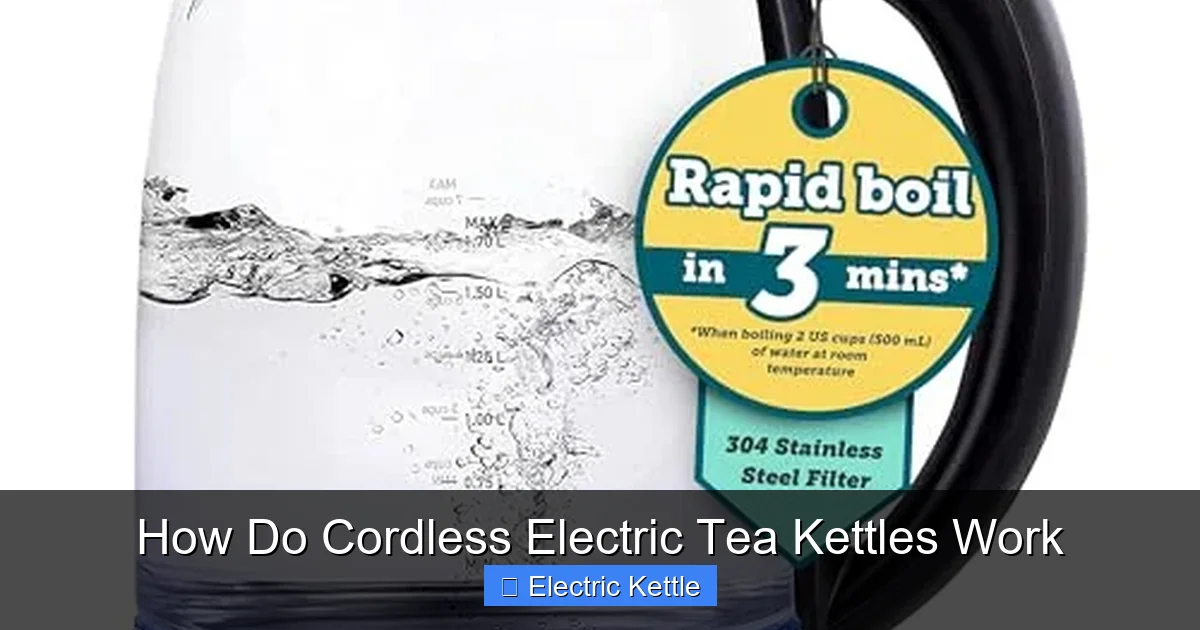
At the heart of every cordless electric tea kettle is a powerful heating element, usually located at the bottom of the kettle’s interior. This element is typically made of stainless steel or another heat-resistant metal and is designed to transfer energy efficiently to the water. When you plug in the base and place the kettle on it, electrical current flows through the conductive contacts on the base and into the heating element.
The heating process begins almost instantly. As electricity passes through the element, it resists the flow of current, generating heat—a principle known as Joule heating. This heat is then transferred directly to the water through conduction. Because the element is submerged or in direct contact with the water, the transfer is highly efficient, meaning less energy is wasted and water heats up faster.
Most cordless kettles can bring a full liter of water to a boil in under five minutes—often faster than a stovetop kettle. This speed is one of the main reasons people switch to electric models. For example, if you’re making a quick cup of green tea in the morning, a cordless kettle can have your water ready in just 3–4 minutes, compared to 6–8 minutes on a gas stove.
The efficiency of the heating system also contributes to energy savings. Electric kettles heat only the water you need, unlike stovetops that heat the entire burner and pot. Studies show that electric kettles can be up to 80% more energy-efficient than gas stoves for boiling water. This not only saves money on your utility bill but also reduces your carbon footprint.
The Role of the Power Base and Conductive Contacts
The power base is a critical component of a cordless electric tea kettle. It’s the stationary unit that plugs into the wall outlet and serves as the bridge between the electrical supply and the kettle. The base contains a set of conductive metal contacts—usually spring-loaded pins—that align with matching contacts on the bottom of the kettle.
When the kettle is placed on the base, these contacts connect, completing the electrical circuit. Power flows from the outlet, through the base, and into the kettle’s heating element. The design ensures a secure and stable connection, even if the kettle is slightly misaligned. Some high-end models use magnetic alignment systems to help the kettle snap into place correctly, further improving safety and efficiency.
One of the key benefits of this system is safety. Because the electrical connection is only active when the kettle is seated properly on the base, there’s minimal risk of electric shock during use. The contacts are typically recessed or shielded to prevent accidental contact, and many models include insulation to protect against moisture.
The base also often houses additional components, such as the thermostat and control circuitry. In kettles with temperature control, the base communicates with sensors inside the kettle to monitor water temperature and regulate heating. This allows for precise control over the boiling process, which is essential for brewing delicate teas like white or oolong that require lower temperatures.
Another advantage of the detachable design is ease of cleaning. Since the base doesn’t come into contact with water, it rarely needs cleaning beyond a quick wipe. The kettle itself can be washed separately, and because there’s no cord to navigate, it’s easier to rinse and dry thoroughly.
Automatic Shut-Off and Safety Mechanisms
Safety is a top priority in cordless electric tea kettles, and manufacturers have incorporated several smart features to prevent accidents. One of the most important is the automatic shut-off function. This feature uses a built-in thermostat to monitor the temperature of the water. Once the water reaches boiling point (typically around 100°C or 212°F), the thermostat triggers a switch that cuts off power to the heating element.
This not only prevents the water from boiling dry but also reduces the risk of overheating, which could damage the kettle or create a fire hazard. In fact, most modern kettles will shut off within seconds of reaching boiling temperature, ensuring consistent and safe operation every time.
Another critical safety feature is boil-dry protection. If you accidentally turn on the kettle without water, the heating element can overheat quickly. To prevent this, many kettles are equipped with a thermal fuse or secondary thermostat that detects excessive heat and cuts power immediately. This protects both the appliance and your home.
Many cordless kettles also include cool-touch handles and exteriors. Even when the water inside is boiling, the handle remains safe to touch, reducing the risk of burns. Some models go a step further with double-wall insulation, which keeps the outer surface cool while maintaining heat inside the kettle.
Additionally, the stable, wide base design prevents tipping, and non-slip feet keep the unit firmly in place on the countertop. These small but important details make cordless kettles safer to use, especially in busy kitchens or households with children.
Temperature Control and Precision Features
Not all hot water needs to be boiling. That’s why many advanced cordless electric tea kettles now come with variable temperature control. This feature allows you to select specific temperatures—such as 80°C for green tea, 90°C for white tea, or 70°C for baby formula—ensuring optimal flavor and safety.
The temperature control system works through a combination of sensors, microprocessors, and the heating element. When you select a temperature on the control panel (usually via buttons or a dial), the kettle heats the water to that exact point and then shuts off automatically. Some models even include a “keep warm” function that maintains the water at the desired temperature for up to an hour.
This precision is especially valuable for tea enthusiasts. Overheating delicate teas can result in bitterness, while underheating may fail to extract full flavor. With temperature control, you can brew each type of tea perfectly every time. For example, a Japanese sencha tea tastes best at 70–80°C, while black tea benefits from a full boil.
Some high-end kettles also offer pre-programmed settings for different beverages. You might see options like “Green,” “White,” “Oolong,” “Black,” and “Coffee,” each calibrated to the ideal temperature. This takes the guesswork out of brewing and makes the kettle accessible even to beginners.
Another useful feature is the LED display, which shows the current water temperature in real time. This allows you to monitor the heating process and know exactly when your water is ready. Some models even beep or flash when the target temperature is reached, so you don’t have to watch the kettle constantly.
Energy Efficiency and Environmental Benefits
Cordless electric tea kettles are not only convenient—they’re also environmentally friendly. Compared to stovetop kettles, electric models use significantly less energy to boil the same amount of water. This is because they transfer heat directly to the water with minimal loss, whereas stovetops lose heat to the surrounding air and the pot itself.
According to the U.S. Department of Energy, electric kettles are about 80% efficient, meaning 80% of the energy used goes directly into heating the water. Gas stoves, by comparison, are only about 30–40% efficient. This means you’re using less fuel and emitting fewer greenhouse gases when you choose an electric kettle.
Another factor contributing to energy savings is the ability to heat only the amount of water you need. Instead of boiling a full kettle for one cup of tea, you can heat just 250 ml, which uses far less electricity. Many kettles also have minimum fill lines to help you measure the right amount.
Over time, these small savings add up. If you boil water multiple times a day, switching to an electric kettle can reduce your household energy consumption noticeably. Plus, because they heat water faster, you spend less time with the appliance running, further cutting energy use.
From a sustainability standpoint, cordless kettles also reduce waste. Unlike disposable plastic bottles or single-use coffee pods, a quality electric kettle can last for years with proper care. Many are made from recyclable materials like stainless steel and glass, and some brands offer repair services to extend their lifespan.
Maintenance and Care Tips
To keep your cordless electric tea kettle working efficiently and safely, regular maintenance is essential. One of the most common issues is limescale buildup, especially in areas with hard water. Limescale is a white, chalky deposit made of calcium and magnesium that accumulates on the heating element and interior surfaces over time.
If left unchecked, limescale can reduce heating efficiency, affect the taste of your water, and even damage the kettle. To prevent this, it’s recommended to descale your kettle every 1–2 months, depending on usage and water hardness.
Descaling is simple. You can use a commercial descaling solution or a natural alternative like white vinegar. Fill the kettle halfway with equal parts water and vinegar, let it sit for an hour, then boil the mixture. After boiling, let it cool, then rinse thoroughly with clean water. Repeat if necessary until all residue is gone.
Cleaning the exterior is also important. Wipe the base and kettle with a damp cloth—never submerge the base in water. For stainless steel models, use a mild cleaner to maintain shine. Glass kettles can be cleaned with a soft sponge to avoid scratches.
Avoid using abrasive cleaners or steel wool, as they can damage the surface. Also, never run the kettle empty, as this can damage the heating element. Always ensure there’s water above the minimum fill line before turning it on.
Finally, store your kettle in a dry place when not in use. If you’re traveling, make sure to unplug the base and let the kettle cool completely before packing.
Conclusion
Cordless electric tea kettles are more than just a modern convenience—they’re a smart, efficient, and safe way to heat water for all your daily needs. By combining rapid heating, detachable design, and advanced safety features, they offer a superior alternative to traditional stovetop kettles. Whether you’re a tea connoisseur, a busy professional, or a parent preparing baby formula, a cordless kettle can simplify your routine and enhance your experience.
Understanding how they work—from the conductive base and heating element to the thermostat and temperature control—helps you appreciate the engineering behind this everyday appliance. With proper care and maintenance, a quality cordless kettle can serve you reliably for years, saving time, energy, and frustration.
So the next time you’re waiting for water to boil, consider making the switch. Your future self—and your taste buds—will thank you.
Frequently Asked Questions
How does a cordless electric kettle get power without a cord?
A cordless electric kettle gets power through a separate base that plugs into the wall. The kettle connects to the base via conductive metal contacts, allowing electricity to flow to the heating element when placed on the base.
Are cordless electric kettles safe to use?
Yes, they are designed with multiple safety features, including automatic shut-off, boil-dry protection, and cool-touch handles. These features minimize the risk of burns, overheating, and electrical hazards.
Can I leave water in a cordless electric kettle overnight?
It’s not recommended to leave water in the kettle for extended periods, as it can promote bacterial growth or limescale buildup. Empty and rinse the kettle after each use for best results.
Do cordless kettles use more electricity than stovetops?
No, electric kettles are more energy-efficient than stovetops. They heat water faster and use less energy by transferring heat directly to the water with minimal loss.
How often should I descale my cordless kettle?
Descale your kettle every 1–2 months if you have hard water, or less frequently with soft water. Regular descaling maintains performance and prevents mineral buildup.
Can I use a cordless kettle for purposes other than tea?
Absolutely! Cordless kettles are great for making coffee, instant soups, oatmeal, baby formula, and more. Just ensure the water temperature is appropriate for the task.