An electric kettle typically takes 2 to 5 minutes to boil water, depending on its wattage, capacity, and starting water temperature. Higher-wattage models and smaller volumes boil faster, while factors like altitude and limescale can slow the process.
If you’ve ever stood in your kitchen, staring at your electric kettle and wondering, “How long does this thing actually take to boil?”—you’re not alone. Whether you’re rushing to make morning coffee, preparing tea for guests, or heating water for instant noodles, waiting for your kettle can feel like an eternity. The good news? Understanding what affects boiling time can help you choose the right kettle and use it more efficiently.
Electric kettles have become a staple in modern kitchens thanks to their speed, convenience, and energy efficiency. Unlike stovetop kettles that rely on gas or electric burners, electric kettles heat water directly through an internal heating element, often submerged in the water. This direct transfer of heat makes them significantly faster—and more consistent—than traditional methods. But just how fast is “fast”? The answer isn’t one-size-fits-all. Boiling time depends on several factors, including the kettle’s power (measured in watts), the amount of water, the starting temperature of the water, and even your location.
In this guide, we’ll break down everything you need to know about how long an electric kettle takes to boil. We’ll explore the science behind the speed, compare different models, and share practical tips to help you get that perfect cup of tea—or that quick meal—on the table faster. Whether you’re shopping for a new kettle or just curious about your current one, this article will give you the insights you need.
Key Takeaways
- Boiling time varies by wattage: Most electric kettles (1500–3000W) boil 1 liter of water in 2–4 minutes.
- Smaller volumes boil faster: Half a liter may boil in under 2 minutes, while full capacity takes longer.
- Starting water temperature matters: Cold tap water takes longer than warm or preheated water.
- Altitude affects boiling point: At higher elevations, water boils at lower temperatures, potentially increasing time slightly.
- Regular cleaning improves speed: Limescale buildup insulates heating elements, slowing heating.
- Energy-efficient models may be slower: Some eco-friendly kettles prioritize energy savings over speed.
- Modern features can optimize time: Variable temperature settings and rapid-boil modes help customize heating.
📑 Table of Contents
What Affects How Long an Electric Kettle Takes to Boil?
When it comes to boiling water, not all electric kettles are created equal. While most people assume that all kettles boil at the same speed, the reality is more nuanced. Several key factors influence how quickly your kettle can bring water to a boil. Understanding these variables can help you make smarter choices—both when buying a new kettle and when using your current one.
Wattage: The Power Behind the Speed
The most significant factor affecting boiling time is the kettle’s wattage. Wattage refers to the amount of electrical power the kettle uses, and it directly impacts how fast the heating element can warm the water. Most household electric kettles range from 1500 to 3000 watts. Higher wattage means more energy is delivered to the water per second, resulting in faster boiling.
For example, a 3000-watt kettle can boil 1 liter of water in about 2 to 2.5 minutes, while a 1500-watt model might take closer to 4 to 5 minutes for the same amount. This difference might not seem huge, but when you’re in a hurry, those extra minutes can feel like an eternity. If speed is a top priority, look for kettles with higher wattage—especially those rated at 2500W or above.
It’s worth noting that not all countries support high-wattage appliances due to electrical standards. In the U.S., for instance, most kitchen circuits can handle up to 1800–2000W safely, so many kettles sold there cap out around 1500–1800W. In contrast, European models often go up to 3000W because of higher voltage standards (220–240V). So, your location can also influence the maximum wattage available to you.
Water Volume: Less Is More (When It Comes to Speed)
Another major factor is the amount of water you’re heating. It’s simple physics: heating a smaller volume of water requires less energy and time. Most electric kettles have a minimum and maximum fill line. If you only need one cup of hot water, filling the kettle to its maximum capacity will waste time and energy.
For instance, boiling 500ml (about 2 cups) of water typically takes half the time of boiling 1 liter. A high-wattage kettle might boil 500ml in just 1.5 to 2 minutes, while 1 liter could take 3 to 4 minutes. This is why many modern kettles include markings for different serving sizes—so you can heat only what you need.
Some advanced models even feature “rapid boil” modes that optimize heating for smaller amounts. These modes adjust power output and heating patterns to focus energy where it’s needed most, shaving off precious seconds.
Starting Water Temperature
Believe it or not, the temperature of the water you start with makes a difference. Cold tap water (around 10–15°C or 50–59°F) will naturally take longer to boil than water that’s already warm (say, 25–30°C or 77–86°F). If you’re using water from a hot water tap or preheating it slightly, you can reduce boiling time by 30 seconds to a full minute.
This might not seem like a big deal, but over time—especially if you use your kettle multiple times a day—those small savings add up. Some people even keep a small pitcher of warm water in the fridge for this purpose, though this is more of a niche tip.
Altitude and Atmospheric Pressure
Your geographic location can also play a role. At higher altitudes, atmospheric pressure decreases, which lowers the boiling point of water. For example, at sea level, water boils at 100°C (212°F), but at 2,000 meters (about 6,500 feet), it boils at around 93°C (199°F). While this means water technically “boils” at a lower temperature, it doesn’t necessarily mean it heats up faster.
In fact, because the boiling point is lower, the kettle’s thermostat may detect boiling sooner, but the water might not be as hot as you expect. Additionally, lower air pressure can slightly reduce heat transfer efficiency, potentially increasing boiling time by a few seconds. If you live in a mountainous region, you might notice your kettle takes a bit longer—or that your tea doesn’t steep as effectively.
Kettle Design and Heating Element
Not all heating elements are created equal. Some kettles use a concealed heating element (a flat disc at the bottom), while others have an exposed coil. Concealed elements are generally safer and easier to clean, but they can be slightly less efficient because heat must transfer through the base material.
However, modern concealed-element kettles often use advanced materials like stainless steel or ceramic coatings that improve heat conductivity. Some high-end models even feature dual heating zones or spiral elements that distribute heat more evenly, reducing hot spots and improving overall efficiency.
The material of the kettle body also matters. Glass and stainless steel kettles tend to retain heat better than plastic ones, which can lose heat to the environment. A well-insulated kettle will maintain temperature more effectively, potentially reducing reboiling time if you need hot water again shortly after.
How Long Does It Take Different Kettles to Boil?
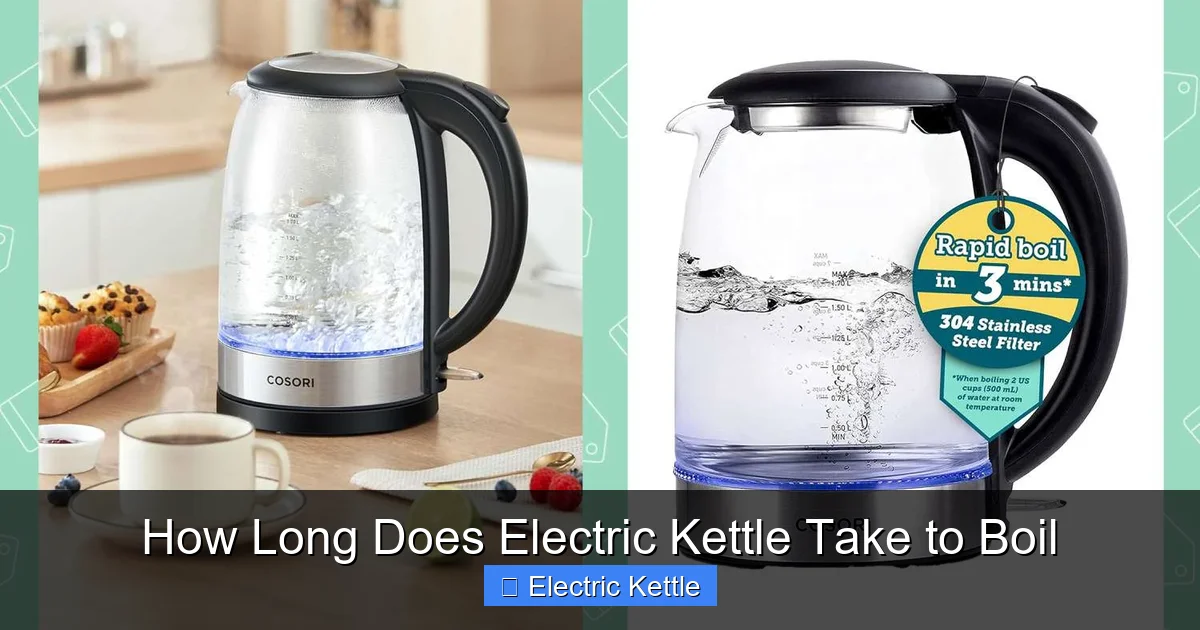
Visual guide about How Long Does Electric Kettle Take to Boil
Image source: longroadhomeproject.com
Now that we’ve covered the factors that influence boiling time, let’s look at real-world examples. Boiling times can vary widely depending on the kettle model, so it’s helpful to compare different types and brands.
Standard 1500W Kettle
A typical 1500-watt electric kettle is common in many homes, especially in the U.S. and other regions with lower voltage standards. When filled to its maximum capacity (usually 1.7 liters), it takes about 4 to 5 minutes to boil. For 1 liter, expect around 3 to 3.5 minutes. If you’re only heating 500ml, it might take just 2 minutes.
These kettles are reliable and energy-efficient, but they’re not the fastest on the market. They’re a good choice for everyday use, especially if you’re not in a rush.
High-Wattage 3000W Kettle
In countries like the UK, Australia, and much of Europe, 3000-watt kettles are widely available. These powerhouses can boil 1 liter of water in just 2 to 2.5 minutes. For 500ml, it’s often under 1.5 minutes. That’s nearly twice as fast as a 1500W model.
Brands like Breville, Russell Hobbs, and Smeg offer high-wattage models with sleek designs and advanced features. If you value speed and don’t mind a higher upfront cost, these kettles are worth considering.
Compact and Travel Kettles
Travel kettles are smaller, usually holding between 0.5 and 1 liter, and often run on lower wattage (800–1200W). While convenient for small spaces or travel, they’re slower. A 1-liter travel kettle might take 4 to 6 minutes to boil, and even 500ml could take 2.5 to 3 minutes.
These are best for occasional use or when portability is more important than speed.
Smart and Variable Temperature Kettles
Smart kettles, like those from Fellow or Cuisinart, offer precise temperature control and programmable settings. While they may not always be the fastest, many include “rapid boil” modes that prioritize speed for boiling.
For example, the Fellow Stagg EKG+ can boil 1 liter in about 3 minutes, even though it’s designed for precision. These kettles are ideal for tea lovers who want to heat water to exact temperatures without over-boiling.
Energy-Efficient and Eco Modes
Some kettles come with eco or energy-saving modes that reduce power output to save electricity. While environmentally friendly, these modes can increase boiling time by 30 seconds to a minute. If you’re using eco mode regularly, you might notice a slight delay—but the energy savings can be significant over time.
Tips to Speed Up Boiling Time
Want to get your water boiling faster without buying a new kettle? Try these practical tips to optimize your current setup.
Only Heat What You Need
This is the easiest and most effective way to save time. Instead of filling your kettle to the top for one cup of tea, measure out just the amount you need. Use the markings on the kettle or a measuring cup to get it right. Not only will this speed up boiling, but it also saves energy and reduces wear on the heating element.
Use Warm Water
If your tap provides warm water, use it instead of cold. Even a small increase in starting temperature can shave off 30 seconds or more. Just make sure the water is safe to drink—some older pipes may contain contaminants when water sits in them.
Keep Your Kettle Clean
Limescale buildup is the enemy of efficiency. In areas with hard water, mineral deposits can accumulate on the heating element, acting as an insulator and slowing heat transfer. Over time, this can add 30 seconds to a minute to your boiling time.
To prevent this, descale your kettle regularly using a mixture of vinegar and water (1:1 ratio). Let it sit for an hour, then rinse thoroughly. Some kettles even have built-in descaling indicators to remind you when it’s time.
Close the Lid
It might seem obvious, but always make sure the lid is securely closed. An open lid allows heat to escape, increasing boiling time. Most modern kettles have tight-fitting lids designed to retain heat, so take advantage of them.
Use the Right Settings
If your kettle has multiple temperature settings or a rapid-boil mode, use them wisely. For boiling (100°C), select the highest setting. Avoid using lower temperatures unless you’re steeping delicate teas like green or white tea.
Preheat the Kettle (Optional)
Some users swear by preheating the kettle with a small amount of hot water before adding the full amount. While this isn’t scientifically proven to make a huge difference, it can help slightly by warming the interior components.
Energy Efficiency vs. Speed: Finding the Balance
It’s easy to assume that faster boiling means higher energy consumption, but that’s not always the case. In fact, electric kettles are generally more energy-efficient than stovetop methods because they heat water directly and lose less heat to the environment.
However, there’s a trade-off between speed and efficiency. High-wattage kettles use more power per second, but they complete the task faster. Lower-wattage models use less power overall but take longer. The total energy used (measured in kilowatt-hours) is often similar, but the experience differs.
For example, boiling 1 liter of water requires about 0.1 kWh of energy, regardless of the kettle. A 3000W kettle might use that energy in 2 minutes, while a 1500W model takes 4 minutes. Both consume the same amount of electricity, but the high-wattage kettle does it faster.
That said, if you’re only heating a small amount of water, a lower-wattage kettle might be more efficient because it avoids overheating excess water. Always match the kettle size and power to your needs.
Some kettles also feature auto shut-off and keep-warm functions, which can save energy by preventing repeated boiling. These features are especially useful if you tend to forget your kettle on the base.
Common Myths About Electric Kettle Boiling Times
There are several misconceptions about how electric kettles work and how long they should take to boil. Let’s clear up a few of the most common myths.
Myth: All Electric Kettles Boil at the Same Speed
False. As we’ve seen, wattage, capacity, and design all play a role. A high-end 3000W kettle can be twice as fast as a basic 1500W model.
Myth: Boiling Water Multiple Times Makes It Unsafe
Reboiling water is generally safe, though it can concentrate certain minerals and reduce oxygen content. However, this doesn’t make it harmful for drinking or brewing tea. Just avoid reboiling the same water repeatedly over long periods.
Myth: Glass Kettles Are Slower Than Metal Ones
Not necessarily. While glass is a poorer conductor of heat than metal, modern glass kettles often have efficient heating elements and good insulation. In many cases, boiling times are comparable to stainless steel models.
Myth: You Should Always Fill the Kettle to the Top
This wastes time and energy. Only heat what you need. Most kettles have minimum fill lines for safety, but there’s no benefit to overfilling.
Myth: Electric Kettles Use More Energy Than Stovetops
Actually, electric kettles are typically more efficient. They transfer up to 80% of their energy to the water, while stovetops may lose 30–40% to the air.
Conclusion
So, how long does an electric kettle take to boil? The answer is: it depends. On average, most kettles take between 2 and 5 minutes to boil 1 liter of water, with higher-wattage models on the faster end and lower-wattage or eco-friendly models on the slower side. Factors like water volume, starting temperature, altitude, and maintenance all influence the final time.
The key to getting the fastest boil is choosing the right kettle for your needs—whether that’s a high-powered 3000W model for speed or a compact, energy-efficient one for small spaces. And once you have it, simple habits like heating only what you need and keeping it clean can make a noticeable difference.
Ultimately, the electric kettle is a marvel of modern convenience. It’s fast, efficient, and reliable—perfect for busy mornings, impromptu tea breaks, or quick meals. By understanding how it works and what affects its performance, you can get the most out of this everyday kitchen hero.
So the next time you press that button, you’ll know exactly what to expect—and maybe even impress your guests with your kettle knowledge.
Frequently Asked Questions
How long does a 1500W electric kettle take to boil 1 liter of water?
A 1500W electric kettle typically takes 3 to 4 minutes to boil 1 liter of water, depending on the starting temperature and kettle design. It may take slightly longer if the water is very cold or if the kettle has limescale buildup.
Can I speed up my electric kettle’s boiling time?
Yes, you can speed up boiling by heating only the amount of water you need, using warm tap water, keeping the kettle clean, and ensuring the lid is closed. Regular descaling also helps maintain efficiency.
Does altitude affect how long an electric kettle takes to boil?
Yes, at higher altitudes, water boils at a lower temperature due to reduced atmospheric pressure. While the kettle may detect boiling sooner, the process can take slightly longer because of lower heat transfer efficiency.
Is it safe to reboil water in an electric kettle?
Yes, it’s generally safe to reboil water, though repeated boiling can concentrate minerals and reduce oxygen levels. For best taste and quality, it’s better to use fresh water when possible.
Do smart kettles boil faster than regular ones?
Not necessarily. Smart kettles focus on precision and temperature control, but many include rapid-boil modes that can match or exceed standard kettles in speed. Check the wattage and features to compare performance.
Why is my electric kettle taking longer to boil than before?
This is often due to limescale buildup on the heating element, which insulates and slows heat transfer. Descaling the kettle with vinegar or a commercial cleaner usually restores normal boiling times.