Most electric kettles range from 1,200 to 3,000 watts, with higher wattage meaning faster boiling times. Understanding wattage helps you balance speed, energy use, and safety when choosing or using your kettle.
Key Takeaways
- Electric kettles typically use 1,200 to 3,000 watts: Higher wattage means faster boiling, but also higher energy consumption.
- Wattage directly affects boiling speed: A 3,000-watt kettle can boil water nearly twice as fast as a 1,500-watt model.
- Energy efficiency isn’t just about wattage: Insulation, auto shut-off, and proper filling improve overall efficiency.
- Kitchen circuits matter: Most homes support 1,500–1,800 watts safely; check your circuit limits before using high-wattage kettles.
- Choose based on your needs: Small households may prefer lower-wattage models, while large families or offices benefit from higher power.
- Safety features are essential: Look for automatic shut-off, boil-dry protection, and cool-touch exteriors regardless of wattage.
- Noise levels vary: Higher-wattage kettles may sound louder due to rapid heating elements.
📑 Table of Contents
- How Many Watts Is an Electric Kettle? A Complete Guide
- Understanding Electric Kettle Wattage
- Typical Wattage Ranges for Electric Kettles
- How Wattage Affects Boiling Speed and Efficiency
- Safety and Electrical Considerations
- Choosing the Right Wattage for Your Needs
- Maintenance and Longevity
- Conclusion
How Many Watts Is an Electric Kettle? A Complete Guide
If you’ve ever stood waiting by the stove for a pot of water to boil, you know how slow and inefficient traditional methods can be. Enter the electric kettle—a modern kitchen staple that heats water quickly, quietly, and with minimal effort. But have you ever wondered, “How many watts is an electric kettle?” It’s a simple question with a surprisingly important answer. The wattage of your electric kettle doesn’t just determine how fast your tea or coffee is ready—it also affects your electricity bill, safety, and even the lifespan of your appliance.
In this guide, we’ll dive deep into the world of electric kettle wattage. Whether you’re shopping for a new kettle, trying to understand your current one, or just curious about how these handy devices work, you’ll find everything you need right here. We’ll explore typical wattage ranges, how power affects performance, energy efficiency tips, and what to look for when buying. By the end, you’ll know exactly how many watts your kettle should have—and why it matters.
Understanding Electric Kettle Wattage
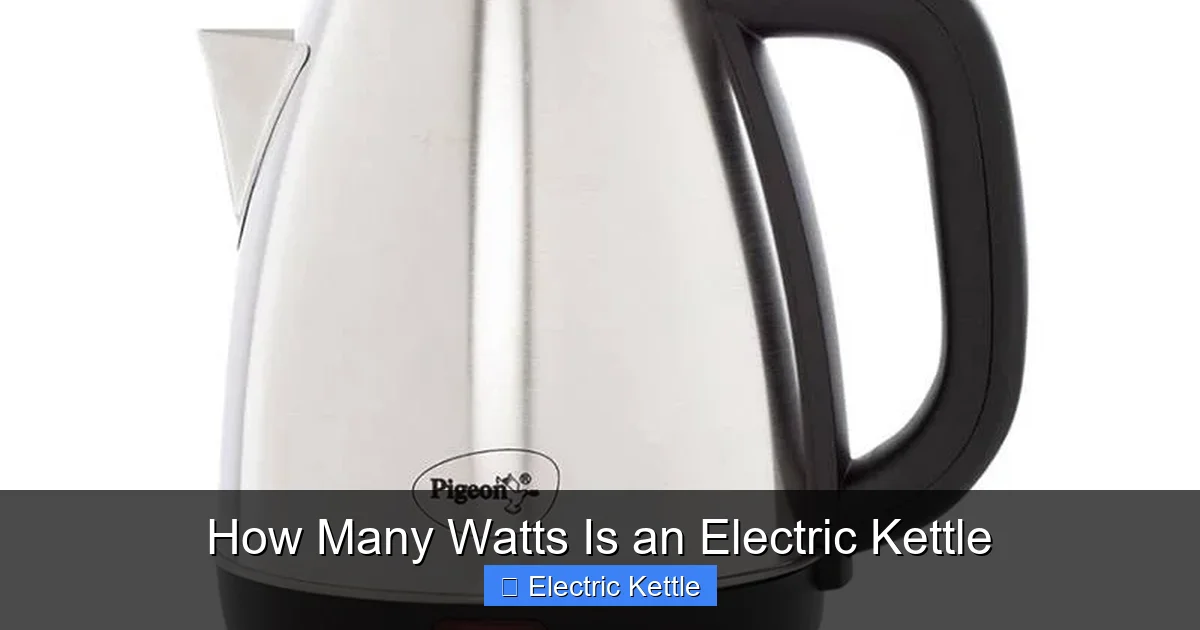
Visual guide about How Many Watts Is an Electric Kettle
Image source: brandstik.com
At its core, wattage is a measure of power—specifically, how much energy an appliance uses per second. In the case of electric kettles, wattage tells you how quickly the heating element can convert electrical energy into heat. The higher the wattage, the more power the kettle draws, and the faster it can bring water to a boil.
Most electric kettles on the market today range from 1,200 to 3,000 watts. That’s a wide range, and it reflects the variety of needs and preferences among users. For example, a compact 1,200-watt kettle might be perfect for a small apartment or a single person who only boils water occasionally. On the other hand, a 3,000-watt model is ideal for busy households, offices, or anyone who needs hot water in a hurry.
But wattage isn’t just about speed. It also influences energy consumption. A higher-wattage kettle uses more electricity per minute, which can add up over time—especially if you’re boiling water multiple times a day. However, because it works faster, it might actually use less total energy than a slower, lower-wattage kettle that runs longer. It’s a bit of a balancing act, and understanding your usage patterns is key.
Why Wattage Matters
So why should you care about wattage? After all, isn’t the goal just to get hot water? While that’s true, the wattage of your electric kettle affects several important factors:
– **Boiling time:** This is the most obvious. A 3,000-watt kettle can boil a liter of water in under three minutes, while a 1,500-watt model might take five or six.
– **Energy efficiency:** Contrary to what you might think, a faster kettle isn’t always less efficient. If it boils water quickly and shuts off automatically, it may use less total energy than a slower one that stays on longer.
– **Circuit safety:** High-wattage appliances draw more current. If your kitchen circuit isn’t designed to handle it, you could trip a breaker or overload the system.
– **Noise level:** Higher-wattage kettles often have more powerful heating elements, which can produce a louder humming or clicking sound during operation.
– **Appliance lifespan:** Constantly running a high-wattage kettle at full power may wear out components faster than a moderate-use model.
In short, wattage is a critical specification that affects performance, cost, and safety. Choosing the right one means matching your kettle’s power to your lifestyle and kitchen setup.
Typical Wattage Ranges for Electric Kettles
Now that you understand why wattage matters, let’s look at the common ranges you’ll find when shopping for an electric kettle. These aren’t hard rules—some models fall outside these ranges—but they give you a solid framework for comparison.
Low-Wattage Kettles (1,200–1,500 Watts)
These are the most common kettles for home use, especially in regions with standard 120-volt electrical systems (like North America). A 1,500-watt kettle is often considered the sweet spot for everyday boiling. It’s powerful enough to heat water quickly—usually in 4 to 6 minutes for a full liter—but not so strong that it risks overloading typical kitchen circuits.
Low-wattage kettles are ideal for:
– Small households or individuals
– People who boil water infrequently
– Renters or those with older electrical systems
– Energy-conscious users who want to minimize power draw
Many popular brands like Hamilton Beach, Cuisinart, and OXO offer models in this range. They’re often more affordable, lighter, and easier to store. However, if you’re boiling water multiple times a day or need it for large batches (like making pasta or instant soup), you might find these kettles a bit slow.
Mid-Range Kettles (1,800–2,200 Watts)
Stepping up to 1,800 watts or more makes a noticeable difference in speed. These kettles can boil a liter of water in about 3 to 4 minutes, making them great for families or frequent users. They’re still safe for most home circuits, especially if you’re not running other high-power appliances (like microwaves or toasters) at the same time.
Mid-range kettles often come with added features like:
– Variable temperature settings (for tea, coffee, or baby formula)
– Keep-warm functions
– Stainless steel or glass bodies
– LED indicators and digital displays
Brands like Breville, Smeg, and Russell Hobbs offer excellent mid-range models. They strike a good balance between performance and energy use, making them a popular choice for modern kitchens.
High-Wattage Kettles (2,500–3,000 Watts)
If speed is your top priority, high-wattage kettles are the way to go. These powerhouses can boil a liter of water in under three minutes—sometimes as little as two. They’re common in Europe and other regions with 220–240-volt electrical systems, where higher wattage is more practical and safer.
High-wattage kettles are perfect for:
– Large families or shared living spaces
– Offices or break rooms
– People who value time and convenience
– Those who frequently boil water for cooking
However, there are trade-offs. These kettles draw a lot of power—up to 3,000 watts is equivalent to running three hair dryers at once. That means you need a dedicated circuit or at least a kitchen outlet that can handle the load. Overloading a circuit can trip breakers, damage appliances, or even pose a fire risk.
Also, high-wattage kettles tend to be louder and may have shorter lifespans if used excessively. But for many users, the speed and efficiency outweigh these concerns.
Commercial and Industrial Kettles (3,000+ Watts)
While most home users won’t need anything beyond 3,000 watts, commercial settings like cafes, restaurants, or hospitals often use industrial-grade kettles with even higher power ratings. These can exceed 5,000 watts and are designed for continuous, heavy-duty use.
These kettles are built with reinforced elements, heavy-duty cords, and advanced safety systems. They’re not practical for home use due to their size, cost, and power requirements, but they highlight how wattage scales with demand.
How Wattage Affects Boiling Speed and Efficiency
One of the biggest reasons people care about wattage is boiling speed. After all, who wants to wait five minutes for water to boil when you could be sipping your tea in half the time? But the relationship between wattage and speed isn’t always straightforward.
The Science of Boiling Water
To understand why wattage affects boiling time, let’s look at the basics. Heating water requires energy—specifically, about 4.18 joules to raise one gram of water by one degree Celsius. To boil a liter of water (which weighs about 1,000 grams) from room temperature (20°C) to boiling (100°C), you need roughly 334,400 joules of energy.
Now, power (in watts) is energy per second. So a 1,500-watt kettle delivers 1,500 joules per second. In theory, it would take about 223 seconds (or 3.7 minutes) to boil that liter of water—assuming 100% efficiency.
But no kettle is 100% efficient. Some heat is lost to the air, the kettle body, or the surrounding environment. That’s why real-world boiling times are usually a bit longer. Still, the math holds: higher wattage = faster boiling.
Real-World Examples
Let’s compare two common kettles:
– **Kettle A:** 1,500 watts
– **Kettle B:** 3,000 watts
Assuming both are filled with 1 liter of water at 20°C:
– Kettle A might take 4.5 minutes to boil.
– Kettle B might take 2.5 minutes.
That’s a 2-minute difference—significant if you’re in a rush. Over the course of a week, that adds up to over 10 minutes saved. For someone who boils water multiple times a day, that’s a real time-saver.
But here’s the catch: while the 3,000-watt kettle is faster, it also uses twice as much power per minute. So in terms of total energy used, both kettles might consume roughly the same amount—around 0.125 kWh (kilowatt-hours) per boil. The high-wattage model just does it faster.
Energy Efficiency Tips
So how can you get the best of both worlds—speed and efficiency? Here are some practical tips:
1. **Only boil what you need:** Filling your kettle to the brim when you only need one cup wastes energy. Most kettles have minimum and maximum fill lines—use them.
2. **Use a lid:** An uncovered kettle loses heat to the air, slowing boiling and increasing energy use.
3. **Descale regularly:** Mineral buildup insulates the heating element, reducing efficiency. Clean your kettle every few months with vinegar or a descaling solution.
4. **Choose a kettle with auto shut-off:** This prevents over-boiling and saves energy.
5. **Consider insulation:** Some kettles have double-walled or vacuum-insulated designs that keep water hot longer, reducing the need to reboil.
By combining the right wattage with smart habits, you can enjoy fast boiling without wasting energy.
Safety and Electrical Considerations
With great power comes great responsibility—especially when it comes to electricity. High-wattage kettles are convenient, but they also pose risks if not used properly. Understanding your home’s electrical system is crucial for safe operation.
Understanding Circuit Limits
Most homes in the U.S. have 120-volt circuits rated for 15 or 20 amps. That means a 15-amp circuit can safely handle up to 1,800 watts (120V × 15A = 1,800W), and a 20-amp circuit up to 2,400 watts.
If you plug a 3,000-watt kettle into a 15-amp circuit, you’re already over the limit—even before accounting for other appliances. This can cause the circuit breaker to trip, or worse, overheat and create a fire hazard.
To stay safe:
– Check your circuit breaker panel to see the amp rating of your kitchen outlets.
– Avoid running other high-wattage appliances (microwave, toaster, coffee maker) on the same circuit while using your kettle.
– Consider using a dedicated outlet for high-power devices.
In Europe and other regions with 220–240-volt systems, the math is different. A 230V, 13-amp circuit can handle up to 2,990 watts—making 3,000-watt kettles much more practical and safer.
Safety Features to Look For
Regardless of wattage, always choose a kettle with built-in safety features:
– **Automatic shut-off:** Turns off the kettle when water reaches boiling point.
– **Boil-dry protection:** Shuts off if the kettle is turned on without water.
– **Cool-touch exterior:** Prevents burns, especially important with high-wattage models that heat up quickly.
– **Stable base and secure lid:** Reduces the risk of spills and accidents.
– **Cordless design:** Makes pouring safer and reduces tripping hazards.
These features are especially important in homes with children or elderly users. A high-wattage kettle without proper safety mechanisms can be dangerous.
Noise and Wear Over Time
Higher-wattage kettles often produce more noise due to the intensity of the heating element. You might hear a loud hum, clicking, or bubbling sound as the water heats. While this is normal, excessive noise could indicate a problem—like mineral buildup or a failing element.
Also, frequent use of high-wattage kettles can wear out components faster. The heating element, thermostat, and seals may degrade over time, especially if the kettle is used multiple times a day. Regular maintenance and following the manufacturer’s guidelines can help extend its life.
Choosing the Right Wattage for Your Needs
Now that you know the ins and outs of electric kettle wattage, how do you pick the right one? The answer depends on your lifestyle, kitchen setup, and priorities.
Assess Your Usage
Ask yourself:
– How often do I boil water? (Daily? Multiple times a day?)
– How much water do I typically need? (One cup? A full liter?)
– Do I need variable temperatures for tea or coffee?
– Is speed a top priority?
If you’re a tea enthusiast who brews multiple cups a day, a 2,200-watt kettle with temperature control might be ideal. If you’re a student in a dorm with limited outlets, a 1,200-watt model could be safer and more practical.
Consider Your Kitchen’s Electrical Capacity
Before buying a high-wattage kettle, check your kitchen’s electrical setup. Can your outlets handle 3,000 watts? Are there other appliances on the same circuit? If you’re unsure, consult an electrician.
In older homes or apartments, circuits may not be designed for modern high-power appliances. Upgrading your electrical system can be costly, so it’s often better to choose a kettle that fits your current setup.
Budget and Features
Higher-wattage kettles often come with more features—and a higher price tag. While a basic 1,500-watt kettle might cost $25, a premium 3,000-watt model with digital controls and insulation could run $100 or more.
Decide what features matter most to you. Do you need a keep-warm function? A gooseneck spout for pour-over coffee? A sleek design? Balance your wants with your budget and wattage needs.
Brand and Warranty
Stick with reputable brands that offer good warranties and customer support. A kettle is a long-term investment, and you want one that will last. Look for models with at least a 1–2 year warranty and positive user reviews.
Maintenance and Longevity
No matter the wattage, proper care can extend your kettle’s life and keep it running efficiently.
Regular Cleaning
Mineral deposits from hard water can build up on the heating element, reducing efficiency and potentially causing damage. Clean your kettle every 1–3 months:
– Fill with equal parts water and white vinegar.
– Boil, then let sit for 30 minutes.
– Rinse thoroughly and boil with clean water to remove any vinegar taste.
Avoid Overfilling and Underfilling
Always stay within the min and max fill lines. Overfilling can cause spills and damage the base; underfilling can trigger boil-dry protection or damage the element.
Store Properly
Keep your kettle in a dry, cool place. Avoid wrapping the cord tightly around the base, as this can damage the wires over time.
Conclusion
So, how many watts is an electric kettle? The answer isn’t one-size-fits-all. Most home kettles range from 1,200 to 3,000 watts, with higher wattage offering faster boiling at the cost of higher power draw. The right choice depends on your needs, kitchen setup, and usage habits.
Whether you prioritize speed, energy efficiency, or safety, understanding wattage helps you make an informed decision. Pair that knowledge with smart usage and maintenance, and your electric kettle will serve you well for years to come.
Next time you’re shopping for a kettle—or just waiting for your water to boil—remember: it’s not just about how hot it gets. It’s about how smartly it heats.
Frequently Asked Questions
What is the average wattage of an electric kettle?
The average electric kettle uses between 1,500 and 1,800 watts, making it fast enough for most home needs while staying within standard circuit limits.
Can a 3,000-watt kettle damage my electrical system?
It can if your kitchen circuit isn’t rated for that load. Most U.S. homes have 15- or 20-amp circuits, so check your breaker panel and avoid overloading the circuit.
Does higher wattage mean higher electricity bills?
Not necessarily. While high-wattage kettles use more power per minute, they boil water faster, so total energy use may be similar to slower models.
Is a 1,200-watt kettle too slow?
It depends on your needs. For occasional use or small households, 1,200 watts is sufficient. For frequent boiling, consider 1,800 watts or higher.
Do all electric kettles have the same wattage?
No. Wattage varies by model, brand, and region. Always check the label or product specs before buying.
Can I use a high-wattage kettle in an older home?
Only if your electrical system can handle it. Older homes may have lower-capacity circuits, so consult an electrician if unsure.