Wondering how much does an electric kettle cost to run? The average kettle uses around 0.1 kWh per use, costing just a few cents per boil. With smart habits and efficient models, you can keep energy bills low while enjoying hot water daily.
Key Takeaways
- Electric kettles are energy-efficient: They use less power than stovetop kettles or microwaves, making them one of the cheapest ways to boil water.
- Average running cost is low: Boiling a full kettle typically costs between 2 to 4 cents, depending on your electricity rate and kettle wattage.
- Overfilling increases costs: Only boil the amount of water you need—extra water means wasted energy and higher bills over time.
- Kettle wattage matters: Higher-wattage kettles (1500W–3000W) boil faster but may use more power if not used efficiently.
- Regular maintenance saves money: Descaling your kettle improves efficiency and prevents energy waste from limescale buildup.
- Smart habits reduce costs: Using a lid, choosing energy-efficient models, and avoiding reheating cold water can cut usage significantly.
- Compare with alternatives: Electric kettles are generally cheaper to run than gas stoves or microwaves for heating water.
📑 Table of Contents
- Introduction: The Everyday Appliance That Pays for Itself
- Understanding the Basics: How Electric Kettles Use Energy
- Calculating Your Electric Kettle’s Running Cost
- Comparing Electric Kettles to Other Water-Heating Methods
- Tips to Reduce Your Electric Kettle’s Running Cost
- The Bigger Picture: Environmental and Financial Impact
- Conclusion: Small Appliance, Big Savings
Introduction: The Everyday Appliance That Pays for Itself
We’ve all been there—rushing in the morning, craving that first sip of tea or coffee, and reaching for the electric kettle. It’s fast, convenient, and seemingly harmless to our wallets. But have you ever stopped to wonder: how much does an electric kettle cost to run? It’s a question that seems small, but over time, those tiny energy uses add up. Whether you’re brewing one cup a day or filling the kettle five times, understanding the real cost can help you make smarter choices—both for your budget and the planet.
Electric kettles have become a staple in kitchens around the world. From students in dorm rooms to busy professionals at home, they offer speed and simplicity. But with rising energy prices and growing awareness about sustainability, it’s worth digging into the numbers. The good news? Electric kettles are among the most energy-efficient appliances for heating water. Unlike stovetop kettles that lose heat to the air or microwaves that heat unevenly, electric kettles transfer energy directly to the water. This means less waste and lower costs.
In this guide, we’ll break down exactly how much it costs to run an electric kettle, factoring in electricity rates, wattage, usage habits, and even regional differences. You’ll learn how to calculate your own costs, discover energy-saving tips, and compare kettles to other heating methods. By the end, you’ll know not only how much your kettle is costing you—but also how to keep that number as low as possible.
Understanding the Basics: How Electric Kettles Use Energy
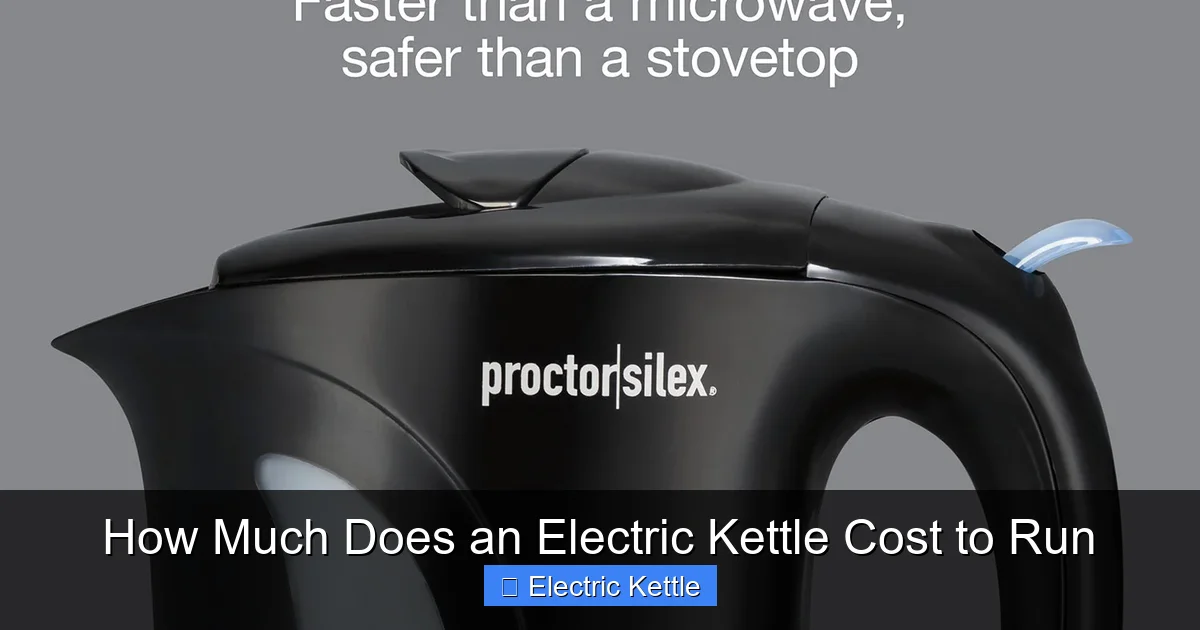
Visual guide about How Much Does an Electric Kettle Cost to Run
Image source: proctorsilex.com
To figure out how much does an electric kettle cost to run, we first need to understand how these appliances work and what drives their energy use. At its core, an electric kettle is a simple device: it uses an electric heating element submerged in water to generate heat. When you flip the switch, electricity flows through the element, which resists the current and heats up—much like the coil in a toaster. This heat is transferred directly to the water, bringing it to a boil quickly and efficiently.
The key factor in energy consumption is wattage. Most household electric kettles range from 1500 watts (W) to 3000W. Higher wattage means faster boiling—a 3000W kettle can boil a liter of water in under three minutes, while a 1500W model might take closer to five. But speed doesn’t always mean higher cost. Because the kettle runs for a shorter time, the total energy used (measured in kilowatt-hours, or kWh) can be similar or even lower than a slower, lower-wattage model.
Let’s break it down with an example. Say you have a 2000W kettle and you boil it once a day. If it takes 3 minutes (0.05 hours) to boil, the energy used per boil is:
Energy (kWh) = Power (kW) × Time (hours)
Energy = 2 kW × 0.05 hours = 0.1 kWh
Now, if your electricity rate is $0.15 per kWh (the U.S. average), the cost per boil is:
Cost = 0.1 kWh × $0.15 = $0.015
That’s just 1.5 cents per use. Even if you boil the kettle five times a day, you’re only spending about 7.5 cents daily—less than $27 per year. Compared to other kitchen appliances, that’s incredibly efficient.
Why Wattage Isn’t the Whole Story
While wattage plays a big role, it’s not the only factor. The amount of water you boil matters just as much. Heating a full kettle uses more energy than heating half a kettle, even if both take similar times. That’s because more water requires more heat energy to reach boiling point. The specific heat capacity of water means it takes about 4.2 joules to raise 1 gram of water by 1°C. So, heating 1 liter (1000 grams) from 20°C to 100°C requires roughly 336,000 joules—or about 0.093 kWh.
This is why overfilling your kettle is one of the biggest energy wasters. If you only need one cup of water but boil a full kettle, you’re using nearly four times the energy. Over a month, that could add up to several extra kilowatt-hours—and a few extra dollars on your bill.
Another factor is starting water temperature. Cold tap water in winter might be 10°C, while in summer it could be 20°C. Heating from a lower temperature requires more energy. Some kettles have temperature control features that let you heat water to lower temps (like 80°C for green tea), which saves energy compared to boiling every time.
Calculating Your Electric Kettle’s Running Cost
Now that we understand the basics, let’s get practical. How can you calculate how much does an electric kettle cost to run in your home? It’s easier than you think—and you don’t need a degree in physics.
Start with three key pieces of information:
1. Your kettle’s wattage (usually printed on the base or in the manual)
2. How long it takes to boil (you can time it)
3. Your local electricity rate (found on your utility bill)
Let’s walk through a real-world example. Say you have a 2200W kettle that takes 4 minutes (0.067 hours) to boil 1 liter of water. Your electricity costs $0.18 per kWh (a bit above average, but common in some states).
Step 1: Convert watts to kilowatts
2200W = 2.2 kW
Step 2: Calculate energy per boil
Energy = 2.2 kW × 0.067 hours = 0.147 kWh
Step 3: Multiply by electricity rate
Cost = 0.147 kWh × $0.18 = $0.0265 (about 2.7 cents)
So, each full boil costs roughly 2.7 cents. If you boil it twice a day, that’s 5.4 cents daily, or about $19.70 per year. Not bad for daily convenience.
But what if you only boil half the kettle? Let’s say it takes 2.5 minutes (0.042 hours) to boil 0.5 liters.
Energy = 2.2 kW × 0.042 = 0.092 kWh
Cost = 0.092 × $0.18 = $0.0166 (1.7 cents)
By boiling only what you need, you’ve cut the cost by nearly 40%. Over a year, that saves you about $7.30—money that could buy a new tea blend or two.
Regional Differences in Electricity Costs
Your location plays a big role in how much does an electric kettle cost to run. Electricity prices vary widely across the U.S. and globally. For example:
– Louisiana: ~$0.11 per kWh (lowest in the U.S.)
– California: ~$0.27 per kWh (among the highest)
– UK: ~£0.30 per kWh (about $0.38 USD)
– Germany: ~€0.40 per kWh (about $0.43 USD)
Using the same 2.2 kW kettle example:
– In Louisiana: 0.147 kWh × $0.11 = 1.6 cents per boil
– In California: 0.147 kWh × $0.27 = 3.97 cents per boil
– In the UK: 0.147 kWh × £0.30 = 4.4 pence (~$5.6 cents USD)
That’s more than double the cost in high-rate areas. If you live somewhere with expensive electricity, small savings add up fast. Boiling only what you need, using a lid, and maintaining your kettle become even more important.
Using Online Calculators and Apps
If math isn’t your thing, don’t worry. There are plenty of free online tools to help. Websites like the U.S. Department of Energy’s appliance calculator or apps like “Energy Cost Calculator” let you input your kettle’s specs and usage to get instant estimates. Some smart plugs also track energy use in real time, so you can see exactly how much your kettle consumes each day.
These tools are great for comparing scenarios. For instance, you can test how switching to a lower-wattage kettle or reducing boil frequency affects your annual cost. They also help you visualize the impact of habits—like reheating cold water instead of using fresh cold water.
Comparing Electric Kettles to Other Water-Heating Methods
Now that we know how much does an electric kettle cost to run, let’s see how it stacks up against other common ways to heat water. Is the electric kettle really the most efficient choice?
Electric Kettle vs. Stovetop Kettle
Stovetop kettles are classic, but they’re not as efficient. Whether you use gas or electric, stovetop methods lose heat to the surrounding air. Only about 40–50% of the energy from a gas flame actually heats the water. Electric stovetops are slightly better at 70–80%, but still lag behind electric kettles, which transfer over 80% of energy directly to water.
Let’s compare costs. A gas stovetop might use 0.03 therms to boil 1 liter. At $1.20 per therm, that’s about 3.6 cents. An electric stovetop could use 0.15 kWh at $0.15/kWh = 2.25 cents. The electric kettle? As low as 1.5 cents. So even though gas is cheaper per unit, the kettle’s efficiency often wins.
Electric Kettle vs. Microwave
Microwaves are convenient, but not ideal for boiling water. They heat unevenly and can cause superheating (water boiling violently when disturbed). Energy-wise, microwaves are about 50–60% efficient for water heating. To boil 1 cup (250ml), a 1000W microwave might take 2 minutes—using 0.033 kWh. At $0.15/kWh, that’s 0.5 cents. Sounds cheap, but scale it up.
Boiling 1 liter in a microwave could take 6–8 minutes, using 0.1–0.13 kWh = 1.5–2 cents. That’s similar to a kettle—but with more risk and less control. Plus, microwaves use standby power even when off, adding hidden costs.
Electric Kettle vs. Instant Hot Water Dispensers
Some homes have instant hot water taps or under-sink heaters. These keep water hot 24/7, which sounds convenient—but it’s energy-intensive. A typical unit might use 2–3 kWh per day just to maintain temperature. At $0.15/kWh, that’s 30–45 cents daily—over $100 per year.
An electric kettle, used 3 times a day, costs about 4.5 cents daily—$16.43 per year. That’s a savings of over $80 annually. Unless you’re boiling water constantly, the kettle is far cheaper.
Tips to Reduce Your Electric Kettle’s Running Cost
Even though electric kettles are already efficient, small changes can make a big difference over time. Here’s how to minimize how much does an electric kettle cost to run.
1. Boil Only What You Need
This is the #1 rule. Measure your cup or mug and fill the kettle to that level. Most kettles have markings inside—use them. If you’re making one cup, don’t boil four. You’ll save energy, time, and money.
2. Use Cold Water, Not Hot
Some people think using hot tap water saves time. But hot water from the tap often comes from your water heater, which uses gas or electricity. Heating already-hot water in the kettle doubles the energy use. Always start with cold water.
3. Keep the Lid On
Never boil an open kettle. Heat escapes, increasing boiling time and energy use. A lid traps steam and speeds up the process. It’s a simple habit with real savings.
4. Descale Regularly
Limescale buildup insulates the heating element, making it work harder. In hard water areas, descale every 1–2 months with vinegar or a commercial cleaner. A clean kettle heats faster and uses less power.
5. Choose an Energy-Efficient Model
Look for kettles with:
– Insulated walls (keep water hot longer)
– Temperature control (avoid boiling unnecessarily)
– Auto shut-off (prevents over-boiling)
– Low standby power
Some newer models use induction heating or vacuum insulation for even greater efficiency.
6. Avoid Reheating Cold Water
If you forget your tea and it goes cold, don’t reheat it in the kettle. Use a microwave or wait for fresh water. Reheating uses nearly as much energy as boiling from cold.
7. Use a Kettle with a Keep-Warm Function
If you drink multiple cups, a keep-warm feature (usually 1–2 hours) lets you reheat without reboiling. Just don’t leave it on all day—it can use more energy than boiling fresh.
The Bigger Picture: Environmental and Financial Impact
While the cost per boil is small, the cumulative effect matters—both for your wallet and the planet. Let’s say the average household boils the kettle 3 times a day. At 0.1 kWh per boil, that’s 0.3 kWh daily, or 109.5 kWh per year.
At $0.15/kWh, that’s $16.43 annually. Multiply by 130 million U.S. households, and we’re talking over $2 billion in kettle-related electricity costs each year. On a global scale, with billions of kettles in use, the number climbs into the tens of billions.
But the environmental impact is even greater. Generating 1 kWh of electricity emits about 0.4–0.9 kg of CO₂, depending on the energy source. That means the average household’s kettle use emits 44–98 kg of CO₂ per year. While it’s a small fraction of total household emissions, it’s still worth reducing.
By adopting efficient habits—boiling only what you need, maintaining your kettle, and choosing energy-efficient models—you can cut your kettle’s carbon footprint by 30–50%. Over a lifetime, that’s hundreds of kilograms of CO₂ saved.
And financially, those small savings add up. The $10–$20 you save annually on kettle use might not seem like much, but it’s money that could go toward a new appliance, a weekend trip, or your emergency fund. When combined with other energy-saving habits, it becomes part of a larger strategy for financial health.
Conclusion: Small Appliance, Big Savings
So, how much does an electric kettle cost to run? The answer is: not much—especially when used wisely. With an average cost of 1.5 to 4 cents per boil, electric kettles are one of the most affordable and efficient ways to heat water. They outperform stovetops, microwaves, and instant hot water systems in both cost and energy use.
But the real savings come from smart habits. Boiling only what you need, keeping the lid on, descaling regularly, and choosing an efficient model can cut your costs by nearly half. Over a year, that’s enough to buy a new kettle—or a year’s supply of your favorite tea.
More than just a kitchen gadget, the electric kettle is a symbol of how small changes can lead to big results. By understanding your usage and making mindful choices, you can enjoy hot drinks daily without guilt—or a surprise on your electricity bill. So go ahead, boil that kettle. Just do it wisely.
Frequently Asked Questions
How much does it cost to boil a kettle once?
On average, boiling a full electric kettle costs between 1.5 and 4 cents, depending on your electricity rate and kettle wattage. This is based on using 0.1–0.15 kWh of energy per boil.
Is it cheaper to boil a kettle or use a microwave?
For small amounts of water, a microwave can be slightly cheaper, but for larger quantities, an electric kettle is more efficient. Kettles heat water faster and with less energy waste, especially when boiling a full liter.
Does a higher-wattage kettle cost more to run?
Not necessarily. Higher-wattage kettles boil faster, so they may use less total energy than slower, lower-wattage models. The key is using the right amount of water and not overfilling.
How can I reduce my electric kettle’s energy use?
Boil only the water you need, use cold water, keep the lid on, descale regularly, and avoid reheating cold water. These habits can cut energy use by 30% or more.
Are electric kettles more efficient than gas stoves?
Yes, electric kettles are typically more efficient than gas stovetops because they transfer heat directly to the water with minimal loss. Gas stoves lose heat to the air, reducing overall efficiency.
How often should I descale my electric kettle?
In areas with hard water, descale every 1–2 months. In soft water areas, every 3–4 months is usually sufficient. Regular descaling improves efficiency and extends the kettle’s lifespan.