Boiling an electric kettle is one of the most energy-efficient ways to heat water, but the actual cost depends on your kettle’s wattage, local electricity rates, and usage habits. On average, it costs between 3 to 6 cents per boil—making it far cheaper than using a stovetop or microwave.
Key Takeaways
- Typical cost per boil: Most electric kettles cost between 3 and 6 cents to boil a full liter of water, depending on your electricity rate.
- Wattage matters: Higher-wattage kettles (1500W–3000W) boil water faster but may use slightly more energy per minute—though total cost remains low due to shorter run time.
- Electricity rates vary: Costs differ by region; in the U.S., the average residential rate is about 16 cents per kWh, but it can be as low as 10 cents or over 30 cents in some areas.
- Overfilling wastes money: Only boil the amount of water you need—boiling a full kettle for one cup doubles your cost per use.
- Efficiency beats alternatives: Electric kettles are up to 80% more efficient than stovetops and microwaves for heating water.
- Smart habits save more: Descaling your kettle regularly and using a lid improves efficiency and reduces long-term costs.
- Annual cost is minimal: Even with daily use, boiling a kettle costs less than $25 per year for most households.
📑 Table of Contents
- How Much Does It Cost to Boil an Electric Kettle?
- Understanding the Basics: How Electric Kettles Use Energy
- Calculating the Real Cost to Boil Water
- Comparing Costs: Electric Kettle vs. Other Appliances
- Factors That Affect the Cost of Boiling Water
- Tips to Reduce the Cost of Boiling Water
- Environmental Impact and Long-Term Savings
- Conclusion: Is Boiling an Electric Kettle Worth It?
How Much Does It Cost to Boil an Electric Kettle?
Imagine this: it’s early morning, and you’re craving a hot cup of tea or coffee. You fill your electric kettle, press the button, and within minutes, you’re sipping your favorite brew. It’s quick, convenient, and feels almost free—but is it really? How much does it actually cost to boil an electric kettle?
The short answer? Not much. In fact, boiling water in an electric kettle is one of the cheapest and most efficient ways to heat water in your home. But the exact cost depends on several factors: the wattage of your kettle, how much water you’re boiling, your local electricity rate, and how often you use it. While the price per boil might seem trivial—just a few cents—those small amounts can add up over time, especially if you’re not using your kettle efficiently.
In this guide, we’ll break down the real cost of boiling an electric kettle, step by step. You’ll learn how to calculate your own costs, compare different appliances, and discover simple tips to save even more. Whether you’re a tea lover, a coffee enthusiast, or just someone trying to cut down on household expenses, understanding the cost of boiling water can help you make smarter energy choices—without sacrificing convenience.
Understanding the Basics: How Electric Kettles Use Energy
Before we dive into costs, let’s understand how electric kettles work and why they’re so efficient. Unlike stovetops or microwaves, electric kettles are designed specifically for one job: heating water quickly and with minimal energy loss.
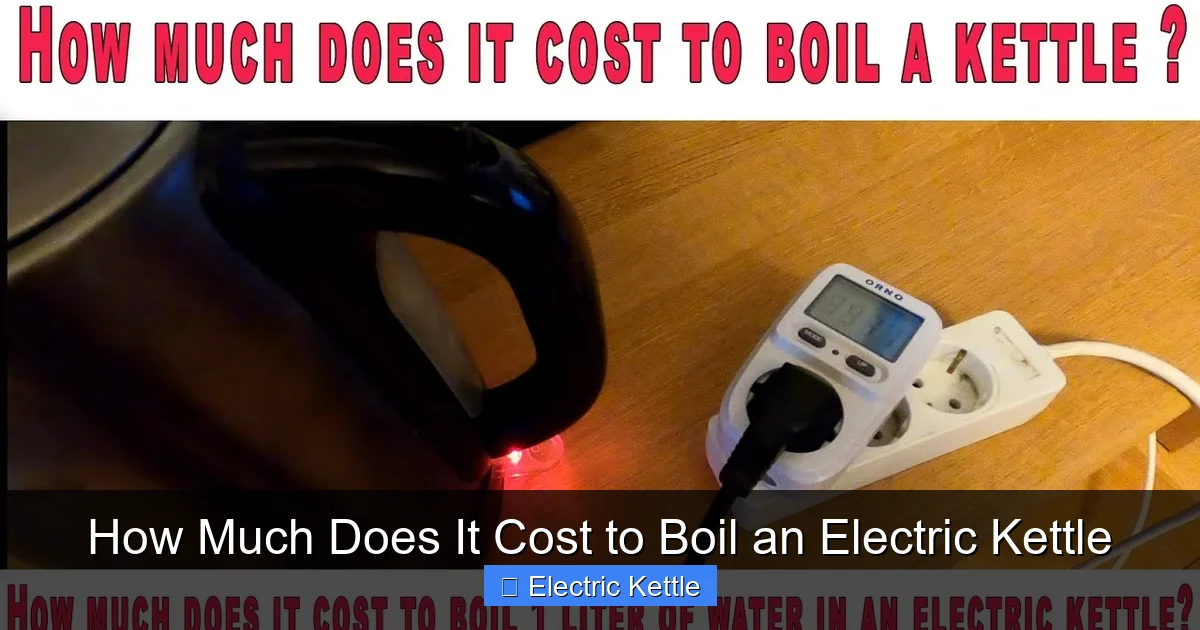
Visual guide about How Much Does It Cost to Boil an Electric Kettle
Image source: i.ytimg.com
How Electric Kettles Heat Water
Electric kettles use an internal heating element—usually a coiled metal rod or a flat disc at the base—that heats up when electricity flows through it. This element is submerged in water (or directly in contact with it), transferring heat directly to the liquid. Because the heat is applied directly to the water and not to a pot or container, there’s very little wasted energy.
Most modern electric kettles also come with automatic shut-off features. Once the water reaches boiling point (around 212°F or 100°C at sea level), the kettle turns off on its own. This not only prevents overheating but also ensures you’re not using extra electricity after the water is ready.
Power Ratings and Wattage
The speed and efficiency of your kettle depend largely on its wattage—the amount of electrical power it uses. Common wattages for household electric kettles range from 1200 watts to 3000 watts. Higher wattage means faster boiling times. For example:
- A 1500W kettle might take 3–4 minutes to boil 1 liter of water.
- A 3000W kettle can do the same in under 2 minutes.
While higher-wattage kettles use more power per second, they complete the job faster, so the total energy used (measured in kilowatt-hours, or kWh) is often similar or even less than lower-wattage models. This makes high-wattage kettles not just faster, but potentially more efficient for daily use.
Energy Efficiency Compared to Other Appliances
One of the biggest advantages of electric kettles is their energy efficiency. Studies show that electric kettles convert about 80–90% of the electricity they use into heat for the water. In contrast:
- Gas stovetops are only about 40% efficient—most of the heat escapes into the air.
- Microwaves are around 50–60% efficient, and they heat water unevenly.
- Electric stovetops are slightly better at 70%, but still lose heat to the surrounding air.
This means that for the same amount of water, an electric kettle uses less energy and costs less to operate than most alternatives.
Calculating the Real Cost to Boil Water
Now let’s get into the numbers. How much does it actually cost to boil an electric kettle? The answer depends on three main factors: the energy used (in kWh), your electricity rate (cost per kWh), and how much water you’re boiling.
Step 1: Determine Energy Used (kWh)
Energy use is measured in kilowatt-hours (kWh). To calculate how much energy your kettle uses per boil, use this formula:
Energy (kWh) = (Wattage × Time in hours) ÷ 1000
For example, if you have a 1500W kettle and it takes 3.5 minutes (0.058 hours) to boil 1 liter of water:
Energy = (1500 × 0.058) ÷ 1000 = 0.087 kWh
So, boiling 1 liter of water uses about 0.087 kWh of electricity.
Step 2: Find Your Electricity Rate
Electricity rates vary widely by location. In the United States, the average residential rate is about 16 cents per kWh (as of 2024), but this can range from under 10 cents in states like Washington and Idaho to over 30 cents in places like California and Hawaii.
You can find your exact rate on your electricity bill, usually listed as “cents per kWh” or “$/kWh.” Some utilities also charge different rates at different times of day (time-of-use pricing), but for simplicity, we’ll use the average rate.
Step 3: Calculate Cost Per Boil
Now, multiply the energy used by your electricity rate:
Cost = Energy (kWh) × Electricity Rate ($/kWh)
Using our example:
Cost = 0.087 kWh × $0.16/kWh = $0.0139
That’s about 1.4 cents to boil 1 liter of water.
But wait—most people don’t boil exactly 1 liter. Let’s look at real-world scenarios.
Real-World Examples
Example 1: One Cup (250ml)
If you’re just making one cup of tea, you might boil 250ml (0.25 liters). Assuming the same 1500W kettle takes about 1 minute (0.0167 hours):
Energy = (1500 × 0.0167) ÷ 1000 = 0.025 kWh
Cost = 0.025 × $0.16 = $0.004 → about 0.4 cents
Example 2: Full Kettle (1.7 liters)
Many kettles hold up to 1.7 liters. Boiling a full kettle might take 5 minutes (0.083 hours):
Energy = (1500 × 0.083) ÷ 1000 = 0.1245 kWh
Cost = 0.1245 × $0.16 = $0.0199 → about 2 cents
Example 3: High-Wattage Kettle (3000W)
A 3000W kettle boiling 1 liter in 2 minutes (0.033 hours):
Energy = (3000 × 0.033) ÷ 1000 = 0.099 kWh
Cost = 0.099 × $0.16 = $0.0158 → about 1.6 cents
As you can see, even with a powerful kettle, the cost remains very low—usually under 2 cents per liter.
What If You Overfill?
One common mistake is boiling more water than needed. If you boil a full 1.7-liter kettle just to make one cup of tea, you’re using nearly 7 times more energy than necessary. That turns a 0.4-cent cup into a 2.8-cent cup—still cheap, but unnecessarily so.
To save money and energy, always boil only the amount of water you’ll use. Many kettles have minimum and maximum fill lines—use them wisely.
Comparing Costs: Electric Kettle vs. Other Appliances
Now that we know how cheap electric kettles are to operate, let’s see how they stack up against other common methods of heating water.
Electric Kettle vs. Stovetop
Using a gas or electric stovetop to boil water is significantly less efficient. Here’s why:
- Gas stovetop: Only about 40% of the heat reaches the water. The rest is lost to the air. To boil 1 liter, a gas stove might use the equivalent of 0.15 kWh of energy. At $0.16/kWh, that’s about 2.4 cents—but remember, you’re paying for gas, not electricity, and gas prices can be higher per unit of energy.
- Electric stovetop: More efficient than gas (around 70%), but still slower and less direct. It might take 6–8 minutes to boil 1 liter, using about 0.12 kWh—costing around 1.9 cents. While close to an electric kettle, it’s still less efficient and takes longer.
Winner: Electric kettle—faster, more efficient, and often cheaper.
Electric Kettle vs. Microwave
Microwaves are convenient, but not ideal for boiling water. They heat water unevenly and can cause “superheating,” where water becomes dangerously hot without bubbling. In terms of cost:
- A microwave uses about 1000–1500W and takes 2–3 minutes to heat 1 cup (250ml) of water.
- Energy used: (1200W × 0.04 hours) ÷ 1000 = 0.048 kWh
- Cost: 0.048 × $0.16 = $0.0077 → about 0.8 cents
That’s actually cheaper than a kettle for one cup—but only because the microwave heats less water. If you scale up to 1 liter, the microwave takes much longer and uses more energy overall. Plus, microwaves are less efficient at transferring heat to water.
Winner: Electric kettle for larger quantities; microwave might edge out for single cups, but with safety and efficiency trade-offs.
Electric Kettle vs. Hot Water Dispenser
Some homes have instant hot water dispensers (like those under the sink). These keep water heated 24/7, which uses standby energy. Even if you only use a little water, the system is constantly using electricity to maintain temperature.
Over time, this standby loss can make hot water dispensers more expensive than boiling water on demand with a kettle.
Winner: Electric kettle—more energy-efficient for occasional use.
Factors That Affect the Cost of Boiling Water
While the base cost is low, several factors can influence how much you spend when boiling water.
1. Electricity Rates by Region
Your location plays a big role. Here are average U.S. electricity rates (2024):
- Louisiana: ~10 cents/kWh
- Washington: ~11 cents/kWh
- Texas: ~13 cents/kWh
- National average: ~16 cents/kWh
- California: ~28 cents/kWh
- Hawaii: ~35 cents/kWh
If you live in California or Hawaii, boiling water costs nearly twice as much as in Louisiana. But even at 35 cents/kWh, boiling 1 liter in a 1500W kettle costs only about 3 cents—still very affordable.
2. Kettle Age and Maintenance
Over time, limescale buildup (common in hard water areas) can insulate the heating element, making your kettle less efficient. This means it takes longer to boil water and uses more energy.
Regular descaling (using vinegar or a commercial descaler) can restore efficiency and reduce costs. A well-maintained kettle boils faster and uses less power.
3. Water Temperature and Starting Point
Boiling cold tap water (around 50°F) takes more energy than boiling warm water (from a hot water heater). If your tap water is already warm, your kettle will use less electricity.
However, in most homes, the difference is small—unless you’re using pre-heated water from a solar system or hot water line.
4. Frequency of Use
How often you boil your kettle affects your annual cost. Let’s do the math:
- If you boil 1 liter once a day: 0.087 kWh × 365 = 31.76 kWh/year
- At $0.16/kWh: 31.76 × 0.16 = $5.08/year
- If you boil 1 liter twice a day: ~$10.16/year
- If you boil a full 1.7L kettle once a day: ~$8.60/year
Even with heavy use, the annual cost is under $15 for most households—less than the price of a single coffee shop drink.
Tips to Reduce the Cost of Boiling Water
Even though boiling water is already cheap, small changes can help you save even more—and reduce your environmental impact.
1. Boil Only What You Need
This is the #1 money-saving tip. If you’re making one cup, don’t fill the kettle to the max. Use the minimum fill line or measure your water. You’ll save energy, time, and money.
2. Use a Lid
Always keep the lid on while boiling. An open kettle loses heat to the air, making it take longer and use more energy. A closed lid traps heat and speeds up boiling.
3. Descale Regularly
Limescale buildup reduces efficiency. Descale your kettle every 1–3 months, depending on water hardness. Use a mixture of white vinegar and water (1:1), let it sit for an hour, then rinse thoroughly.
4. Choose the Right Kettle
If you’re in the market for a new kettle, look for one with:
- High wattage (1500W or more) for faster boiling
- Automatic shut-off
- Water level indicators
- Removable limescale filter
Energy-efficient models may cost more upfront but save money over time.
5. Use Cold Water
Despite myths, using cold water is more efficient than hot. Water heaters use energy to maintain temperature, and hot water can cause more limescale buildup. Plus, cold water boils faster in many cases because it’s denser.
6. Unplug When Not in Use
Some kettles have digital displays or keep-warm functions that use standby power. Unplugging the kettle when not in use eliminates this “phantom load.”
Environmental Impact and Long-Term Savings
Beyond cost, it’s worth considering the environmental impact of boiling water. Electric kettles are not only cheaper but also greener than most alternatives—especially if your electricity comes from renewable sources.
Carbon Footprint
The carbon emissions from boiling water depend on your local power grid. In areas with coal-heavy electricity, each kWh produces about 1 kg of CO₂. In regions with more renewables (wind, solar, hydro), it’s much lower.
For example, boiling 1 liter of water (0.087 kWh) in a coal-heavy area emits about 87 grams of CO₂. In a clean energy grid, it could be under 20 grams.
Still, electric kettles produce far fewer emissions per boil than gas stoves or microwaves, making them a more sustainable choice.
Long-Term Savings
Over a year, the savings from using an electric kettle instead of a stovetop or microwave can add up. If you save just 1 cent per boil and boil water 3 times a day, that’s $10.95 per year. Over 10 years, that’s over $100—plus the time saved and reduced wear on other appliances.
And if you switch from a gas stove to an electric kettle, the savings could be even greater, especially as gas prices rise.
Conclusion: Is Boiling an Electric Kettle Worth It?
So, how much does it cost to boil an electric kettle? The answer is clear: very little. For most households, it costs between 1 and 3 cents to boil a liter of water—making it one of the cheapest and most efficient ways to heat water.
When you factor in speed, convenience, and energy efficiency, electric kettles are a smart investment for any kitchen. Whether you’re brewing tea, making instant coffee, or preparing pasta, using an electric kettle saves time, money, and energy compared to stovetops, microwaves, or hot water dispensers.
By following simple tips—like boiling only what you need, descaling regularly, and choosing an efficient model—you can keep costs even lower and extend the life of your kettle. And with annual costs often under $15, it’s hard to argue against such a small price for so much convenience.
So go ahead—press that button, listen to the gentle hum, and enjoy your hot drink. You’re not just saving time. You’re also saving money, one boil at a time.
Frequently Asked Questions
How much does it cost to boil an electric kettle once?
On average, it costs between 1 and 3 cents to boil a full liter of water in an electric kettle, depending on your electricity rate and kettle wattage. For a single cup, the cost drops to under 1 cent.
Is it cheaper to boil water in a kettle or on the stove?
Yes, an electric kettle is generally cheaper and more efficient than boiling water on a gas or electric stovetop. Kettles transfer heat directly to water, reducing energy waste and saving time.
Does a higher-wattage kettle cost more to use?
Not necessarily. While higher-wattage kettles use more power per minute, they boil water faster, so the total energy used (and cost) is often similar or even lower than lower-wattage models.
How can I reduce the cost of boiling water?
Boil only the amount of water you need, keep the lid on, descale your kettle regularly, and use cold water. These simple habits can significantly reduce energy use and cost.
Is it safe to leave water in an electric kettle?
It’s safe to leave water in the kettle for a short time, but prolonged storage can promote limescale buildup and bacterial growth. It’s best to empty and rinse the kettle after each use.
Do electric kettles use a lot of electricity?
No, electric kettles use relatively little electricity per use. Even with daily boiling, the annual energy consumption is typically under 50 kWh, costing less than $10 per year for most users.