Electric kettles are among the most energy-efficient appliances for boiling water, but their electricity consumption depends on wattage, frequency of use, and filling habits. Understanding how much power they use can help you reduce energy bills and make smarter kitchen choices.
Key Takeaways
- Typical power usage: Most electric kettles consume between 1,500 to 3,000 watts, boiling water in 3–5 minutes.
- Energy per boil: A single boil uses about 0.1 to 0.2 kWh, costing just a few cents depending on your electricity rate.
- Overfilling wastes energy: Boiling more water than needed increases electricity use and heating time.
- Efficiency tips: Use only the water you need, descale regularly, and choose kettles with automatic shut-off.
- Compare to stovetops: Electric kettles are generally 20–50% more efficient than gas or electric stovetops for boiling water.
- Long-term savings: Switching to an energy-efficient kettle can save $10–$20 annually with regular use.
- Smart features matter: Variable temperature settings and insulation help reduce unnecessary energy consumption.
📑 Table of Contents
- How Much Electricity Does an Electric Kettle Really Use?
- Understanding Electric Kettle Power Ratings
- Calculating Electricity Consumption: kWh Explained
- Factors That Affect Electric Kettle Energy Use
- Electric Kettle vs. Other Water-Heating Methods
- Tips to Reduce Electric Kettle Energy Consumption
- Environmental Impact and Long-Term Savings
- Conclusion: Smart Boiling for a Greener, Cheaper Kitchen
How Much Electricity Does an Electric Kettle Really Use?
If you’re like most people, your day probably starts with a cup of tea or coffee made using an electric kettle. It’s fast, convenient, and feels almost magical—just press a button, and in minutes, you have piping hot water. But have you ever stopped to wonder how much electricity your trusty kettle is actually using? Is it a silent energy hog, or is it as efficient as it seems?
The truth is, electric kettles are among the most energy-efficient ways to boil water—especially when compared to stovetops or microwaves. But like any appliance, their electricity consumption depends on several factors: the kettle’s wattage, how much water you boil, how often you use it, and even the model you own. Understanding these details can help you make smarter choices, save on your energy bill, and reduce your environmental footprint.
In this guide, we’ll break down exactly how much electricity an electric kettle consumes, what affects that usage, and how you can use your kettle more efficiently. Whether you’re a daily tea drinker or just curious about household energy use, this article will give you the facts you need—without the jargon.
Understanding Electric Kettle Power Ratings
Before we dive into electricity consumption, it’s important to understand how electric kettles are rated. Most kettles list their power in watts (W), which tells you how much electrical power the appliance uses when running. The higher the wattage, the faster the kettle can heat water.
Typical Wattage Range
Most household electric kettles operate between 1,500 and 3,000 watts. Here’s a quick breakdown:
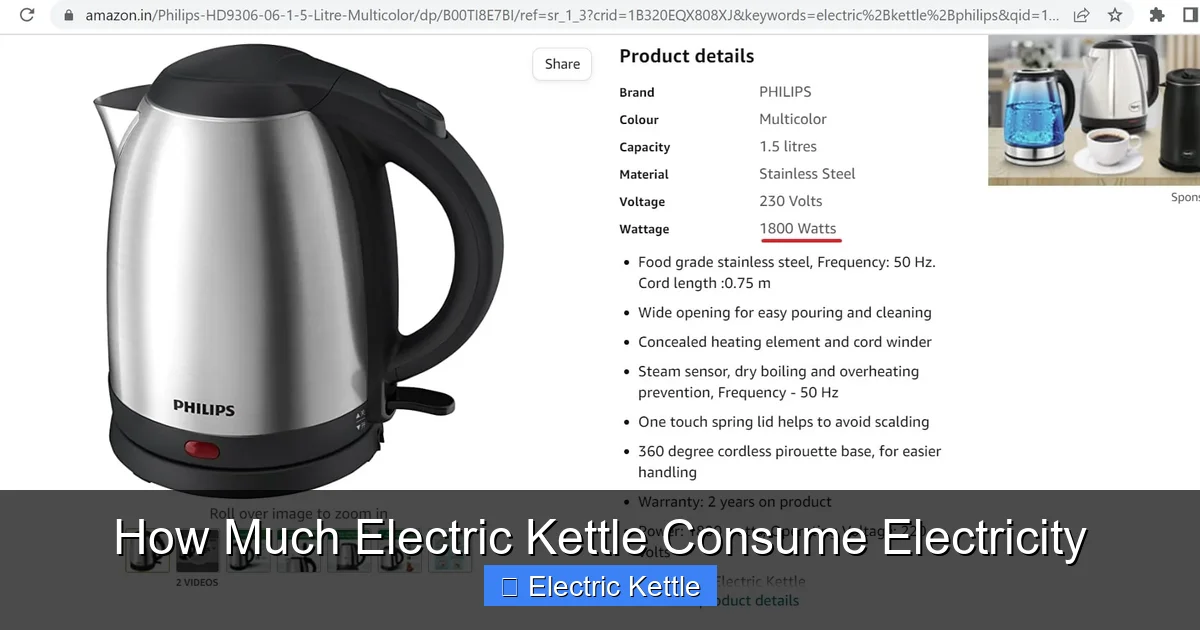
Visual guide about How Much Electric Kettle Consume Electricity
Image source: letsavelectricity.com
- 1,500–2,000W: Common in basic or compact models. These take a bit longer to boil but use less power per minute.
- 2,000–2,500W: The sweet spot for most homes—fast boiling with reasonable energy use.
- 2,500–3,000W: High-performance kettles, often found in offices or larger households. They boil water in under 3 minutes but draw more current.
For example, a 2,200W kettle is typical in many modern homes. It can boil 1 liter of water in about 3–4 minutes, depending on the starting temperature of the water and ambient conditions.
Why Wattage Matters
Wattage directly affects how quickly your kettle heats water. A 3,000W kettle will boil water faster than a 1,500W one, but it doesn’t necessarily use more total energy—it just delivers that energy more quickly. Think of it like a sprinter versus a jogger: the sprinter finishes the race faster, but both cover the same distance.
However, higher wattage kettles do draw more current, which can be a concern in homes with older wiring or limited circuit capacity. Most standard kitchen outlets in the U.S. can handle up to 1,800–2,400W safely, so a 3,000W kettle might require a dedicated circuit or careful use to avoid tripping breakers.
Voltage and Regional Differences
Electric kettles are designed for specific voltage systems. In the U.S., most run on 120 volts, while in Europe, the UK, and many other countries, they use 220–240 volts. This affects both wattage and performance. A 2,200W kettle in the UK will boil water faster than the same model in the U.S. because of the higher voltage.
Always check the voltage rating before using a kettle in a different country. Using a 120V kettle on a 240V outlet (or vice versa) can damage the appliance or pose a safety risk.
Calculating Electricity Consumption: kWh Explained
Now that we know about wattage, let’s talk about actual electricity use. Electricity consumption is measured in kilowatt-hours (kWh), which is what your utility company charges you for. One kWh equals using 1,000 watts of power for one hour.
How to Calculate Kettle Energy Use
To find out how much electricity your kettle uses per boil, use this simple formula:
Energy (kWh) = (Wattage × Time in hours) ÷ 1,000
Let’s say you have a 2,200W kettle and it takes 4 minutes (0.067 hours) to boil 1 liter of water:
(2,200 × 0.067) ÷ 1,000 = 0.147 kWh per boil
That means each time you boil a full kettle, you use about 0.15 kWh of electricity.
Real-World Examples
Here are a few practical examples based on common scenarios:
- Boiling 500ml (half full): Takes about 2 minutes. Energy use: (2,200 × 0.033) ÷ 1,000 = 0.073 kWh
- Boiling 1 liter (full): Takes 4 minutes. Energy use: 0.147 kWh
- Boiling 1.5 liters: Takes 6 minutes. Energy use: (2,200 × 0.1) ÷ 1,000 = 0.22 kWh
As you can see, boiling more water increases energy use, but not always proportionally—because the heating element is working harder and longer.
Cost Per Boil
To find out how much each boil costs, multiply the kWh used by your electricity rate. The average U.S. electricity rate is about $0.15 per kWh.
- 0.15 kWh × $0.15 = $0.0225 per boil (about 2.25 cents)
- If you boil water twice a day: 2 × $0.0225 = $0.045 per day
- Annual cost: $0.045 × 365 = $16.43 per year
That’s less than the cost of a single coffee from a café! Even heavy users (4–5 boils per day) will spend under $40 a year on kettle electricity.
Factors That Affect Electric Kettle Energy Use
Not all kettles—or boiling sessions—are created equal. Several factors influence how much electricity your kettle consumes.
1. Amount of Water
This is the biggest factor. Boiling a full kettle uses more energy than boiling just what you need. For example, if you only need one cup of water (250ml), but you fill the kettle to 1 liter, you’re using 4 times the energy for no reason.
Tip: Only boil the water you’ll use. Many kettles have minimum and maximum fill lines—stick to the minimum when making a single cup.
2. Starting Water Temperature
Cold water takes longer to heat than warm or room-temperature water. If you’re using water straight from the tap in winter, it might be as low as 10°C (50°F), whereas in summer it could be 20°C (68°F) or higher.
Example: Heating 1 liter from 10°C to 100°C requires more energy than heating it from 20°C to 100°C. The difference can add 30–60 seconds to boiling time and increase energy use by 10–15%.
3. Kettle Efficiency and Design
Not all kettles are equally efficient. Older models or poorly designed ones may lose heat through the body or have less effective heating elements. Look for kettles with:
- Insulated walls (keep heat in)
- Flat, sealed heating elements (better heat transfer)
- Automatic shut-off (prevents over-boiling)
- Thermal insulation or double-wall construction
Modern kettles with these features can be 10–20% more efficient than basic models.
4. Frequency of Use
The more you use your kettle, the more electricity it consumes overall. A household that boils water 5 times a day will use significantly more energy than one that uses it once.
But here’s the good news: because kettles are so fast, even frequent use doesn’t add up to a huge bill. Still, being mindful of unnecessary boils (like reboiling water that’s still hot) can help.
5. Descaling and Maintenance
Over time, mineral deposits (scale) build up inside the kettle, especially in hard water areas. This layer insulates the heating element, making it less efficient. The kettle has to work harder and longer to heat water, increasing energy use.
Tip: Descale your kettle every 1–3 months using vinegar or a commercial descaler. This keeps it running efficiently and extends its lifespan.
Electric Kettle vs. Other Water-Heating Methods
Many people wonder: is an electric kettle really more efficient than using a stovetop or microwave? Let’s compare.
Electric Kettle vs. Gas Stovetop
Gas stovetops are common, but they’re not the most efficient for boiling water. Much of the heat is lost to the surrounding air, and it takes longer to heat the pot and water.
Studies show that electric kettles are 20–50% more efficient than gas stovetops for boiling water. For example:
- Gas stovetop: ~40% efficiency (only 40% of the energy heats the water)
- Electric kettle: ~80–90% efficiency (most energy goes directly into the water)
So even though gas might be cheaper per unit of energy in some areas, the kettle’s efficiency often makes it the better choice.
Electric Kettle vs. Electric Stovetop
Electric coil or induction stovetops are better than gas but still lag behind kettles. An electric stovetop might take 6–8 minutes to boil 1 liter, while a kettle does it in 3–4 minutes.
Plus, kettles heat only the water, not a large pot, so there’s less wasted energy.
Electric Kettle vs. Microwave
Microwaves can heat water, but they’re not ideal. They heat unevenly, can cause superheating (water boils suddenly when disturbed), and are less efficient for large volumes.
For a single cup, a microwave might use about the same energy as a kettle. But for larger amounts, the kettle wins on speed and safety.
Verdict: Kettle Wins on Efficiency
For boiling water, the electric kettle is generally the most energy-efficient option. It’s fast, direct, and designed specifically for the task. Unless you’re heating a large pot of soup, the kettle is your best bet.
Tips to Reduce Electric Kettle Energy Consumption
Even though kettles are efficient, small changes in habit can save energy and money over time.
1. Boil Only What You Need
This is the #1 tip. If you’re making one cup of tea, don’t fill the kettle to the max. Use the minimum fill line or measure your cup and boil just that much.
Example: Boiling 250ml instead of 1 liter saves 75% of the energy per use.
2. Use Cold Water
Some people think using hot tap water saves time, but it’s actually less efficient. Hot water from the tap has already been heated by your water heater, which uses energy. It’s better to use cold water and let the kettle do the work.
Plus, hot tap water can contain more dissolved minerals and even lead in older pipes—so cold is safer too.
3. Descale Regularly
As mentioned earlier, limescale buildup reduces efficiency. Clean your kettle every few months to keep it running smoothly.
How to descale: Fill the kettle halfway with equal parts water and white vinegar. Boil, let sit for 30 minutes, then rinse thoroughly.
4. Choose the Right Kettle
Invest in a kettle with energy-saving features:
- Variable temperature settings: Lets you heat water to the right temp for tea, coffee, or baby formula—no need to boil unnecessarily.
- Insulated body: Keeps water hot longer, so you don’t need to reboil.
- Automatic shut-off: Prevents over-boiling and saves energy.
- Rapid boil technology: Heats water faster, reducing total energy use.
5. Avoid Reboiling
If you boil water and don’t use it all, don’t reboil the leftovers. Let it cool and reheat only what you need. Reboiling uses extra energy and can concentrate minerals in the water.
6. Unplug When Not in Use
Some kettles have LED displays or keep-warm functions that use a small amount of standby power. If you’re not using the kettle for a while, unplug it to save a tiny bit of energy.
Environmental Impact and Long-Term Savings
Using an electric kettle efficiently isn’t just good for your wallet—it’s good for the planet.
Carbon Footprint
Electricity generation produces greenhouse gases, depending on your local grid. By using less electricity, you reduce your carbon footprint.
For example, if you save 0.1 kWh per day by boiling only what you need, that’s 36.5 kWh saved per year. In the U.S., that’s roughly equivalent to 30–40 pounds of CO2 emissions avoided, depending on your energy source.
Long-Term Savings
Let’s say you switch from a gas stovetop to an electric kettle and save $0.02 per boil. If you boil water 3 times a day, that’s $0.06 saved daily, or $21.90 per year.
Over 5 years, that’s nearly $110 saved—plus the convenience and speed of the kettle.
Energy Star and Eco Labels
While there’s no official Energy Star label for kettles (as of 2024), some manufacturers highlight energy-efficient designs. Look for kettles with eco modes, low standby power, or sustainability certifications.
Conclusion: Smart Boiling for a Greener, Cheaper Kitchen
So, how much electricity does an electric kettle consume? The answer is: not much—especially when used wisely. A typical kettle uses about 0.1 to 0.2 kWh per boil, costing just a few cents. Over a year, even heavy users spend less than $20 on electricity for their kettle.
But the real savings come from smart habits: boiling only what you need, maintaining your kettle, and choosing an efficient model. Compared to stovetops and microwaves, electric kettles are clear winners in speed, efficiency, and convenience.
By understanding how your kettle uses electricity, you can make small changes that add up to real savings—both on your energy bill and your environmental impact. So go ahead, boil that water. Just do it wisely.
Frequently Asked Questions
How much electricity does a 1,500W electric kettle use?
A 1,500W kettle uses about 0.1 kWh to boil 1 liter of water in 4–5 minutes. At $0.15 per kWh, that’s roughly 1.5 cents per boil.
Is it cheaper to boil water in a kettle or on the stove?
Yes, electric kettles are generally cheaper and more efficient than stovetops. They use less energy and boil water faster, saving time and money.
Does leaving the kettle plugged in use electricity?
Most kettles use no power when off, but models with displays or keep-warm functions may use a small amount of standby electricity. Unplugging saves a tiny bit of energy.
How often should I descale my electric kettle?
Descale every 1–3 months, depending on water hardness. In areas with hard water, monthly descaling helps maintain efficiency and taste.
Can I boil water in a microwave instead of a kettle?
Yes, but it’s less efficient for large amounts and can be unsafe due to superheating. Kettles are faster, safer, and more energy-efficient for boiling water.
Do higher wattage kettles use more electricity?
Higher wattage kettles boil water faster but don’t necessarily use more total energy. They deliver power more quickly, which can actually reduce overall consumption if used correctly.