Understanding how much electricity a kettle uses per hour helps you manage energy consumption and lower utility bills. Most electric kettles consume between 1,200 and 3,000 watts, boiling water in just a few minutes—making them surprisingly efficient for quick tasks.
If you’ve ever stood in your kitchen waiting for the kettle to boil, wondering if it’s secretly running up your electricity bill, you’re not alone. Electric kettles are a staple in homes around the world—especially for tea lovers, coffee enthusiasts, and anyone who needs hot water fast. But how much electricity does a kettle actually use per hour? And is it really worth switching to a stovetop pot or microwave to save energy?
The short answer? Electric kettles are surprisingly efficient. While they do consume a fair amount of power—often more than your toaster or coffee maker—they complete their job in just a few minutes. That means even though the wattage is high, the total energy used per hour is relatively low, especially when compared to other kitchen appliances. In this guide, we’ll break down exactly how much electricity a kettle uses, what factors influence that number, and how you can use your kettle more efficiently to save energy and money.
Whether you’re trying to reduce your carbon footprint, cut down on utility costs, or simply curious about your appliance’s energy habits, this article will give you the facts you need. We’ll explore real-world examples, compare kettles to other heating methods, and share practical tips to make every boil count. So grab a cup of tea (once your kettle finishes, of course), and let’s dive in.
Key Takeaways
- Typical power range: Electric kettles use 1,200 to 3,000 watts, with most household models averaging around 1,500–2,500 watts.
- Short usage time = low hourly cost: Despite high wattage, kettles run for only 2–5 minutes, so actual energy use per hour is minimal unless used repeatedly.
- Energy efficiency matters: Modern kettles with automatic shut-off and insulated designs use less electricity over time.
- Boiling only what you need: Filling the kettle beyond necessary increases energy waste—measure water to match your needs.
- Cost per boil is low: On average, boiling a full kettle costs less than $0.05, depending on local electricity rates.
- Compare with alternatives: Kettles are often more efficient than stovetop pots or microwaves for heating water.
- Maintenance improves efficiency: Descaling regularly prevents limescale buildup, which can reduce heating efficiency and increase electricity use.
📑 Table of Contents
Understanding Kettle Power Consumption
When it comes to electricity use, the first thing to know is that electric kettles are high-wattage appliances. Most standard models range from 1,200 to 3,000 watts, with the majority falling between 1,500 and 2,500 watts. To put that in perspective, a typical incandescent light bulb uses about 60 watts, and a laptop might use 50–100 watts. So yes, your kettle is a power-hungry device—but only for a short burst.
The reason kettles need so much power is simple: they must heat water from room temperature (around 20°C or 68°F) to boiling (100°C or 212°F) in just a few minutes. Water has a high specific heat capacity, meaning it takes a lot of energy to raise its temperature. A kettle’s heating element—usually a coiled metal rod at the base—must deliver that energy quickly and efficiently.
But here’s the key: kettles don’t run for an hour. In fact, most boil a full liter of water in 2 to 4 minutes. That means even though the wattage is high, the total energy consumed per use is relatively small. Electricity is measured in kilowatt-hours (kWh), which is the amount of energy used by a 1,000-watt device running for one hour. So a 2,000-watt kettle running for 3 minutes uses:
(2,000 watts ÷ 1,000) × (3 ÷ 60) = 0.1 kWh
That’s just one-tenth of a kilowatt-hour per boil. If you boil the kettle five times a day, that’s 0.5 kWh per day. Over a month, that’s about 15 kWh. Depending on your electricity rate—say, $0.12 per kWh—that’s less than $2 per month. Not bad for daily convenience.
How Wattage Affects Energy Use
Not all kettles are created equal. Higher-wattage models heat water faster but may use slightly more energy per boil. For example, a 3,000-watt kettle might boil water in 90 seconds, while a 1,200-watt model could take over 5 minutes. At first glance, the faster kettle seems better—but is it more efficient?
In most cases, yes—but only if you’re boiling a full kettle. The faster heating time reduces heat loss to the surrounding air, meaning more energy goes into the water, not the room. However, if you’re only boiling a cup of water, the high-wattage kettle might still use nearly the same amount of energy as a lower-wattage one, because it can’t scale down its power output. Most kettles run at full power until the water boils, then shut off automatically.
So, while a higher-wattage kettle can be more efficient for full boils, it’s not necessarily better for small amounts. That’s why choosing the right kettle for your habits matters. If you often boil just one or two cups, look for a model with variable temperature settings or a smaller capacity (like 0.5 to 1 liter).
Real-World Examples of Kettle Energy Use
Let’s look at a few real-world scenarios to understand how much electricity a kettle uses per hour in practice.
Example 1: Morning Routine
You boil the kettle twice—once for coffee and once for tea. Each boil uses 0.1 kWh (based on a 2,000-watt kettle running for 3 minutes). Total: 0.2 kWh.
Example 2: Family of Four
Each person boils the kettle once in the morning and once in the evening. That’s 8 boils per day. At 0.1 kWh each, that’s 0.8 kWh daily.
Example 3: Office Break Room
The kettle is used 20 times a day by employees. At 0.1 kWh per boil, that’s 2 kWh per day—still less than what a desktop computer uses in 8 hours.
Now, if you left the kettle running continuously for an hour (which no one does), a 2,000-watt model would use 2 kWh. But since kettles shut off automatically after boiling, that scenario is unrealistic. The actual hourly usage depends entirely on how often you use it.
Factors That Influence Electricity Use
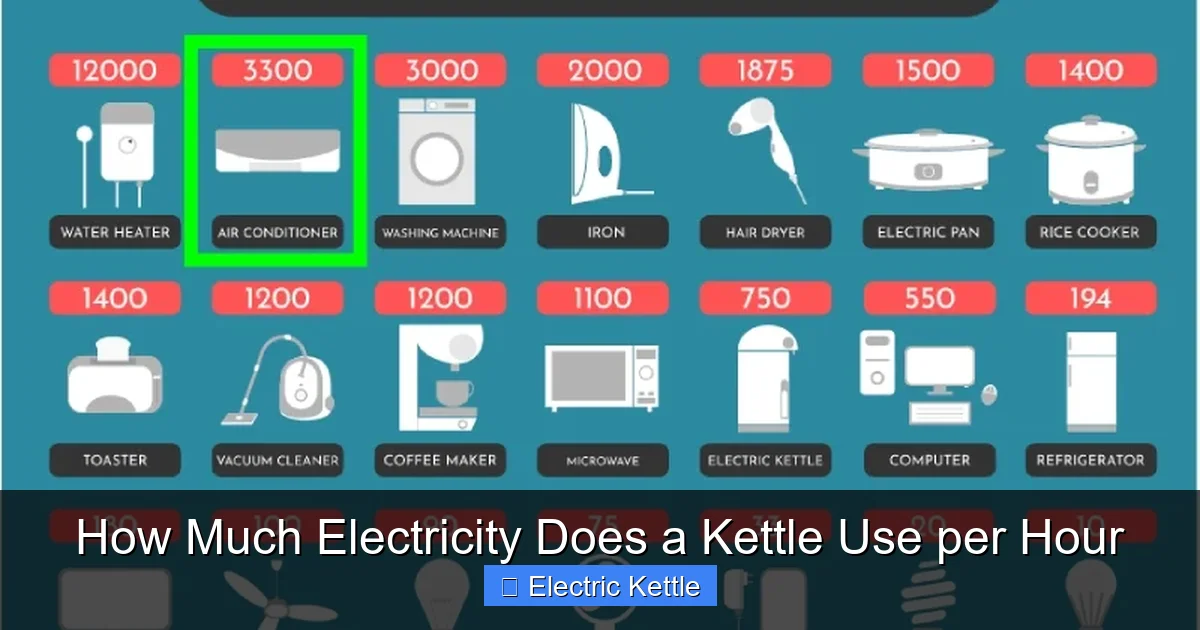
Visual guide about How Much Electricity Does a Kettle Use per Hour
Image source: learnmetrics.com
While wattage and usage time are the biggest factors, several other elements can affect how much electricity your kettle consumes.
Water Volume and Starting Temperature
The amount of water you boil has a direct impact on energy use. Heating 1 liter of water requires more energy than heating 0.5 liters. Similarly, starting with cold tap water (around 10–15°C in winter) takes more energy than using water that’s already warm from the tap.
For example, boiling 1 liter of cold water might take 3 minutes and 0.1 kWh, while boiling 0.5 liters of the same water could take 1.5 minutes and 0.05 kWh. That’s a 50% reduction in energy use—just by boiling less water.
This is why experts recommend only filling the kettle with the amount of water you actually need. Many kettles have minimum and maximum fill lines, but few people pay attention to them. Overfilling is a common habit that leads to unnecessary energy waste.
Kettle Design and Insulation
Not all kettles are built the same. Some modern models come with insulated walls or double-wall construction, which help retain heat and reduce energy loss. These kettles may use slightly more electricity upfront but can keep water hot longer, reducing the need to reboil.
Additionally, kettles with flat, sealed heating elements (as opposed to exposed coils) tend to be more efficient. They transfer heat more evenly and are easier to clean, which prevents limescale buildup—a major efficiency killer.
Limescale and Maintenance
If you live in an area with hard water, limescale can accumulate on the heating element over time. This mineral deposit acts as an insulator, forcing the kettle to work harder and longer to heat the water. In severe cases, limescale can increase energy use by 10–20%.
Regular descaling—using vinegar or a commercial descaling solution—can restore efficiency and extend the life of your kettle. Most manufacturers recommend descaling every 1–3 months, depending on water hardness.
Frequency of Use
How often you use your kettle plays a big role in total electricity consumption. A household that boils the kettle 10 times a day will use significantly more energy than one that uses it twice. While each individual boil is cheap, the cumulative effect adds up over time.
For heavy users, investing in an energy-efficient kettle or adopting habits like batch-boiling (heating extra water for multiple uses) can help reduce overall consumption.
Comparing Kettles to Other Water-Heating Methods
Many people wonder if using a stovetop pot or microwave is more energy-efficient than an electric kettle. The answer depends on several factors, but in most cases, the electric kettle comes out on top.
Electric Kettle vs. Stovetop Pot
Stovetop kettles or saucepans heat water using gas or electric burners. Gas stoves are generally more efficient than electric stovetops, but even then, they lose more heat to the surrounding air. Electric stovetops are particularly inefficient—only about 70% of the heat reaches the pot, compared to 90% or more in an electric kettle.
A study by the Energy Saving Trust found that electric kettles use about 25% less energy than electric stovetops to boil the same amount of water. Gas stoves were slightly more efficient than electric stovetops but still less efficient than modern electric kettles, especially when considering heat loss and longer boiling times.
Electric Kettle vs. Microwave
Microwaves are often seen as energy-efficient, but when it comes to heating water, they’re not always the best choice. Microwaves heat water unevenly and can cause superheating—where water becomes hotter than boiling point without bubbling, leading to sudden eruptions when disturbed.
In terms of energy, microwaves use about 1,000–1,500 watts, similar to kettles. However, they take longer to heat the same amount of water. For example, heating a cup of water in a microwave might take 2–3 minutes, compared to 1–2 minutes in a kettle. Plus, microwaves are less efficient at transferring energy to water due to uneven heating patterns.
Overall, electric kettles are faster, safer, and more energy-efficient for boiling water—especially for larger quantities.
How to Reduce Your Kettle’s Electricity Use
Even though kettles are already efficient, there are several ways to minimize their electricity consumption and save even more.
Boil Only What You Need
This is the single most effective tip. Instead of filling the kettle to the max every time, measure the water you actually need. Use a measuring cup or rely on the kettle’s built-in markings. If you’re making one cup of tea, don’t boil enough for four.
Over time, this simple habit can save significant energy. For example, if you reduce your average boil from 1 liter to 0.5 liters, you cut your energy use in half—without sacrificing convenience.
Choose the Right Kettle
When shopping for a new kettle, look for models with:
– High efficiency ratings
– Automatic shut-off
– Variable temperature settings (for different types of tea or coffee)
– Insulated walls
– Flat, concealed heating elements
Brands like Breville, Russell Hobbs, and Bosch often offer energy-efficient models with smart features. While they may cost more upfront, the long-term savings on electricity can make them worthwhile.
Maintain Your Kettle
Regular cleaning and descaling keep your kettle running efficiently. Follow the manufacturer’s instructions for descaling frequency and method. In hard water areas, consider using filtered water to reduce mineral buildup.
Also, wipe down the exterior and base to ensure good contact with the power source. A dirty or corroded base can reduce electrical efficiency.
Use a Kettle with a Keep-Warm Function
Some advanced kettles have a keep-warm feature that maintains water temperature for 30 minutes to an hour after boiling. While this uses a small amount of additional electricity, it can prevent the need to reboil water multiple times—saving energy in the long run.
Just be mindful not to leave it on for too long, as continuous heating will increase electricity use.
Unplug When Not in Use
Although most kettles don’t draw power when off, some models with digital displays or timers may have a small standby draw. Unplugging the kettle when not in use eliminates this phantom load.
Alternatively, use a smart plug to cut power completely and even schedule boiling times.
Cost of Running an Electric Kettle
Now that we know how much energy kettles use, let’s talk money. How much does it actually cost to boil a kettle?
The average electricity rate in the U.S. is about $0.12 per kWh. Using our earlier example—a 2,000-watt kettle boiling for 3 minutes (0.1 kWh)—the cost per boil is:
0.1 kWh × $0.12 = $0.012
That’s just over one cent per boil. Even if you boil the kettle 10 times a day, that’s only $0.12 per day, or about $3.60 per month. Over a year, that’s less than $45.
Compare that to other appliances:
– A 1,500-watt space heater running for 3 hours: $0.54 per day
– A 100-watt incandescent bulb running for 5 hours: $0.06 per day
– A 300-watt gaming PC running for 4 hours: $0.14 per day
Your kettle is still one of the most cost-effective appliances in your home—especially considering how much use it gets.
Regional Variations in Cost
Electricity rates vary widely by location. In states like Louisiana or Washington, rates can be as low as $0.09 per kWh. In places like California or Hawaii, they can exceed $0.25 per kWh.
In high-cost areas, the same 0.1 kWh boil could cost $0.025—still less than three cents. Even with frequent use, the impact on your bill remains minimal.
Environmental Impact of Kettle Use
Beyond cost, it’s worth considering the environmental footprint of your kettle use. Electricity generation often relies on fossil fuels, so every kWh used contributes to carbon emissions.
However, because kettles use so little energy per boil, their environmental impact is relatively small. For example, 0.1 kWh of electricity might produce about 0.05 kg of CO₂, depending on your local grid.
To put that in perspective, driving a car for one mile emits about 0.4 kg of CO₂. So boiling the kettle 8 times is roughly equivalent to driving 1 mile in terms of emissions.
Still, small changes add up. By boiling only what you need and maintaining your kettle, you can reduce your carbon footprint without sacrificing comfort.
Conclusion
So, how much electricity does a kettle use per hour? The answer isn’t a single number—it depends on wattage, usage frequency, water volume, and efficiency. But on average, a typical electric kettle uses between 1,200 and 3,000 watts and runs for just 2–5 minutes per boil, consuming about 0.05 to 0.15 kWh per use.
While the hourly usage can add up if you’re constantly reboiling, the actual cost and environmental impact remain low. In fact, electric kettles are among the most efficient ways to heat water—outperforming stovetops and microwaves in speed, safety, and energy use.
The key to minimizing electricity consumption lies in smart habits: boil only what you need, maintain your kettle, and choose an energy-efficient model. With these tips, you can enjoy your daily cup of tea or coffee without worrying about your energy bill.
In a world where energy efficiency matters more than ever, the humble electric kettle proves that convenience and sustainability can go hand in hand. So go ahead—boil that water. Just do it wisely.
Frequently Asked Questions
How much electricity does a kettle use per hour if left on?
Electric kettles are designed to shut off automatically once the water reaches boiling point, so they don’t run continuously. If somehow left on (e.g., malfunctioning), a 2,000-watt kettle would use 2 kWh per hour—but this is highly unlikely and unsafe.
Is it cheaper to boil a kettle or use a microwave?
Generally, electric kettles are cheaper and faster for boiling water. Microwaves take longer and heat water less efficiently, especially for larger amounts, making kettles the more energy-efficient choice.
Does a higher-wattage kettle use more electricity?
Higher-wattage kettles use more power per second but boil water faster, which can reduce overall energy loss. For full boils, they’re often more efficient; for small amounts, the difference is minimal.
How can I calculate my kettle’s electricity cost?
Multiply the kettle’s wattage by the boiling time in hours, divide by 1,000 to get kWh, then multiply by your electricity rate. For example: (2,000W × 0.05 hours) ÷ 1,000 × $0.12 = $0.012 per boil.
Should I unplug my kettle when not in use?
Yes, unplugging eliminates any standby power draw, especially in models with digital displays. It’s a small step that can save energy over time.
Does descaling really save electricity?
Absolutely. Limescale buildup insulates the heating element, forcing the kettle to work harder. Regular descaling restores efficiency and can reduce energy use by up to 20%.