Boiling a kettle uses about 0.1 kWh of electricity per minute, costing roughly 2–3 cents per boil. Understanding your kettle’s wattage and usage habits helps reduce energy waste and lower your utility bills.
Key Takeaways
- Typical energy use: Most electric kettles consume between 1,500 and 3,000 watts, using about 0.1 kWh to boil 1 liter of water.
- Cost per boil: Boiling a full kettle once costs around 2–3 cents, depending on your electricity rate and kettle efficiency.
- Faster boiling = higher wattage: Higher-wattage kettles boil water quicker but may use more energy if overfilled.
- Only boil what you need: Heating excess water wastes electricity—measure your cup or pot before filling.
- Regular maintenance matters: Limescale buildup reduces efficiency, increasing energy use over time.
- Smart habits save money: Unplugging, using lids, and choosing energy-efficient models cut long-term costs.
- Environmental impact: Reducing unnecessary boiling lowers your carbon footprint and supports sustainable living.
📑 Table of Contents
- How Much Electricity Does It Take to Boil a Kettle?
- Understanding Kettle Wattage and Energy Consumption
- Factors That Affect Electricity Use When Boiling Water
- How Much Does It Cost to Boil a Kettle?
- Energy-Saving Tips for Boiling Water
- The Environmental Impact of Boiling Water
- Common Myths About Kettle Energy Use
- Conclusion: Smart Boiling for a Sustainable Future
How Much Electricity Does It Take to Boil a Kettle?
We’ve all done it—walked into the kitchen, flicked the switch, and waited for that familiar whistle. But have you ever stopped to wonder: how much electricity does it actually take to boil a kettle? It’s a simple question with surprisingly practical answers. Whether you’re making tea, instant coffee, or preparing pasta, understanding the energy behind boiling water can help you save money, reduce waste, and make smarter choices at home.
Electric kettles are one of the most common kitchen appliances worldwide. They’re fast, convenient, and reliable. But like any electrical device, they consume power—and that power comes at a cost. The amount of electricity needed to boil a kettle depends on several factors: the kettle’s wattage, the volume of water, the starting temperature of the water, and even the altitude where you live. In this guide, we’ll break down everything you need to know about how much electricity to boil a kettle, how to calculate your own usage, and how to minimize energy waste without sacrificing convenience.
Understanding Kettle Wattage and Energy Consumption
At the heart of the question “how much electricity to boil a kettle” is the concept of wattage. Wattage refers to the rate at which an appliance uses electrical power. Most electric kettles range from 1,500 to 3,000 watts (W), with the average household model sitting around 2,200 W. The higher the wattage, the faster the kettle can heat water—but that doesn’t always mean it’s more efficient.
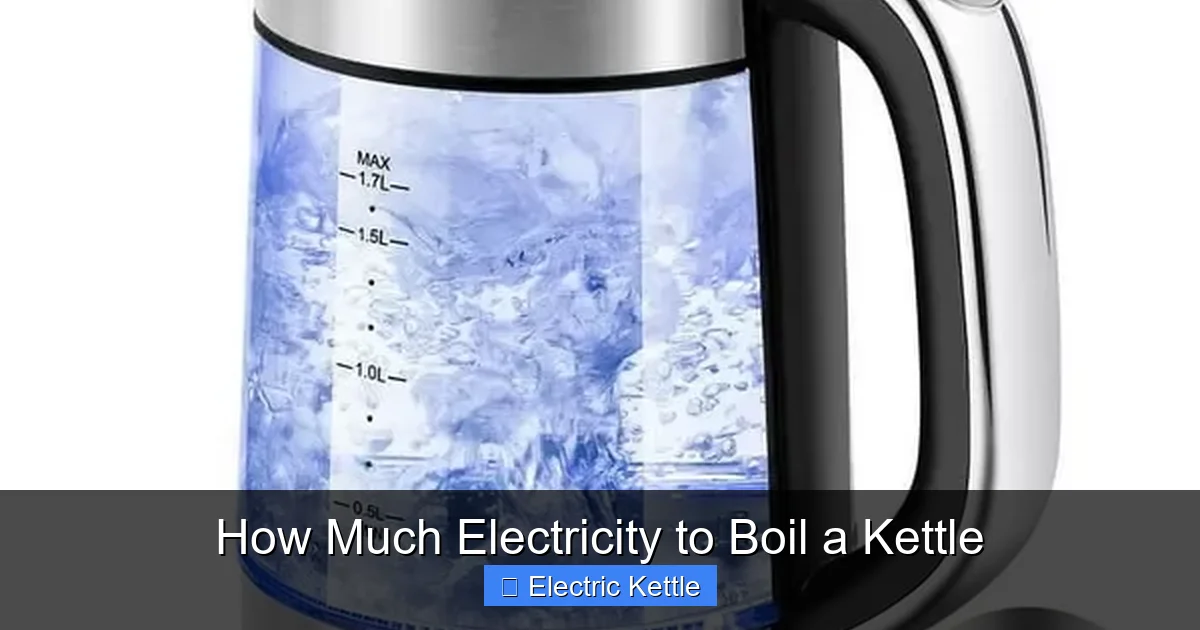
Visual guide about How Much Electricity to Boil a Kettle
Image source: irrorwxhiqijjr5q.ldycdn.com
What Is a Kilowatt-Hour (kWh)?
Electricity usage is measured in kilowatt-hours (kWh), which represents the amount of energy used by a 1,000-watt device running for one hour. For example, a 2,000-watt kettle running for 3 minutes (0.05 hours) uses 0.1 kWh of electricity. This is the standard unit your utility company uses to bill you, so understanding kWh helps you estimate real costs.
Calculating Energy Use Per Boil
Let’s do a quick calculation. Suppose you have a 2,200-watt kettle and you boil 1 liter of water. Assuming the water starts at room temperature (about 20°C or 68°F) and needs to reach 100°C (212°F), it takes roughly 3–4 minutes to boil. Here’s the math:
- 2,200 watts = 2.2 kilowatts
- Boiling time: 3.5 minutes = 0.058 hours
- Energy used = 2.2 kW × 0.058 h ≈ 0.128 kWh
So, boiling one liter of water uses about 0.13 kWh. If your electricity rate is $0.15 per kWh, that’s just under 2 cents per boil. Not much, right? But multiply that by multiple boils a day, and the numbers start to add up.
Does Kettle Size Matter?
Yes—kettle capacity plays a big role. A small 0.5-liter kettle will use less energy than a 1.7-liter model, but only if you’re boiling less water. The real issue arises when people overfill their kettles. Boiling a full kettle to make one cup of tea is like driving a truck to carry a single apple—it’s overkill. Always match the water volume to your actual need.
Factors That Affect Electricity Use When Boiling Water
While wattage and volume are the biggest factors, several other variables influence how much electricity to boil a kettle. Understanding these can help you optimize your usage and avoid unnecessary energy waste.
Starting Water Temperature
Cold tap water takes longer to heat than water that’s already warm. In winter, when groundwater is colder, your kettle will work harder and use more electricity. Conversely, in summer or if you use water from a warm tap, boiling time—and energy use—decreases slightly.
Altitude and Boiling Point
Water boils at lower temperatures at higher altitudes. For example, at 5,000 feet above sea level, water boils at about 95°C (203°F) instead of 100°C. This means your kettle may reach boiling point faster, using slightly less energy. However, this effect is minor for most home users and doesn’t significantly change overall consumption.
Limescale Buildup
Hard water areas are prone to limescale, a chalky deposit that builds up inside kettles. This layer acts as insulation, reducing heat transfer efficiency. As a result, your kettle takes longer to boil water and uses more electricity. Regular descaling—using vinegar or a commercial cleaner—can restore efficiency and save energy over time.
Kettle Design and Insulation
Modern kettles often feature better insulation, faster heating elements, and automatic shut-off features. These improvements reduce heat loss and prevent over-boiling, which saves electricity. Older or poorly designed kettles may lose heat more quickly, requiring more energy to maintain temperature.
Leaving the Kettle On
Some people leave their kettles plugged in and ready to go. While convenient, this can lead to “phantom load” if the kettle has a digital display or standby mode. Even a small amount of standby power adds up over time. Unplugging your kettle when not in use eliminates this waste.
How Much Does It Cost to Boil a Kettle?
Now for the practical part: how much does it actually cost to boil a kettle? Let’s break it down with real-world numbers.
Average Cost Per Boil
Using the earlier example—0.13 kWh per boil and an electricity rate of $0.15 per kWh—the cost is:
- 0.13 kWh × $0.15 = $0.0195, or about 2 cents per boil.
If you boil a full kettle once a day, that’s roughly $7.30 per year. If you boil it three times a day, it jumps to over $20 annually. While these numbers seem small, they’re part of a larger pattern of energy use in the home.
Comparing Kettle Types
Not all kettles are created equal. Here’s a quick comparison of common types:
- Standard electric kettle (2,200 W): Boils 1L in 3–4 minutes, uses ~0.13 kWh.
- High-wattage kettle (3,000 W): Boils 1L in 2–3 minutes, uses ~0.1 kWh—slightly more efficient due to speed.
- Low-wattage kettle (1,500 W): Boils 1L in 5–6 minutes, uses ~0.15 kWh—slower and less efficient if overfilled.
- Stovetop kettle: Uses gas or electric stove, typically less efficient than electric kettles due to heat loss.
Electric kettles are generally more energy-efficient than stovetop methods because they transfer heat directly to the water with minimal loss.
Regional Electricity Rates
Your location affects cost. In the U.S., the average residential electricity rate is around $0.15 per kWh, but it varies widely. In California, it can be over $0.25, while in states like Louisiana, it’s closer to $0.10. In the UK, rates are often higher—around £0.30 per kWh (about $0.38)—making each boil cost nearly 4 cents. Always check your local utility rate for accurate estimates.
Energy-Saving Tips for Boiling Water
Now that you know how much electricity to boil a kettle, let’s talk about how to reduce that usage. Small changes in habit can lead to meaningful savings over time—both for your wallet and the planet.
Only Boil What You Need
This is the #1 rule. Instead of filling the kettle to the max for one cup, measure the water you actually need. Use a measuring cup or rely on the kettle’s internal markers. Boiling excess water wastes energy and increases your carbon footprint. A study by the Energy Saving Trust found that overfilling kettles costs UK households millions in unnecessary energy bills each year.
Use the Right Kettle for the Job
If you frequently make just one or two cups, consider a smaller kettle (0.5–1L). Larger kettles are great for families or entertaining, but they’re inefficient for small tasks. Some modern kettles even have variable temperature settings, allowing you to heat water to lower temperatures for green tea or baby formula—saving energy by not overheating.
Descale Regularly
Limescale isn’t just unsightly—it’s inefficient. Aim to descale your kettle every 1–3 months, depending on water hardness. Use a mixture of equal parts water and white vinegar, let it sit for an hour, then rinse thoroughly. This simple maintenance task can improve heating efficiency by up to 25%.
Unplug When Not in Use
Even when off, some kettles draw a small amount of standby power. Unplugging eliminates this “vampire load.” If unplugging is inconvenient, use a power strip with an on/off switch to cut power completely.
Choose an Energy-Efficient Model
When it’s time to replace your kettle, look for energy-efficient features: rapid boil, insulated walls, automatic shut-off, and precise temperature control. While these models may cost more upfront, they save money and energy in the long run.
Consider Alternative Methods
For small amounts of water, a microwave can be more efficient than a kettle. Heating 250ml in a microwave uses about 0.05 kWh—less than half the energy of boiling a full kettle. However, microwaves aren’t ideal for larger volumes or for achieving a rolling boil.
The Environmental Impact of Boiling Water
Beyond cost, there’s an environmental angle to consider. Every kilowatt-hour of electricity generated contributes to carbon emissions, especially if your grid relies on fossil fuels. In the U.S., the average kWh produces about 0.85 pounds of CO₂. That means each kettle boil emits roughly 0.11 pounds of CO₂.
Reducing Your Carbon Footprint
By boiling only what you need, you can significantly reduce your household’s emissions. If a family of four cuts their daily kettle use by one unnecessary boil, they save over 40 kWh and 35 pounds of CO₂ per year. Multiply that across millions of households, and the impact is substantial.
Renewable Energy and Smart Grids
If your home uses solar panels or you’re on a green energy tariff, your kettle’s environmental impact drops dramatically. Some smart kettles even sync with home energy systems to boil water during off-peak hours when renewable energy is more abundant.
Common Myths About Kettle Energy Use
There’s a lot of misinformation out there. Let’s clear up some common myths about how much electricity to boil a kettle.
Myth 1: “It’s cheaper to boil water on the stove.”
Not necessarily. Gas stoves can be efficient, but electric stovetops often lose more heat to the air. Electric kettles are designed to transfer heat directly to water, making them generally more efficient—especially for small to medium volumes.
Myth 2: “Boiling water multiple times uses more energy.”
Reboiling water does use extra energy, but the amount is small. If you boil the same water twice, you’re only reheating it from near-boiling, so the extra cost is minimal—less than a cent. The bigger waste comes from boiling more water than needed in the first place.
Myth 3: “All kettles use the same amount of electricity.”
False. Wattage, design, age, and maintenance all affect energy use. A well-maintained 2,500W kettle will be far more efficient than a decade-old 1,800W model covered in limescale.
Myth 4: “You should always fill the kettle to the max for efficiency.”
The opposite is true. Filling beyond your need wastes energy. Efficiency comes from matching input to output—boil only what you’ll use.
Conclusion: Smart Boiling for a Sustainable Future
So, how much electricity to boil a kettle? On average, about 0.1–0.15 kWh per liter, costing just a few cents per use. While individual boils seem insignificant, cumulative habits shape our energy footprint. By understanding your kettle’s power consumption, adopting energy-saving practices, and maintaining your appliance, you can enjoy your daily cup of tea without guilt—or unnecessary expense.
The key is mindfulness. Small actions—like measuring water, descaling regularly, and choosing efficient appliances—add up. In a world where energy demand is rising and climate concerns are urgent, every watt counts. Whether you’re brewing coffee, making soup, or sterilizing baby bottles, boiling water wisely is a simple yet powerful step toward a more sustainable lifestyle.
Frequently Asked Questions
How much electricity does it take to boil a kettle once?
Boiling a standard 1-liter kettle uses about 0.1 to 0.15 kWh of electricity, depending on wattage and starting water temperature. This typically costs 2–3 cents per boil.
Is it cheaper to boil water in a kettle or on the stove?
Electric kettles are generally more energy-efficient than stovetops because they transfer heat directly to water with minimal loss. For small to medium amounts, kettles usually use less electricity.
Does boiling a full kettle use more electricity than a half-full one?
Yes. Boiling a full kettle uses more energy because it heats more water. Always boil only the amount you need to save electricity and reduce waste.
How can I reduce the electricity my kettle uses?
Only boil what you need, descale regularly, unplug when not in use, and choose an energy-efficient model with rapid boil and insulation features.
Does limescale increase electricity use?
Yes. Limescale acts as insulation, reducing heat transfer efficiency. This makes the kettle work harder and use more electricity. Regular descaling improves performance.
Can I use a microwave instead of a kettle to save energy?
For small amounts (like one cup), a microwave can be more efficient. However, for larger volumes or a rolling boil, an electric kettle is usually faster and more effective.