Electric kettles are among the most energy-efficient appliances for boiling water, often using less electricity than stovetops or microwaves. While they do consume power, their speed and precision make them a smart choice for saving both time and energy when used wisely.
Key Takeaways
- Electric kettles are highly efficient: They convert up to 80% of energy into heat, minimizing waste compared to gas or induction stoves.
- Power rating affects consumption: Most kettles use 1500–3000 watts, but they boil water quickly, reducing overall energy use.
- Boiling only what you need saves electricity: Overfilling leads to wasted energy—measure water to match your needs.
- Regular descaling improves efficiency: Mineral buildup forces the kettle to work harder, increasing electricity use over time.
- They’re faster than alternatives: Electric kettles boil water in 3–5 minutes, using less energy than stovetops or microwaves for the same task.
- Smart features can reduce waste: Kettles with temperature control and auto-shutoff prevent over-boiling and save power.
- Long-term savings outweigh initial cost: Despite higher wattage, their efficiency leads to lower electricity bills over time.
📑 Table of Contents
- Is Electric Kettle Consume More Electricity? The Real Answer
- How Much Electricity Does an Electric Kettle Actually Use?
- Factors That Affect How Much Electricity an Electric Kettle Uses
- Electric Kettle vs. Other Appliances: A Fair Comparison
- Tips to Reduce Electricity Consumption When Using an Electric Kettle
- Myths and Misconceptions About Electric Kettle Electricity Use
- Conclusion: Are Electric Kettles Energy Hogs or Saviors?
Is Electric Kettle Consume More Electricity? The Real Answer
If you’ve ever stood in your kitchen watching your electric kettle heat up, you might have wondered: *Is electric kettle consume more electricity than other methods?* It’s a fair question. After all, these sleek appliances plug directly into the wall and often have high wattage ratings—sometimes over 3,000 watts. That number can look intimidating on your energy bill. But here’s the truth: despite their power, electric kettles are actually some of the most energy-efficient tools for boiling water.
Many people assume that because an electric kettle uses a lot of power, it must be a major electricity guzzler. But power and energy consumption aren’t the same thing. Power (measured in watts) is the rate at which energy is used, while energy consumption (measured in kilowatt-hours, or kWh) depends on both power and how long the device runs. Electric kettles use high power for a very short time—usually just 3 to 5 minutes—to boil water. In contrast, stovetops or microwaves may take longer and lose more heat to the surrounding air, making them less efficient overall.
Think of it like sprinting versus jogging. A sprinter uses a lot of energy in a short burst, while a jogger uses less energy per minute but over a longer period. The total energy used might be similar, but the sprinter finishes faster and with less wasted effort. That’s exactly how electric kettles work. They deliver rapid, focused heat directly to the water, minimizing losses and getting the job done quickly.
How Much Electricity Does an Electric Kettle Actually Use?
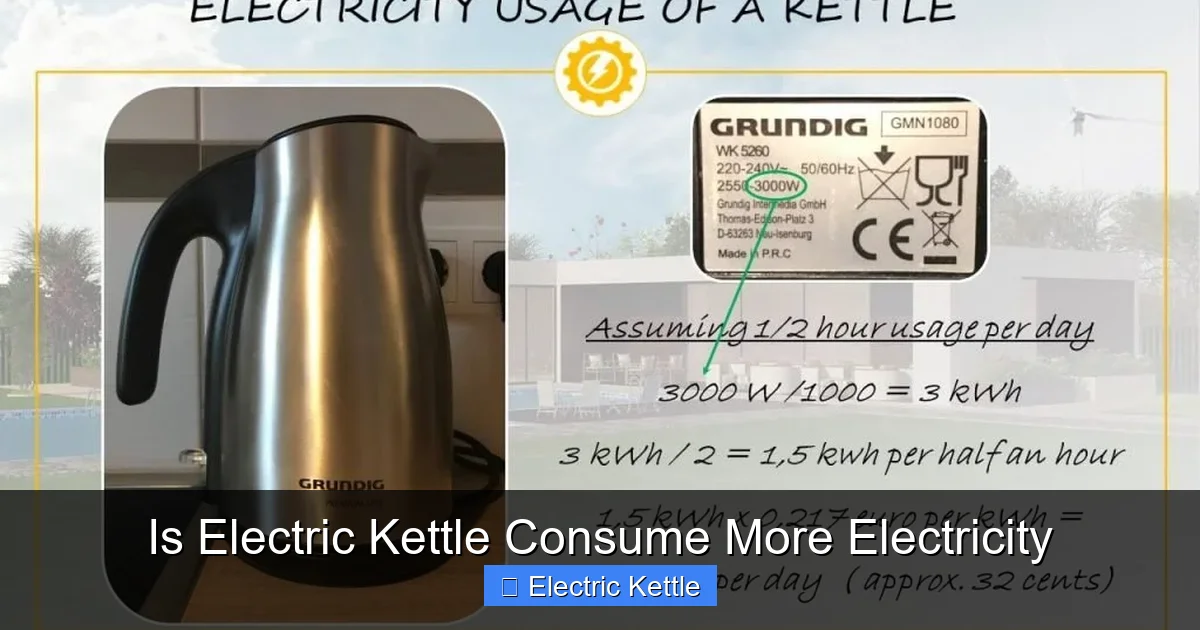
Visual guide about Is Electric Kettle Consume More Electricity
Image source: effiworkx.com
To understand whether an electric kettle consumes more electricity, we need to break down the numbers. Most household electric kettles have a power rating between 1,500 and 3,000 watts. Let’s take a typical 1,500-watt kettle as an example. If you run it for 4 minutes (which is about average for boiling 1 liter of water), here’s how the math works:
– 1,500 watts = 1.5 kilowatts
– 4 minutes = 4/60 = 0.067 hours
– Energy used = 1.5 kW × 0.067 h = 0.10 kWh
So, boiling water once uses about 0.10 kilowatt-hours of electricity. Now, let’s put that into real-world terms. If your electricity costs $0.12 per kWh (the U.S. average), then each boil costs roughly:
– 0.10 kWh × $0.12 = $0.012
That’s just over one cent per use. Even if you boil water five times a day, that’s only about $0.06 per day or around $22 per year. Compare that to other appliances, and the electric kettle looks very economical.
Now, let’s compare this to other common methods:
Stovetop Kettle (Gas or Electric)
A gas stovetop might take 6–8 minutes to boil the same amount of water. Gas is cheaper per unit than electricity in many areas, but stovetops are less efficient because heat escapes around the pot. Only about 40–50% of the energy actually heats the water. Electric stovetops are slightly better at 70–75% efficiency, but they still take longer and lose heat to the air.
Microwave
Microwaves use around 1,000–1,500 watts and take 3–5 minutes to boil water. However, they heat water unevenly and are less efficient for this specific task. Studies show microwaves are only about 50–60% efficient when boiling water because energy is absorbed by the container and some is reflected or lost.
Electric Kettle Efficiency
Electric kettles, on the other hand, are designed specifically for boiling water. The heating element is submerged or directly in contact with the water, and the enclosed design traps heat. This allows them to reach efficiencies of 80–90%. That means nearly all the electricity used goes directly into heating the water—very little is wasted.
So, even though an electric kettle may have a higher wattage, it uses less total energy because it works faster and more efficiently. In most cases, it consumes less electricity than stovetops or microwaves for the same task.
Factors That Affect How Much Electricity an Electric Kettle Uses
While electric kettles are generally efficient, several factors can influence how much electricity they consume. Understanding these can help you use your kettle more wisely and reduce your energy footprint.
Kettle Wattage and Capacity
Higher-wattage kettles boil water faster, which can actually save energy. A 3,000-watt kettle might boil water in 2 minutes, while a 1,200-watt model takes 5 minutes. Even though the high-wattage model uses more power, the shorter runtime often results in lower total energy use. However, if you only need a small amount of water, a large-capacity, high-wattage kettle may be overkill and waste energy.
For example, boiling 1 liter in a 3,000-watt kettle uses about 0.10 kWh. But if you only need 0.5 liters, you’re still using nearly the same amount of energy to heat a full chamber. That’s why matching kettle size to your needs matters.
Amount of Water Boiled
This is one of the biggest energy-wasters. Many people fill their kettles to the max even when they only need one cup of water. But heating extra water takes extra energy. Boiling 1 liter uses roughly twice as much electricity as boiling 0.5 liters.
A simple tip: only boil the water you need. Use a measuring cup or the kettle’s markings to pour in just enough for your tea, coffee, or instant noodles. This small habit can cut your energy use in half over time.
Frequency of Use
If you’re making multiple hot drinks in a row, it’s more efficient to boil a larger amount once rather than reboiling small amounts. Repeated short boils can add up. For instance, boiling 0.5 liters five times uses more energy than boiling 2.5 liters once (assuming you use all the water).
However, don’t boil more than you’ll use within a few hours. Storing boiled water for too long can lead to reboiling, which wastes energy. Some modern kettles have保温 (keep-warm) functions, but these use additional electricity to maintain temperature.
Mineral Buildup (Limescale)
If you live in an area with hard water, mineral deposits (limescale) can build up on the heating element. This acts as an insulator, forcing the kettle to work harder and longer to heat the water. Over time, this can increase electricity consumption by 10–20%.
Regular descaling—using vinegar or a commercial descaler—can restore efficiency. Aim to descale your kettle every 1–3 months, depending on water hardness.
Kettle Design and Insulation
Higher-quality kettles often have better insulation and more efficient heating elements. Some models feature double-walled designs or thermal sleeves that keep water hot longer without using extra power. Look for kettles with energy-saving certifications or eco-modes.
Also, kettles with flat, wide bases heat more evenly and efficiently than those with narrow or curved bottoms.
Electric Kettle vs. Other Appliances: A Fair Comparison
To truly answer whether an electric kettle consumes more electricity, we need to compare it directly to the alternatives. Let’s look at how it stacks up against stovetops, microwaves, and even instant hot water dispensers.
Electric Kettle vs. Stovetop
Stovetops—whether gas or electric—are common for boiling water, but they’re not as efficient. A gas stove might take 7 minutes to boil 1 liter, using about 0.12 kWh of energy (when accounting for heat loss). An electric stovetop takes 6 minutes and uses around 0.11 kWh. Both are slower and less efficient than an electric kettle, which uses about 0.10 kWh in 4 minutes.
Even though the difference per boil is small, it adds up. Over a year of daily use, the electric kettle could save you $5–$10 in electricity costs.
Electric Kettle vs. Microwave
Microwaves seem convenient, but they’re not ideal for boiling water. They heat unevenly, which can cause superheating (water boiling violently when disturbed). They also take about the same time as an electric kettle but use more total energy due to lower efficiency.
A 1,200-watt microwave boiling 1 liter in 4 minutes uses about 0.08 kWh—but because of inefficiency, the actual energy cost is higher. Plus, microwaves are better suited for reheating food, not pure water boiling.
Electric Kettle vs. Instant Hot Water Dispensers
These devices keep water hot 24/7, which sounds convenient but uses constant electricity. Even in standby mode, they consume 50–100 watts to maintain temperature. Over 24 hours, that’s 1.2–2.4 kWh—far more than boiling water on demand.
Unless you need hot water instantly multiple times a day, an electric kettle is far more energy-efficient.
Real-World Example: A Day in the Life
Imagine a household that boils water five times a day—morning coffee, afternoon tea, instant noodles, etc.
– Using an electric kettle: 5 boils × 0.10 kWh = 0.50 kWh/day
– Using a stovetop: 5 boils × 0.12 kWh = 0.60 kWh/day
– Using a microwave: 5 boils × 0.10 kWh (but less efficient) = ~0.65 kWh/day
Over a month, the electric kettle saves 4.5–6 kWh compared to stovetops and even more versus microwaves. That’s a meaningful difference on your energy bill.
Tips to Reduce Electricity Consumption When Using an Electric Kettle
Even though electric kettles are efficient, you can still take steps to minimize electricity use and maximize savings.
Only Boil What You Need
This is the #1 rule. Measure your water before boiling. If you’re making one cup of tea, don’t fill the kettle to the top. Use the minimum markings or a measuring cup. This simple habit can cut your energy use by up to 50%.
Descale Regularly
Hard water leaves behind limescale, which reduces heating efficiency. Clean your kettle every 1–3 months with a mixture of white vinegar and water (1:1 ratio). Let it sit for an hour, then rinse thoroughly. This keeps the heating element clean and efficient.
Use the Right Kettle for Your Needs
If you only boil small amounts, consider a compact 1-liter kettle instead of a large 1.7-liter model. Smaller kettles heat faster and use less energy for small tasks.
Turn Off Immediately After Boiling
Most kettles have auto-shutoff, but some keep-warm models continue using power. If you don’t need the water to stay hot, unplug the kettle or choose a model without保温功能.
Avoid Reboiling Water
Reboiling water that’s already been heated wastes energy. If you’ve boiled water and didn’t use it all, let it cool and reuse it later—or store it in a thermos to keep it hot without electricity.
Choose Energy-Efficient Models
Look for kettles with high efficiency ratings, temperature control, and rapid-boil technology. Some models even have eco-modes that optimize energy use.
Unplug When Not in Use
While most kettles use negligible standby power, unplugging them eliminates any phantom load. It’s a small step, but it adds up over time.
Myths and Misconceptions About Electric Kettle Electricity Use
There are several myths floating around about electric kettles and electricity consumption. Let’s clear them up.
Myth 1: “High Wattage Means High Energy Bills”
False. Wattage is power, not total energy. A 3,000-watt kettle used for 2 minutes uses less energy than a 100-watt light bulb left on for an hour. It’s the combination of power and time that matters.
Myth 2: “Electric Kettles Are Always More Expensive to Run”
Not true. While they use more power per minute, their speed and efficiency often make them cheaper to operate than stovetops or microwaves.
Myth 3: “Boiling Water Multiple Times Uses the Same Energy”
Actually, reboiling water uses additional energy each time. It’s better to boil once and store the extra in a thermos.
Myth 4: “All Electric Kettles Are the Same”
Design, insulation, and features vary widely. A well-designed kettle can be 20–30% more efficient than a basic model.
Myth 5: “You Should Always Fill the Kettle to the Max”
No—this wastes energy. Only boil what you need.
Conclusion: Are Electric Kettles Energy Hogs or Saviors?
So, is electric kettle consume more electricity? The short answer is no—not when used properly. In fact, electric kettles are among the most energy-efficient ways to boil water. They combine high power with short runtimes, direct heat transfer, and minimal waste. Compared to stovetops, microwaves, or instant hot water dispensers, they often use less electricity per boil.
Of course, like any appliance, they can waste energy if misused. Overfilling, reboiling, and neglecting maintenance can increase consumption. But with smart habits—boiling only what you need, descaling regularly, and choosing an efficient model—you can enjoy fast, hot water with minimal environmental and financial cost.
Electric kettles aren’t just convenient—they’re a smart choice for energy-conscious households. They save time, reduce waste, and help lower your electricity bill. So the next time you hear that familiar whistle, rest assured: your kettle is working efficiently, not recklessly.
In a world where energy efficiency matters more than ever, the electric kettle stands out as a small appliance with a big impact. It’s not just about boiling water—it’s about doing it wisely.
Frequently Asked Questions
Does an electric kettle use a lot of electricity?
No, electric kettles use relatively little electricity per use. A typical 1,500-watt kettle boiling water for 4 minutes uses about 0.10 kWh, costing just over one cent. Their high efficiency and short runtime make them economical.
Is it cheaper to boil water in an electric kettle or on the stove?
In most cases, yes—electric kettles are cheaper. They boil water faster and with less heat loss, using about 10–20% less energy than stovetops, especially gas ones.
Can I reduce electricity use with my electric kettle?
Absolutely. Only boil the water you need, descale regularly, avoid reboiling, and choose an energy-efficient model. These habits can cut your energy use significantly.
Do electric kettles waste electricity when not in use?
Most modern kettles have auto-shutoff and use negligible standby power. Unplugging them eliminates any phantom load, but the savings are minimal unless used frequently.
Is a higher-wattage kettle more energy-efficient?
Not always, but often yes. Higher-wattage kettles boil water faster, reducing total energy use. However, they’re best for larger amounts—using one for small tasks can waste energy.
How often should I descale my electric kettle?
Every 1–3 months, depending on water hardness. Regular descaling prevents limescale buildup, which reduces efficiency and increases electricity consumption over time.