Choosing the right electric kettle can transform your daily routine, whether you’re brewing tea, making coffee, or preparing instant meals. With so many options on the market, knowing what to look for in electric kettle features ensures you pick a model that’s safe, efficient, and built to last.
Key Takeaways
- Temperature Control: Look for variable temperature settings to match different beverages—green tea needs lower heat than black tea or coffee.
- Capacity and Size: Choose a kettle that fits your household size—1.5 to 1.7 liters suits most families, while smaller ones are ideal for travel or single users.
- Material Matters: Stainless steel is durable and non-reactive, while glass offers visibility but may break; avoid plastic if you’re concerned about chemicals leaching into water.
- Speed and Efficiency: Higher wattage (1500W+) means faster boiling—great for busy mornings or offices.
- Safety Features: Auto shut-off, boil-dry protection, and cool-touch handles prevent accidents and extend the kettle’s life.
- Ease of Cleaning: Removable lids, wide openings, and smooth interiors make maintenance simple and prevent mineral buildup.
- Additional Features: Keep-warm functions, LED indicators, and quiet operation add convenience and enhance user experience.
📑 Table of Contents
- Why Electric Kettle Features Matter More Than You Think
- Temperature Control: Precision for Perfect Brews
- Capacity and Size: Matching the Kettle to Your Needs
- Material: What Your Kettle Is Made Of Affects Taste and Safety
- Speed and Efficiency: How Fast Should Your Kettle Boil?
- Safety Features: Protecting You and Your Home
- Ease of Cleaning and Maintenance
- Bonus Features That Enhance Convenience
- Conclusion: Finding the Right Kettle for Your Lifestyle
Why Electric Kettle Features Matter More Than You Think
Let’s be honest—most of us don’t spend much time thinking about our kettles. We fill them up, press a button, and wait for the whistle or click. But if you’ve ever burned your favorite green tea because the water was too hot, or waited five minutes for your morning coffee while your kettle slowly heated, you know that not all electric kettles are created equal.
The truth is, the features of an electric kettle can make or break your daily beverage experience. Whether you’re a tea connoisseur, a coffee lover, or someone who just needs hot water for instant oatmeal, understanding what to look for in electric kettle features helps you choose a model that fits your lifestyle. From speed and safety to precision and design, the right combination of features can save you time, protect your health, and even improve the taste of your drinks.
In this guide, we’ll walk you through the most important electric kettle features to consider before you buy. We’ll cover everything from temperature control and capacity to materials and safety, so you can make an informed decision—no guesswork required.
Temperature Control: Precision for Perfect Brews
Visual guide about What to Look for in Electric Kettle Features
Image source: m.media-amazon.com
One of the most overlooked—but most important—features in an electric kettle is temperature control. Not all hot water is the same. Different beverages require different temperatures to bring out their best flavors. For example, green tea should be brewed at around 160–180°F (70–80°C), while black tea and coffee need near-boiling water at 200–212°F (93–100°C). If you use boiling water on delicate green tea, you’ll end up with a bitter, astringent brew.
That’s where variable temperature control comes in. Many modern electric kettles offer preset temperature settings for different types of tea, coffee, and even baby formula. Some high-end models allow you to select exact temperatures in 5- or 10-degree increments. This level of precision is especially valuable for tea enthusiasts who want to experiment with different varieties like white, oolong, or herbal teas.
How Temperature Control Works
Electric kettles with temperature control use built-in thermostats and heating elements that stop heating once the desired temperature is reached. Unlike traditional kettles that boil water and then let it cool, these models maintain accuracy without guesswork. Some even have a “keep warm” function that holds the water at the set temperature for up to an hour—perfect for slow sippers or multiple cups.
For example, the Breville BKE820XL IQ Electric Kettle offers six preset temperatures, including options for green, white, oolong, and French press coffee. It also has a soft-start heating feature that prevents splashing and ensures even heating. If you’re serious about your tea or coffee, this kind of control can elevate your daily ritual.
Why It’s Worth the Upgrade
You might be thinking, “Can’t I just boil the water and let it cool?” Technically, yes—but it’s inefficient and imprecise. Letting water cool for a few minutes might get you close, but it’s hard to know exactly when it’s reached the ideal temperature. Plus, you’re wasting time and energy.
With a temperature-controlled kettle, you get consistent results every time. No more over-steeping or under-extracting. It’s especially useful if you’re hosting guests with different preferences—brew a pot of delicate white tea for one person and a strong black tea for another, all from the same kettle.
Capacity and Size: Matching the Kettle to Your Needs
Another key factor when choosing an electric kettle is capacity. How much water do you typically need at once? A kettle that’s too small means multiple refills; one that’s too large wastes energy and takes up counter space.
Most home electric kettles range from 1 to 1.8 liters. For a single person or couple, a 1- to 1.2-liter model is usually sufficient. It’s compact, heats quickly, and doesn’t hog space in small kitchens. On the other hand, families or frequent entertainers may prefer a 1.5- to 1.7-liter kettle, which can handle multiple cups or a full pot of tea.
Consider Your Daily Habits
Think about how you use your kettle. Do you make one cup of tea in the morning and that’s it? Or do you boil water for pasta, instant soup, or baby bottles throughout the day? If you’re using it for cooking, a larger capacity might save you time. But if you’re only making one or two cups at a time, a smaller kettle will heat faster and use less electricity.
Also, consider where you’ll place the kettle. If counter space is tight, a compact model with a slim profile might be better. Some kettles are designed to fit under cabinets or in small spaces, so look for dimensions before you buy.
Travel and Office Use
For travelers or office workers, portable electric kettles are a game-changer. These are usually 0.5 to 1 liter in size and often come with dual voltage (110V/220V) for international use. They’re perfect for hotel rooms, dorms, or shared workspaces where you want hot water without relying on a microwave or communal coffee maker.
Brands like Mueller and Cuisinart offer travel-friendly models with foldable handles and compact bases. Just make sure your destination allows personal appliances—some hotels have restrictions.
Material: What Your Kettle Is Made Of Affects Taste and Safety
The material of your electric kettle plays a big role in performance, durability, and even the taste of your water. There are three main types: stainless steel, glass, and plastic. Each has pros and cons, so it’s important to choose based on your priorities.
Stainless Steel: The All-Around Winner
Stainless steel is the most popular material for electric kettles—and for good reason. It’s durable, rust-resistant, and doesn’t retain odors or flavors. High-quality stainless steel kettles (like those made with 18/10 or 304-grade steel) are non-reactive, meaning they won’t leach chemicals into your water, even when heated repeatedly.
They’re also excellent at retaining heat, which can help keep water warm longer. Many stainless steel models have double-wall insulation, which keeps the exterior cool to the touch—a major safety plus, especially if you have kids or pets.
One downside? You can’t see the water level inside unless the kettle has a visible water gauge or window. But most modern designs include a clear level indicator on the handle or side.
Glass: Beauty and Visibility
Glass kettles are sleek, modern, and let you watch the water boil—something many people find satisfying. They’re also non-reactive and don’t absorb flavors, making them a great choice if you switch between tea, coffee, and other beverages.
However, glass is more fragile than stainless steel. It can crack if dropped or exposed to sudden temperature changes (like pouring cold water into a hot kettle). Look for borosilicate glass, which is more resistant to thermal shock.
Models like the OXO Brew Glass Electric Kettle combine style and function with a sturdy base and easy-pour spout. Just be extra careful when handling.
Plastic: Lightweight but Risky
Plastic kettles are lightweight and inexpensive, but they come with concerns. Some plastics can release harmful chemicals like BPA when heated, especially if the kettle is old or damaged. Even “BPA-free” plastics may contain other questionable compounds.
Additionally, plastic can retain odors and stains over time, and it’s more prone to scratching, which can harbor bacteria. If you do choose a plastic kettle, make sure it’s labeled food-grade and BPA-free, and avoid using it for anything other than water.
For health and longevity, stainless steel or glass are generally better choices.
Speed and Efficiency: How Fast Should Your Kettle Boil?
Let’s face it—nobody likes waiting. The speed at which your electric kettle heats water depends largely on its wattage. Most home kettles range from 1200W to 1800W. Higher wattage means faster boiling.
A 1500W kettle can boil 1 liter of water in about 3–4 minutes, while a 1200W model might take 5–6 minutes. If you’re in a rush during busy mornings, that difference matters.
Wattage vs. Energy Use
You might worry that a higher-wattage kettle uses more electricity, but that’s not necessarily true. While it draws more power, it operates for a shorter time. In fact, a fast-boiling kettle can be more energy-efficient overall because it spends less time heating.
For example, boiling 1 liter of water with a 1500W kettle for 4 minutes uses about 0.1 kWh of electricity. A 1200W kettle taking 6 minutes uses roughly the same amount. So, speed doesn’t always mean higher bills—it just means convenience.
Quiet Operation: A Bonus Feature
Some kettles are louder than others. The sound of boiling water can be soothing to some, but disruptive in quiet homes or offices. If noise is a concern, look for models with quiet-boil technology.
Brands like Russell Hobbs and Bonavita offer kettles designed to minimize noise during heating. These often have insulated bases and optimized heating elements that reduce bubbling and vibration.
Quiet operation is especially useful if you’re making tea early in the morning or during a work call. You get hot water without waking the household or distracting your colleagues.
Safety Features: Protecting You and Your Home
Safety should never be an afterthought when choosing an electric kettle. These appliances heat water to boiling temperatures, so built-in protections are essential.
Auto Shut-Off and Boil-Dry Protection
The most important safety feature is auto shut-off. This turns the kettle off automatically once the water reaches boiling point, preventing overheating and potential fire hazards. Most modern kettles include this, but it’s worth double-checking.
Even better is boil-dry protection, which shuts off the kettle if it’s turned on without water. This prevents damage to the heating element and reduces the risk of burns or electrical issues.
For example, the Hamilton Beach 40880 Electric Kettle has both auto shut-off and boil-dry protection, along with a cordless design for safe pouring.
Cool-Touch Exterior and Handles
A cool-touch exterior means the outside of the kettle stays safe to touch, even when the water inside is boiling. This is especially important if you have children or elderly users at home.
Look for kettles with insulated bodies and heat-resistant handles. Some models even have double-wall construction, which keeps the outer surface cool while the inner chamber heats efficiently.
Stability and Cord Management
A stable base prevents spills and accidents. Choose a kettle with a wide, flat bottom that sits securely on your counter. Avoid models that tip easily or have slippery feet.
Cord management is another small but helpful feature. Kettles with 360-degree swivel bases and retractable cords make storage easier and reduce clutter. Some even have cord storage compartments built into the base.
Ease of Cleaning and Maintenance
No one wants to spend time scrubbing limescale out of their kettle. Hard water can leave mineral deposits that affect taste and performance over time. That’s why ease of cleaning is a crucial feature.
Removable Lids and Wide Openings
Kettles with removable lids or wide openings are much easier to clean. You can reach inside with a brush or sponge to wipe down the interior. Some models even have dishwasher-safe parts, though most recommend hand washing to preserve the finish.
Look for smooth, seamless interiors without hard-to-reach corners where scale can build up.
Descaling and Maintenance Tips
Even the best kettles need occasional descaling. You can use a commercial descaling solution or a natural alternative like white vinegar. Simply fill the kettle with equal parts water and vinegar, let it sit for an hour, then boil and rinse thoroughly.
Some high-end kettles have built-in descaling indicators that alert you when it’s time to clean. Others come with filters in the spout to catch sediment and improve water quality.
Regular maintenance not only keeps your kettle working well but also ensures your water tastes clean and fresh.
Bonus Features That Enhance Convenience
Beyond the essentials, many electric kettles come with extra features that make daily use more enjoyable.
Keep-Warm Function
This feature maintains the water at a set temperature for up to an hour after boiling. It’s perfect if you’re making multiple cups or need hot water for cooking later. Some models even let you choose the keep-warm temperature.
LED Indicators and Digital Displays
LED lights or digital screens show when the kettle is heating, boiling, or in keep-warm mode. They add a modern touch and make it easy to see the status at a glance.
Precision Pouring and Spout Design
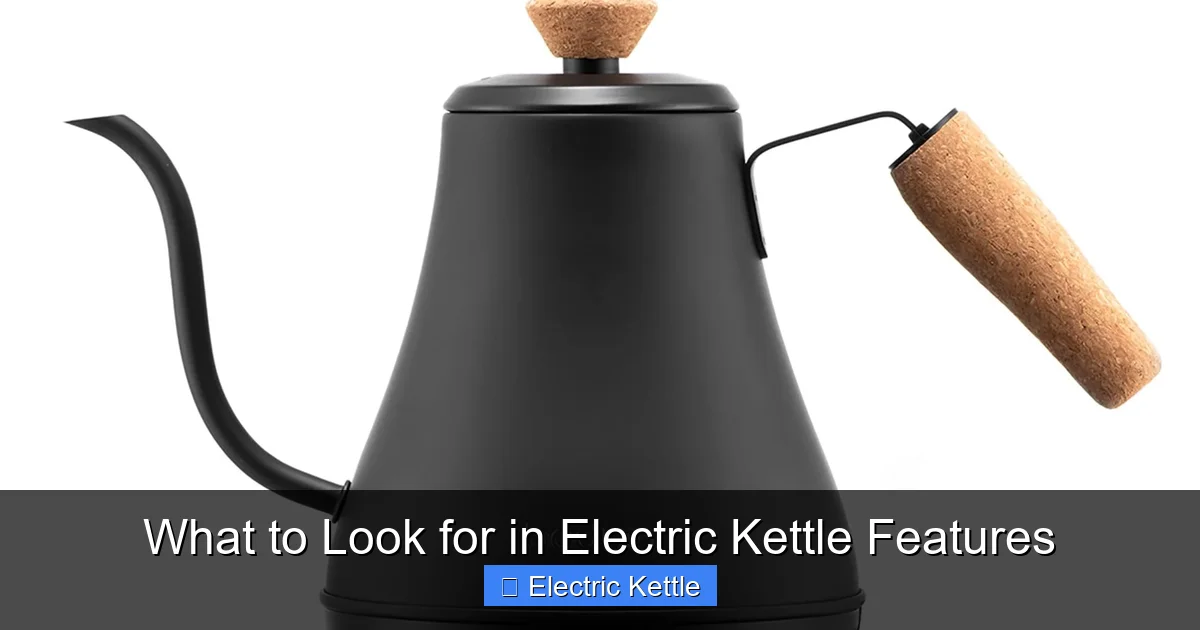
A well-designed spout ensures smooth, drip-free pouring. Look for kettles with gooseneck spouts if you’re into pour-over coffee—they offer better control for slow, even brewing.
Programmable Timers
Some advanced models let you set a timer so the kettle boils water at a specific time—great for having hot water ready when you wake up.
Conclusion: Finding the Right Kettle for Your Lifestyle
Choosing an electric kettle isn’t just about picking the cheapest or prettiest model. It’s about finding the right balance of features that match your needs, habits, and preferences. Whether you prioritize speed, safety, or precision, knowing what to look for in electric kettle features helps you make a smart investment.
Start by thinking about how you use hot water daily. Do you need variable temperatures for different teas? A large capacity for family use? Or quiet operation for a peaceful morning? Once you identify your priorities, you can narrow down your options and find a kettle that truly enhances your routine.
Remember, a good electric kettle should be safe, efficient, and easy to use. It should last for years and make your favorite beverages taste their best. With the right features, it’s more than just an appliance—it’s a daily companion.
So take your time, compare models, and don’t be afraid to spend a little more for quality. Your morning tea—and your peace of mind—will thank you.
Frequently Asked Questions
What temperature should I use for different types of tea?
Green tea brews best at 160–180°F (70–80°C), white tea at 175–185°F (80–85°C), oolong at 185–205°F (85–96°C), and black tea at 200–212°F (93–100°C). Using the right temperature prevents bitterness and brings out the best flavor.
Can I use an electric kettle for cooking?
Yes, electric kettles are great for heating water for instant noodles, oatmeal, pasta, or baby formula. Just make sure the kettle is clean and designed for repeated use with food-safe materials.
How often should I descale my electric kettle?
It depends on your water hardness. If you have hard water, descale every 1–2 months. With soft water, every 3–4 months is usually sufficient. Look for mineral buildup or changes in taste as signs it’s time.
Are plastic electric kettles safe?
Plastic kettles can be safe if they’re labeled BPA-free and food-grade. However, stainless steel or glass are better long-term choices because they don’t leach chemicals and are more durable.
What’s the average lifespan of an electric kettle?
With proper care, most electric kettles last 3–5 years. High-quality models with stainless steel construction and good maintenance can last even longer.
Do electric kettles use a lot of electricity?
Electric kettles are generally energy-efficient because they heat water quickly. A 1500W kettle uses about the same energy as a microwave or toaster for a short time. Using the right amount of water helps reduce waste.