When it comes to energy use, electric kettles are generally more efficient than coffee machines. While both appliances heat water, kettles do so faster and with less wasted energy, making them the greener choice for boiling water—whether for tea, coffee, or instant meals.
Key Takeaways
- Electric kettles use less electricity overall: They heat only the water you need quickly and efficiently, typically using 2,000–3,000 watts for just a few minutes.
- Coffee machines vary widely in energy use: Drip brewers, espresso machines, and pod-based systems can consume more power due to longer run times, heating elements, and standby modes.
- Standby power is a hidden energy drain: Many coffee machines draw electricity even when off, while most kettles use power only during boiling.
- Kettles are faster and more targeted: Boiling water in a kettle takes 2–4 minutes, whereas coffee makers may take 5–10 minutes to brew a full pot.
- Energy efficiency depends on usage habits: Using a kettle to heat water for pour-over or French press coffee can save energy compared to running a full coffee machine cycle.
- Modern appliances are improving: Energy-efficient models of both kettles and coffee makers are now available, reducing long-term electricity costs.
- Small changes add up: Choosing the right appliance for the task and maintaining it properly can significantly reduce your kitchen’s energy footprint.
📑 Table of Contents
- Introduction: The Great Kitchen Energy Debate
- Understanding Energy Consumption in Kitchen Appliances
- Electric Kettle: Efficiency in Simplicity
- Coffee Machines: Variety Comes at a Cost
- Direct Comparison: Kettle vs. Coffee Machine
- Environmental and Cost Implications
- Future Trends: Smarter, Greener Appliances
- Conclusion: Making the Smart Choice
Introduction: The Great Kitchen Energy Debate
Picture this: It’s early morning, and the kitchen hums with quiet anticipation. You’re reaching for your favorite mug, craving that first sip of warmth. But before the ritual begins, a question lingers—should you fire up the electric kettle or press “brew” on the coffee machine? It seems like a simple choice, but beneath the surface lies a bigger issue: energy consumption.
In today’s world, where energy costs are rising and environmental awareness is growing, understanding how much electricity our everyday appliances use is more important than ever. The kitchen, often called the heart of the home, is also one of the biggest energy consumers. And two of its most beloved tools—the electric kettle and the coffee machine—are frequently at the center of the energy debate.
So, which one uses more electricity? The answer isn’t always black and white. It depends on the type of appliance, how you use it, and even the model you own. But by breaking down the facts, we can make smarter, more sustainable choices—without sacrificing our morning brew.
Understanding Energy Consumption in Kitchen Appliances
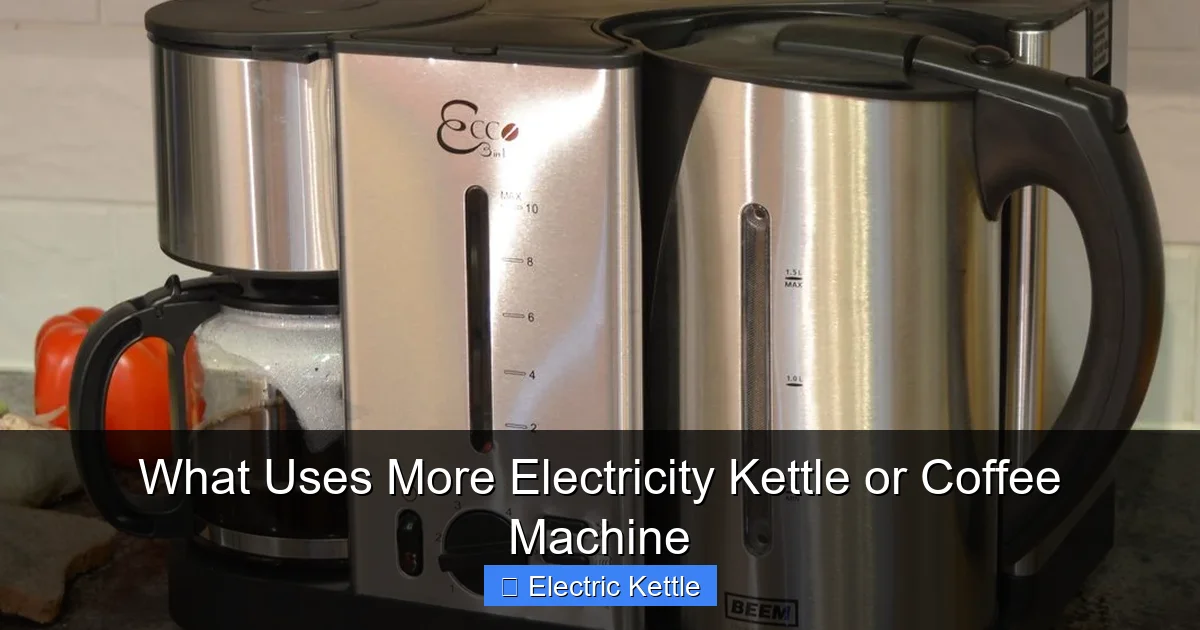
Visual guide about What Uses More Electricity Kettle or Coffee Machine
Image source: images-na.ssl-images-amazon.com
Before we dive into the kettle versus coffee machine showdown, let’s take a step back and understand how electricity use is measured in household appliances. Most of us glance at our monthly utility bill and see a number, but rarely connect it to specific devices. Yet, small habits—like how long you leave the coffee maker on or how often you boil a full kettle for one cup—can add up over time.
Electricity consumption is measured in watts (W) and kilowatt-hours (kWh). A watt is a unit of power, while a kilowatt-hour represents energy used over time. For example, a 1,000-watt appliance running for one hour uses 1 kWh. Your utility company charges you based on how many kWh you consume each month.
Kitchen appliances vary widely in their power draw. A refrigerator runs continuously but uses relatively low power, while a microwave or toaster oven spikes in usage for short bursts. The electric kettle and coffee machine fall into the “high-power, short-duration” category—they use a lot of electricity quickly, but only for a few minutes at a time.
The key to comparing them isn’t just peak wattage, but total energy used per use. A device that uses 3,000 watts for 3 minutes may actually consume less total energy than one that uses 1,200 watts for 10 minutes. That’s why understanding both power and time is essential.
How to Calculate Energy Use at Home
You don’t need a degree in engineering to figure out how much electricity your appliances use. Here’s a simple formula:
Energy (kWh) = (Wattage × Hours Used) ÷ 1,000
Let’s say your electric kettle is rated at 2,500 watts and you use it for 3 minutes (0.05 hours) each morning:
(2,500 × 0.05) ÷ 1,000 = 0.125 kWh per use
If you do this twice a day, that’s 0.25 kWh daily, or about 7.5 kWh per month.
Now, compare that to a drip coffee maker that uses 1,200 watts and runs for 8 minutes (0.13 hours) to brew a full pot:
(1,200 × 0.13) ÷ 1,000 = 0.156 kWh per use
If you brew one pot daily, that’s about 4.7 kWh per month—less than the kettle in this example. But wait—this doesn’t account for standby power or partial use.
Many coffee machines have digital displays, warming plates, or auto-start features that draw power even when not brewing. A warming plate, for instance, can use 50–100 watts continuously. If it stays on for an hour after brewing, that’s an extra 0.05–0.1 kWh per use.
Meanwhile, most electric kettles only use power during the boiling phase. Once the water reaches temperature, they shut off automatically. No warming plate, no display, no standby drain—just quick, efficient heating.
Electric Kettle: Efficiency in Simplicity
The electric kettle is a marvel of modern convenience. It’s fast, reliable, and designed for one purpose: heating water quickly and efficiently. Whether you’re making tea, instant coffee, or oatmeal, the kettle delivers hot water in minutes—often faster than a coffee machine can brew a single cup.
Most electric kettles operate at between 2,000 and 3,000 watts. This high wattage allows them to boil water rapidly. A typical 1.7-liter kettle can bring water to a boil in 3 to 4 minutes, depending on the starting temperature and altitude.
But what makes kettles so energy-efficient isn’t just their speed—it’s their precision. You only heat the water you need. If you’re making one cup of tea, you fill the kettle with one cup. There’s no wasted energy heating an entire carafe or keeping water warm for hours.
How Electric Kettles Work
Inside every electric kettle is a heating element—usually a coiled metal rod or a concealed flat plate at the base. When you turn it on, electricity flows through the element, generating heat. This heat transfers directly to the water, raising its temperature until it reaches boiling point.
Most modern kettles have automatic shut-off features. Once the water boils, a thermostat triggers a switch that cuts power to the heating element. This prevents overheating and saves energy. Some models even have variable temperature settings, allowing you to heat water to specific temperatures for different types of tea or coffee—further reducing unnecessary energy use.
Energy-Saving Tips for Kettle Users
Even though kettles are already efficient, small habits can make them even more so:
– Only boil what you need: Overfilling the kettle wastes energy. Use a measuring cup to pour just the right amount.
– Descale regularly: Mineral buildup from hard water insulates the heating element, making it work harder. Clean your kettle every few months.
– Use the right temperature: Boiling water to 100°C (212°F) isn’t always necessary. Green tea, for example, brews best at 70–80°C (158–176°F). Lower temperatures save energy.
– Unplug when not in use: While most kettles don’t have standby power, unplugging eliminates any phantom load and extends the appliance’s life.
Real-World Example: Kettle vs. Stovetop
You might wonder—how does an electric kettle compare to boiling water on the stove? Surprisingly, the electric kettle often wins in efficiency.
A gas stove may seem cheaper, but it loses a lot of heat to the surrounding air. An electric stovetop is better, but still less efficient than a dedicated kettle. Studies have shown that electric kettles can be up to 80% efficient in transferring energy to water, while gas stoves hover around 40–55%.
So, even if your electricity is more expensive per kWh than gas, the kettle’s efficiency can still make it the greener choice.
Coffee Machines: Variety Comes at a Cost
Coffee machines come in many forms—drip brewers, French presses, espresso machines, pod-based systems like Keurig, and more. Each has its own energy profile, but most share a common trait: they do more than just heat water.
While the core function is brewing coffee, many machines include additional features that increase energy use. Warming plates, digital timers, built-in grinders, and steam wands all draw extra power. And unlike kettles, some of these features stay active long after the brewing is done.
Types of Coffee Machines and Their Energy Use
Let’s break down the most common types:
Drip Coffee Makers: These are the workhorses of many kitchens. They heat water in a reservoir, then drip it through a filter and ground coffee into a carafe. Most use 800–1,200 watts and take 5–10 minutes to brew a full pot. The warming plate beneath the carafe keeps coffee hot but can use 50–100 watts continuously. If you leave it on for an hour, that’s an extra 0.05–0.1 kWh.
Espresso Machines: These high-performance machines use pressure to force hot water through finely ground coffee. They often have powerful heating elements (1,000–2,000 watts) and may take 10–15 minutes to heat up. Some have dual boilers—one for brewing, one for steaming milk—which increases energy use. Pod-based espresso machines (like Nespresso) are faster but still use significant power per cup.
Pod Coffee Makers (e.g., Keurig): These are convenient but energy-intensive. They heat a small amount of water quickly (often under 2 minutes), but the heating element is frequently cycled on and off. Many models also have standby modes that draw 2–5 watts even when “off.” Over a month, this phantom load can add up to 1–2 kWh—enough to brew several extra cups.
French Press and Pour-Over: These manual methods use no electricity at all—except for the kettle you use to heat the water. If you use an electric kettle to boil water for pour-over coffee, you’re combining the efficiency of the kettle with the simplicity of manual brewing.
The Hidden Cost of Standby Power
One of the biggest energy drains in coffee machines is standby power—also known as “vampire power” or “phantom load.” This is electricity used by devices when they’re turned off but still plugged in.
Many coffee makers have digital clocks, programmable timers, or LED displays that stay lit. Even when not brewing, these features consume a small amount of power. While it might seem negligible—say, 3 watts—it adds up.
If a coffee maker uses 3 watts in standby mode and stays plugged in 24/7, that’s:
(3 × 24 × 30) ÷ 1,000 = 2.16 kWh per month
That’s equivalent to brewing an extra 10–15 cups of coffee—without you even pressing a button.
Electric kettles, by contrast, rarely have standby features. Once the water boils and the kettle shuts off, it uses virtually no power. Unless it has a keep-warm function (some premium models do), it’s completely off.
Energy-Saving Tips for Coffee Machine Users
You don’t have to give up your coffee ritual to save energy. Try these tips:
– Use the timer wisely: Program your coffee maker to start brewing just before you wake up, so the warming plate isn’t on all morning.
– Turn off the warming plate: If your machine has a switch, turn it off after brewing. Pour your coffee into a thermos to keep it hot.
– Unplug when not in use: Especially for pod machines, unplugging eliminates standby drain.
– Choose energy-efficient models: Look for ENERGY STAR-certified coffee makers, which meet strict efficiency guidelines.
– Clean regularly: Mineral buildup can reduce heating efficiency. Descale your machine every 1–2 months.
Direct Comparison: Kettle vs. Coffee Machine
Now that we’ve explored both appliances in detail, let’s put them head-to-head. Which one uses more electricity in real-world scenarios?
Let’s consider a typical morning routine: making one cup of coffee or tea.
Scenario 1: Electric Kettle
– Wattage: 2,500 W
– Time to boil 1 cup (250 ml): ~2.5 minutes (0.042 hours)
– Energy used: (2,500 × 0.042) ÷ 1,000 = 0.105 kWh
Scenario 2: Drip Coffee Maker (single cup)
– Wattage: 1,000 W
– Brew time: 6 minutes (0.1 hours)
– Warming plate on for 30 minutes: 75 W × 0.5 hours = 0.0375 kWh
– Total energy: (1,000 × 0.1) ÷ 1,000 + 0.0375 = 0.1 + 0.0375 = 0.1375 kWh
In this case, the coffee maker uses about 30% more energy than the kettle.
Now, let’s look at a pod machine:
Scenario 3: Pod Coffee Maker
– Wattage: 1,400 W
– Brew time: 1.5 minutes (0.025 hours)
– Standby power: 4 W × 24 hours = 0.096 kWh/day
– Energy per use: (1,400 × 0.025) ÷ 1,000 = 0.035 kWh
– Total daily energy (including standby): 0.035 + 0.096 = 0.131 kWh
Again, the pod machine uses more total energy than the kettle—even though the brewing phase is shorter.
When the Coffee Machine Might Be More Efficient
There is one scenario where a coffee machine could be more efficient: brewing a full pot for multiple people.
If four people each want a cup of coffee, using a drip brewer to make a full pot (1.2 liters) might use less energy per cup than boiling four separate kettles.
Let’s compare:
– Kettle (4 cups): 0.105 kWh × 4 = 0.42 kWh
– Drip brewer (full pot): 0.1375 kWh (as above)
In this case, the coffee maker uses significantly less energy per person. But this only holds true if everyone drinks their coffee right away. If the warming plate stays on for hours, the advantage disappears.
The Role of Usage Habits
Ultimately, the most energy-efficient appliance is the one you use wisely. A kettle used to boil a full pot for one cup is wasteful. A coffee machine used to brew a single cup with the warming plate on all day is equally inefficient.
The key is matching the tool to the task:
– Use a kettle for heating water—whether for tea, instant coffee, or cooking.
– Use a coffee machine when brewing a full pot or when you need features like grinding or frothing.
– Consider manual methods (French press, pour-over) with a kettle for the best of both worlds: flavor and efficiency.
Environmental and Cost Implications
Beyond the technical numbers, there are real-world impacts to consider: your wallet and the planet.
Electricity Costs
The average U.S. household pays about $0.15 per kWh. Using our earlier examples:
– Kettle (2 uses/day): 0.25 kWh × $0.15 = $0.0375 per day → ~$1.13 per month
– Coffee maker (1 use/day with warming plate): 0.1375 kWh × $0.15 = $0.0206 per day → ~$0.62 per month
Wait—that suggests the coffee maker is cheaper? Not so fast.
This calculation doesn’t include standby power or multiple uses. If you use the coffee maker twice a day and leave it plugged in, the cost rises. And if you’re using a pod machine with high standby drain, the monthly cost could exceed the kettle’s.
Over a year, the difference might seem small—$10–$20—but multiplied across millions of households, it adds up.
Carbon Footprint
Electricity generation produces greenhouse gases, especially in regions that rely on coal or natural gas. The more electricity you use, the larger your carbon footprint.
By choosing the more efficient appliance—usually the kettle—you reduce demand on power plants and lower emissions. Even small changes, like using a kettle for pour-over coffee instead of a pod machine, can make a difference over time.
Sustainability Beyond Energy
Energy use isn’t the only environmental factor. Pod machines generate significant plastic waste, while drip machines use paper filters. Kettles and French presses produce little to no waste.
If sustainability is a priority, combining an electric kettle with a reusable filter or French press is one of the greenest coffee setups available.
Future Trends: Smarter, Greener Appliances
The good news? Appliance manufacturers are listening. Energy efficiency is becoming a selling point, and new technologies are making both kettles and coffee machines smarter and greener.
Smart Kettles
Some modern kettles come with Wi-Fi connectivity, allowing you to control them via smartphone apps. You can set precise temperatures, schedule boiling times, and even monitor energy use. While these features add a bit of standby power, they also help prevent overuse—like boiling water you don’t need.
Energy-Efficient Coffee Makers
ENERGY STAR-certified coffee makers are now widely available. These models use advanced insulation, efficient heating elements, and auto-shutoff features to reduce energy use. Some even have “eco modes” that shorten brew times or disable the warming plate.
The Rise of Manual Brewing
There’s also a growing trend toward manual brewing methods—AeroPress, V60, French press—paired with electric kettles. These setups offer barista-quality coffee with minimal energy use and no waste.
Conclusion: Making the Smart Choice
So, what uses more electricity: a kettle or a coffee machine?
The answer is clear: in most everyday situations, the coffee machine uses more electricity than the electric kettle. This is due to longer run times, warming plates, standby power, and additional features that draw energy even when not in active use.
But the real takeaway isn’t about picking a winner—it’s about making informed choices. If you’re brewing a single cup, a kettle is usually the more efficient option. If you’re making coffee for a group, a well-used drip brewer might be better. And if you’re committed to sustainability, combining a kettle with a manual brewing method is hard to beat.
Ultimately, the most energy-efficient appliance is the one you use thoughtfully. By understanding how your devices work and adjusting your habits, you can enjoy your morning ritual—without draining your wallet or the planet.
So next time you reach for that mug, ask yourself: what’s the smartest way to get my hot water? The answer might just boil down to a simple kettle.
Frequently Asked Questions
Does an electric kettle use a lot of electricity?
No, electric kettles are among the most energy-efficient appliances for heating water. They use high wattage for short periods, typically consuming less total energy than coffee machines for the same task.
Can I save money by using a kettle instead of a coffee machine?
Yes, especially if you’re making single servings. Kettles heat water faster and use less energy overall, which can lead to noticeable savings on your electricity bill over time.
Do coffee machines use electricity when turned off?
Many do. Coffee makers with digital displays, timers, or warming plates often draw standby power—sometimes 2–5 watts—even when not in use. Unplugging them can eliminate this waste.
Is it more efficient to boil water in a kettle or on the stove?
Electric kettles are generally more efficient than stovetops. They transfer heat directly to water with minimal loss, while stoves lose energy to the air and cookware.
What’s the most energy-efficient way to make coffee?
Using an electric kettle to heat water for a French press or pour-over method is typically the most efficient. It avoids the extra energy used by warming plates and standby modes in coffee machines.
Are there energy-efficient coffee makers available?
Yes, look for ENERGY STAR-certified models. These coffee makers are designed to use less energy during brewing and often include features like auto-shutoff and insulated carafes to reduce waste.