Electric kettles became common in the 1950s after decades of development, with Japan and the UK leading adoption. Their rise was fueled by post-war electrification, urbanization, and the demand for faster, safer boiling methods. Today, they’re a staple in homes across Europe, Asia, and beyond.
Key Takeaways
- Electric kettles were invented in the late 1800s but weren’t practical until the early 20th century. Early models were bulky, expensive, and unsafe, limiting widespread use.
- They became common in the 1950s, especially in the UK and Japan. Post-war economic growth and home electrification made them accessible to average households.
- Japan played a major role in popularizing electric kettles in Asia. Brands like Zojirushi and Tiger introduced compact, efficient models in the 1960s.
- The UK embraced electric kettles for tea culture and convenience. By the 1970s, nearly every British home had one.
- Technological advances improved safety, speed, and energy efficiency. Features like automatic shut-off and cordless designs boosted popularity.
- Global adoption grew in the 1990s and 2000s with globalization and urbanization. Countries like China, India, and parts of Europe saw rapid uptake.
- Today, electric kettles are essential in many kitchens worldwide. They’re valued for speed, safety, and versatility beyond just making tea.
📑 Table of Contents
- The Humble Beginnings: Early Experiments with Electric Heating
- The 1920s–1940s: Slow Progress and Wartime Delays
- The 1950s: The Decade Electric Kettles Went Mainstream
- The 1970s–1990s: Global Expansion and Technological Refinements
- The 2000s–Today: The Modern Electric Kettle Era
- Why Electric Kettles Became a Kitchen Staple
- Conclusion: From Novelty to Necessity
The Humble Beginnings: Early Experiments with Electric Heating
The story of the electric kettle doesn’t start with a sleek, modern appliance on your countertop. Instead, it begins in the late 19th century, a time when electricity was still a novelty in most homes. Inventors were experimenting with ways to harness this new power source for everyday tasks—like boiling water.
One of the earliest patents for an electric kettle was filed in 1893 by a Canadian named Thomas Ahearn. He used an electric heating element to boil water, a concept that was revolutionary at the time. However, this early model was more of a prototype than a practical household item. It was large, expensive, and required direct wiring into the home’s electrical system—something only the wealthiest could afford.
Around the same time, British inventor Arthur Leslie Large developed a similar device in 1902. His kettle had a heating coil inside the water chamber, a design that would later become standard. But like Ahearn’s version, it wasn’t user-friendly. It lacked safety features, had no automatic shut-off, and posed serious risks of overheating or electric shock.
These early attempts were important milestones, but they didn’t lead to widespread use. Electricity was still rare in homes, and most people boiled water using stovetops, fireplaces, or gas stoves. The idea of an electric kettle was intriguing, but not yet practical.
Why Early Electric Kettles Failed to Catch On
So why didn’t electric kettles become common right after their invention? The answer lies in three main challenges: infrastructure, cost, and safety.
First, electricity wasn’t widely available. In the early 1900s, only a small percentage of homes in developed countries had access to electrical power. Rural areas were especially underserved. Without reliable electricity, an electric kettle was useless.
Second, the cost was prohibitive. Early models were hand-built and used expensive materials. They were marketed to wealthy households or commercial settings like hotels, not the average family.
Third—and perhaps most importantly—safety was a major concern. These early kettles had no automatic shut-off mechanism. If you forgot to unplug it, the water could boil dry, causing the heating element to overheat. This could lead to fires, burns, or electrical hazards. There were no thermostats, no insulated handles, and no grounding. Using one was a gamble.
Because of these limitations, electric kettles remained a niche product for decades. They were seen as curiosities or luxury items, not everyday appliances.
The 1920s–1940s: Slow Progress and Wartime Delays
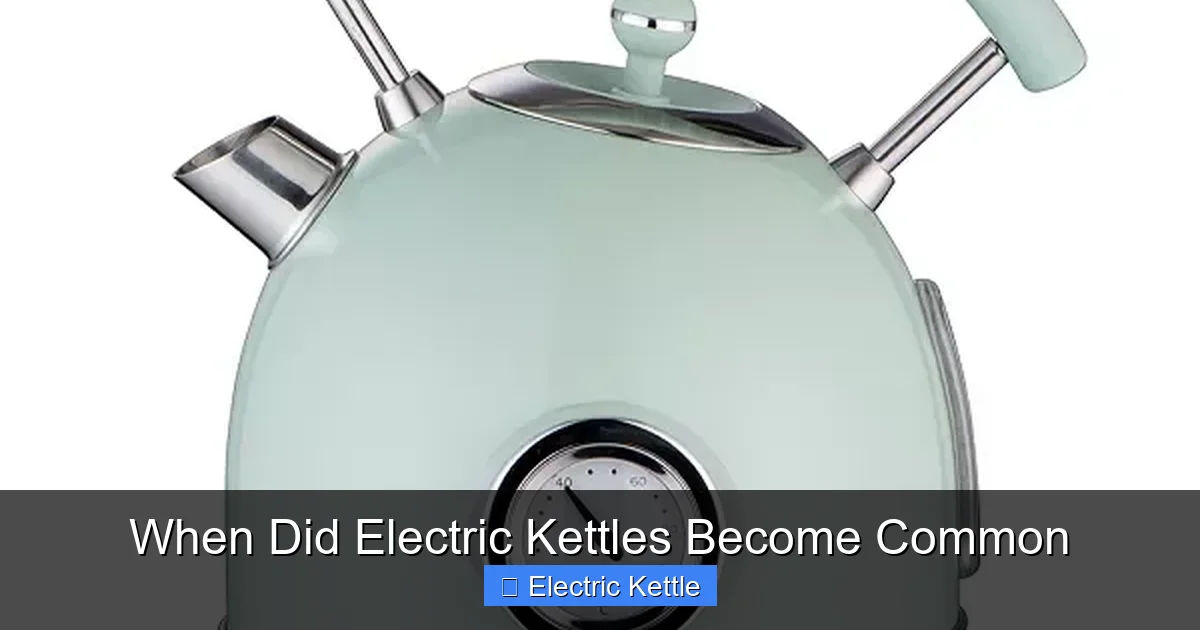
Visual guide about When Did Electric Kettles Become Common
Image source: irrorwxhiqijjr5q.ldycdn.com
The 1920s brought some improvements. As electricity spread to more homes, especially in urban areas, the demand for electric appliances began to grow. Companies started investing in household electrical devices, including kettles.
One notable development was the introduction of the immersion heating element—a coil that sat directly in the water. This design was more efficient than earlier models that relied on external heating plates. It also reduced the risk of overheating, though safety was still a concern.
In 1922, the Swan Company in the UK launched one of the first commercially available electric kettles. It was a simple design with a heating element inside a metal body. While it wasn’t perfect, it was a step forward. Still, sales were limited. Most people were skeptical of electric appliances, and many preferred the familiarity of stovetop kettles.
The 1930s saw further refinements. Some models began to include basic thermostats that could turn off the heating element when the water reached boiling point. This was a major safety improvement. However, these features were often unreliable and added to the cost.
Then came World War II. The war disrupted manufacturing and shifted focus to military production. Resources like copper and steel were diverted to the war effort, making it harder to produce consumer goods. Electric kettle production slowed or stopped in many countries.
After the war, there was a push to rebuild economies and modernize homes. This created the perfect environment for electric appliances to finally take off.
Post-War Optimism and the Rise of Home Electrification
The end of World War II marked a turning point. In countries like the UK, the US, and Japan, governments invested heavily in infrastructure, including electrical grids. More homes were connected to the power supply, and electricity became cheaper and more reliable.
At the same time, there was a cultural shift. People wanted modern, convenient lifestyles. The idea of a “modern kitchen” became popular, filled with electric appliances like refrigerators, toasters, and—yes—electric kettles.
Manufacturers saw an opportunity. They began designing kettles that were safer, more affordable, and easier to use. One key innovation was the automatic shut-off feature. Once the water boiled, the kettle would turn itself off, preventing dry boiling and reducing fire risks.
Another breakthrough was the cordless design. Earlier models had cords attached directly to the kettle, making them awkward to handle. Newer versions had a detachable base, so you could lift the kettle off the stand to pour. This made them much more user-friendly.
By the late 1940s, electric kettles were starting to appear in middle-class homes. But they still weren’t common. The real explosion in popularity would come in the 1950s.
The 1950s: The Decade Electric Kettles Went Mainstream
The 1950s are widely regarded as the decade when electric kettles became common. This was due to a perfect storm of technological, economic, and cultural factors.
Economically, the post-war boom led to rising incomes and increased consumer spending. Families could now afford appliances that were once considered luxuries. In the UK, for example, the number of households with electricity jumped from around 50% in 1945 to over 90% by 1955.
Technologically, manufacturers had solved many of the early problems. Kettles were now safer, faster, and more reliable. Automatic shut-off became standard, and materials like stainless steel and heat-resistant plastics made them more durable.
Culturally, the demand for convenience was growing. People wanted to save time in the kitchen. Boiling water on a stovetop took several minutes. An electric kettle could do it in under two. For busy families, that was a game-changer.
The UK Leads the Way
The United Kingdom was at the forefront of electric kettle adoption. Tea is a national obsession in Britain, and boiling water quickly was essential. The electric kettle fit perfectly into this culture.
By the mid-1950s, brands like Russell Hobbs and Morphy Richards were producing sleek, affordable models. Russell Hobbs, in particular, became a household name. Their kettles were stylish, efficient, and widely advertised.
One of their most popular models, the “K1,” launched in 1955, featured a concealed heating element, automatic shut-off, and a cordless design. It was a hit. Sales soared, and by the 1960s, electric kettles were in nearly every British home.
The UK’s love for tea played a big role. Unlike coffee drinkers, who often brew with hot water from a pot, tea drinkers needed freshly boiled water for the best flavor. The electric kettle made this quick and easy.
Japan’s Quiet Revolution
While the UK was embracing electric kettles for tea, Japan was doing the same—but with a different twist. In the 1950s, Japan was rebuilding its economy after the war. There was a strong focus on innovation and efficiency.
Japanese companies like Zojirushi and Tiger began developing electric kettles tailored to local needs. Japanese homes were often smaller, so compact designs were essential. They also valued quiet operation and energy efficiency.
In the 1960s, Zojirushi introduced the first electric kettle with a thermal insulation feature. It could keep water hot for hours without reheating—perfect for multiple cups of green tea throughout the day.
These kettles were also designed with precision. Some had variable temperature controls, allowing users to heat water to specific temperatures for different types of tea. This level of customization was unheard of in the West at the time.
By the 1970s, electric kettles were standard in Japanese kitchens. They weren’t just for tea—they were used for instant noodles, coffee, and even baby formula.
The 1970s–1990s: Global Expansion and Technological Refinements
The 1970s and 1980s saw electric kettles spread beyond the UK and Japan. As globalization increased, so did the exchange of ideas and products.
In Europe, countries like Germany, France, and the Netherlands began adopting electric kettles. While not as universal as in the UK, they became popular in urban areas and among younger, tech-savvy households.
In the United States, electric kettles were slower to catch on. Americans traditionally used stovetops or microwave kettles. But by the 1990s, they started gaining traction, especially among tea drinkers and college students living in dorms.
One reason for the slower adoption in the US was the voltage difference. American homes use 120 volts, while most of the world uses 220–240 volts. Electric kettles designed for higher voltage boil water faster. American models had to be redesigned to work efficiently at lower voltage, which took time.
Innovations That Changed the Game
During this period, several key innovations made electric kettles even more appealing:
– **Thermostats and Temperature Control:** Advanced thermostats allowed for precise temperature settings. This was especially useful for delicate teas like green or white tea, which require lower temperatures.
– **Cordless Bases:** The detachable base became standard, making pouring easier and safer.
– **Water Level Indicators:** Clear markings inside the kettle helped users measure the right amount of water.
– **Filter Screens:** Mesh filters prevented limescale and debris from entering the spout.
– **Energy Efficiency:** Newer models used less electricity, appealing to environmentally conscious consumers.
These features made electric kettles not just convenient, but also smarter and safer.
The Role of Urbanization
Another factor driving adoption was urbanization. As more people moved to cities, they lived in smaller apartments with limited kitchen space. Electric kettles were compact, didn’t require a stove, and could be used on any flat surface.
In countries like China and India, urban populations were growing rapidly. Electric kettles offered a fast, clean way to boil water—especially important in areas where tap water wasn’t always safe to drink.
By the 1990s, electric kettles were becoming common in major cities across Asia, Europe, and parts of North America.
The 2000s–Today: The Modern Electric Kettle Era
The 21st century has seen electric kettles evolve into high-tech appliances. Today’s models are faster, smarter, and more versatile than ever.
One major trend is **variable temperature control**. High-end kettles allow you to select exact temperatures—say, 175°F for green tea or 200°F for black tea. This precision wasn’t possible just a decade ago.
Another innovation is **rapid boiling**. Some kettles can boil a full liter of water in under three minutes. This is thanks to powerful heating elements and improved insulation.
**Smart features** are also on the rise. Some kettles connect to Wi-Fi and can be controlled via smartphone apps. You can start boiling water from your bedroom or set a timer for morning tea.
Materials have improved too. Many kettles now use BPA-free plastic, stainless steel, or even glass. These materials are safer, easier to clean, and more durable.
Global Popularity Today
Today, electric kettles are common in homes around the world. In the UK, over 90% of households own one. In Japan, they’re nearly universal. In China, sales have skyrocketed as middle-class families embrace modern appliances.
Even in the US, where adoption was slow, electric kettles are now found in many kitchens—especially among tea lovers, students, and health-conscious consumers.
They’re also used for more than just tea. People use them to make instant coffee, oatmeal, soup, and even sterilize baby bottles.
Environmental and Health Benefits
Modern electric kettles are also more eco-friendly. They use less energy than stovetops, especially gas burners. Because they heat only the water you need, there’s less waste.
They’re also safer. With automatic shut-off, boil-dry protection, and cool-touch exteriors, the risk of accidents is minimal.
For health, electric kettles help ensure water is properly boiled, killing harmful bacteria. This is especially important in areas with questionable water quality.
Why Electric Kettles Became a Kitchen Staple
So why did electric kettles become so common? It wasn’t just one reason—it was a combination of factors:
1. **Convenience:** They’re fast, easy to use, and don’t require a stove.
2. **Safety:** Modern designs prevent overheating and electric shocks.
3. **Efficiency:** They use less energy and heat water quickly.
4. **Cultural Fit:** In tea-loving countries, they’re essential.
5. **Affordability:** Mass production made them accessible to average families.
6. **Urban Living:** They’re perfect for small kitchens and apartments.
Over time, these benefits outweighed the drawbacks. What started as a luxury item became a necessity.
Conclusion: From Novelty to Necessity
Electric kettles have come a long way since their invention in the 1890s. From bulky, unsafe prototypes to sleek, smart appliances, their evolution mirrors the broader story of household technology.
They became common in the 1950s, thanks to post-war prosperity, better design, and a growing desire for convenience. The UK and Japan led the way, but today, they’re used worldwide.
Whether you’re brewing tea, making coffee, or heating water for pasta, the electric kettle is one of the most useful tools in the modern kitchen. It’s a simple device that has quietly transformed how we live—one boil at a time.
Frequently Asked Questions
When did electric kettles first appear?
Electric kettles were first invented in the late 1800s, with early patents filed in 1893. However, these early models were impractical and unsafe, so they didn’t become common until much later.
Why didn’t electric kettles become popular right after they were invented?
Early electric kettles were expensive, unsafe, and required electricity, which wasn’t widely available. They also lacked automatic shut-off, making them risky to use.
Which country first adopted electric kettles widely?
The United Kingdom was the first country to widely adopt electric kettles, especially in the 1950s and 1960s, driven by the national love for tea and post-war modernization.
When did electric kettles become common in the US?
Electric kettles became more common in the US in the 1990s and 2000s, though adoption was slower due to voltage differences and cultural preferences for stovetops.
What made electric kettles safer in the 1950s?
The introduction of automatic shut-off, thermostats, and cordless designs made electric kettles much safer and more user-friendly in the 1950s.
Are electric kettles energy efficient?
Yes, modern electric kettles are energy efficient. They heat water faster than stovetops and use only the energy needed, reducing waste and saving money.