If you’re trying to save money on boiling water, the electric kettle is generally cheaper and more energy-efficient than using a stove top. While both methods get the job done, electric kettles heat water faster, use less energy, and cost less per boil—especially when used regularly.
When it comes to making your morning tea, instant coffee, or preparing pasta, one of the first steps is often boiling water. But have you ever stopped to think about which method—using an electric kettle or a stove top—is actually cheaper? It’s a question that might seem minor, but over time, the answer can make a noticeable difference in your energy bills and environmental footprint.
Many people assume that because gas stoves are common in homes, they must be the most cost-effective way to heat water. Others believe that electric kettles, while convenient, might use more electricity and therefore cost more. The truth, however, is a bit more nuanced. While both methods can get water to a boil, the efficiency, speed, and overall cost depend on several factors—including your energy source, how often you boil water, and even how much water you use each time.
In this article, we’ll break down the real costs of using an electric kettle versus a stove top. We’ll look at energy consumption, boiling times, upfront costs, and long-term savings. Whether you’re a daily tea drinker, a busy parent making multiple meals, or just someone trying to cut down on household expenses, understanding which option is cheaper can help you make smarter choices in the kitchen.
Key Takeaways
- Electric kettles are more energy-efficient: They convert nearly all energy into heat, wasting less than stove tops.
- Faster boiling time saves money: Electric kettles boil water in 2–4 minutes, reducing energy use compared to slower stove methods.
- Stove tops vary in cost: Gas stoves may seem cheaper per unit, but electric stoves are less efficient than dedicated kettles.
- Usage frequency matters: Frequent users save more with electric kettles due to consistent low-cost operation.
- Initial cost vs. long-term savings: Electric kettles cost more upfront but pay for themselves in energy savings over time.
- Environmental impact: Electric kettles have a smaller carbon footprint when powered by renewable energy.
- Smart habits boost savings: Only boil the water you need, regardless of method, to minimize waste.
📑 Table of Contents
Understanding Energy Efficiency: Electric Kettle vs. Stove Top
Energy efficiency is the cornerstone of determining which method is cheaper. Simply put, efficiency refers to how much of the energy you pay for actually goes into heating the water, versus being lost to the surrounding air or the appliance itself.
Electric kettles are designed specifically for one task: boiling water. They feature insulated walls, a sealed lid, and a heating element that sits directly in the water. This direct contact allows nearly 80–90% of the electrical energy to be converted into heat that warms the water. Very little energy is wasted. In contrast, stove tops—whether gas or electric—are multipurpose appliances. When you place a pot on a burner, much of the heat escapes around the sides of the pot, especially if the pot is smaller than the burner. This means only about 40–55% of the energy actually heats the water, with the rest lost to the air.
For example, imagine boiling one liter of water. An electric kettle might use around 0.1 kWh of electricity to bring it to a boil in about 3 minutes. A gas stove, depending on the flame and pot size, could use the equivalent of 0.15–0.2 kWh of gas energy to do the same job in 5–7 minutes. Even though gas is often cheaper per unit than electricity, the inefficiency of the stove means you end up using more total energy.
Electric stovetops are even less efficient. Coil or smooth-top electric burners lose a lot of heat to the air and take longer to transfer energy to the pot. In fact, studies show that electric stovetops are only about 70% efficient at best—and that’s under ideal conditions. When you factor in heat loss from an open pot and uneven heating, the real-world efficiency drops significantly.
So, while the cost per unit of gas might be lower than electricity in some regions, the higher efficiency of electric kettles often makes them the cheaper option overall. This is especially true if you’re only boiling small amounts of water, which is common for making tea or coffee.
Cost Comparison: Breaking Down the Numbers
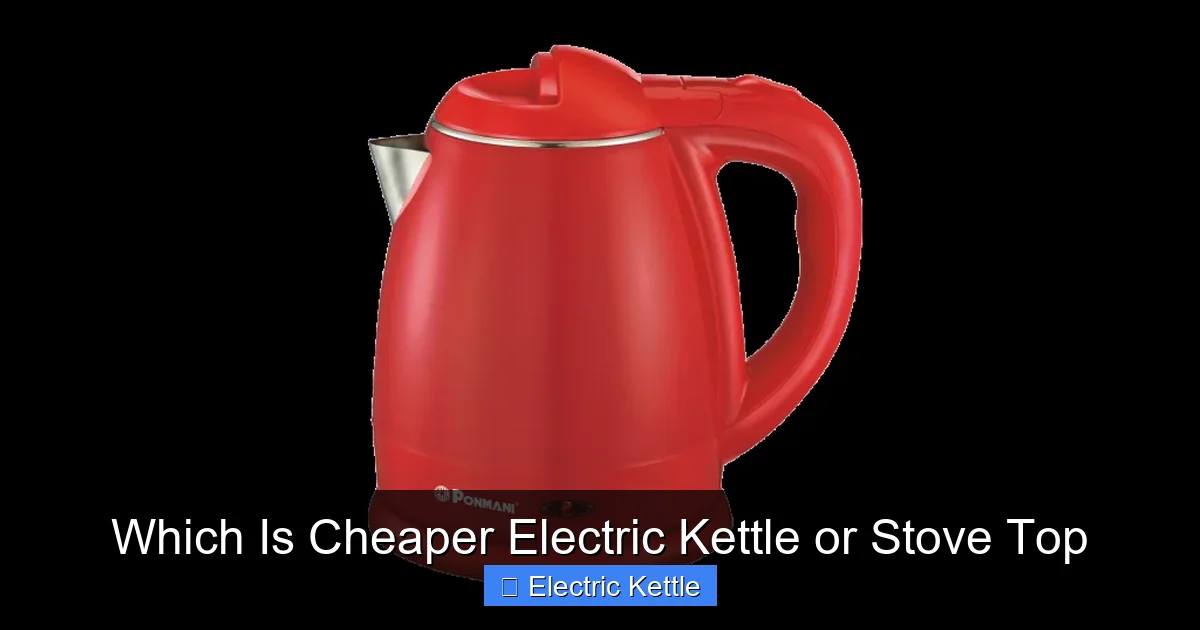
Visual guide about Which Is Cheaper Electric Kettle or Stove Top
Image source: ponmani.com
To truly understand which is cheaper—electric kettle or stove top—we need to look at real-world costs. Let’s break it down with some practical examples based on average energy prices in the United States.
As of 2024, the average cost of electricity is about $0.15 per kilowatt-hour (kWh), while natural gas costs around $1.20 per therm. One therm equals about 29.3 kWh, so the cost per kWh equivalent for gas is roughly $0.04. At first glance, gas seems much cheaper. But remember, efficiency matters.
Let’s say you boil one liter of water every day. Here’s how the costs compare:
– **Electric Kettle:** Uses about 0.1 kWh per boil. At $0.15/kWh, that’s $0.015 per use. Over a year (365 days), that’s about $5.48.
– **Gas Stove:** Uses about 0.18 kWh equivalent per boil (due to lower efficiency). At $0.04/kWh equivalent, that’s $0.0072 per use. Over a year, that’s about $2.63.
– **Electric Stove:** Uses about 0.14 kWh per boil. At $0.15/kWh, that’s $0.021 per use. Over a year, that’s about $7.67.
Wait—doesn’t that make the gas stove the cheapest? Not so fast. These numbers assume perfect conditions. In reality, many people boil more water than they need, leave the stove on longer, or use pots that don’t match the burner size. These habits increase energy use.
Moreover, if you boil water multiple times a day—say, for tea, coffee, and cooking—the savings from an electric kettle add up quickly. For someone who boils water 3 times a day, the annual cost with an electric kettle would be around $16.43, compared to $7.89 for gas and $23.01 for an electric stove.
But here’s the kicker: if you live in an area with high electricity prices or low gas prices, the gap narrows. Conversely, in regions with cheap electricity (like those with hydro or solar power), electric kettles become even more cost-effective.
Another factor is time. Electric kettles boil water in 2–4 minutes, while gas stoves take 5–7 minutes, and electric stoves can take 8–10 minutes. If you value your time—or if you’re making multiple cups throughout the day—the speed of an electric kettle means less waiting and less energy wasted keeping water hot.
Boiling Speed and Its Impact on Cost
Speed isn’t just about convenience—it directly affects how much energy you use. The longer it takes to boil water, the more energy is lost to the environment, especially if the pot is uncovered or the heat is too high.
Electric kettles are built for speed. Most models can boil one liter of water in under 4 minutes, with some high-efficiency models doing it in just 2.5 minutes. This rapid heating means less time for heat to escape, resulting in lower overall energy consumption.
In contrast, stove tops are slower. A gas burner might take 5–7 minutes to boil the same amount of water, and an electric coil stove can take even longer—up to 10 minutes. During this time, heat radiates from the pot and burner, warming the air around your kitchen instead of the water.
Let’s look at a real-life example. Suppose you make two cups of tea every morning. That’s about 500ml of water. An electric kettle might boil this in 2 minutes using 0.05 kWh. A gas stove, even if efficient, might take 4 minutes and use 0.09 kWh equivalent. Over a year, that small difference adds up to nearly double the energy use.
Speed also affects how you use the appliance. With an electric kettle, you’re more likely to boil only what you need because it’s fast and easy. But with a stove, the longer wait might tempt you to boil extra “just in case,” leading to wasted water and energy.
Additionally, many electric kettles have automatic shut-off features. Once the water reaches boiling point, the kettle turns off, preventing over-boiling and energy waste. Stove tops require manual monitoring. If you get distracted and forget to turn off the burner, you could be wasting gas or electricity for minutes—or even hours.
For busy households, the cumulative effect of these small inefficiencies can be significant. Over a year, a family that boils water 5 times a day could save over $20 just by switching from an electric stove to an electric kettle.
Upfront Costs and Long-Term Savings
One argument often made against electric kettles is the upfront cost. A good-quality electric kettle typically costs between $20 and $60, depending on features like temperature control, keep-warm functions, and build quality. In contrast, most people already own a stove and pots, so there’s no additional purchase needed.
However, when you factor in long-term energy savings, the electric kettle often pays for itself within a year or two.
Let’s do the math. Suppose you buy a $40 electric kettle. If it saves you $15 per year in energy costs compared to using an electric stove, it will pay for itself in less than three years. If you’re comparing it to a gas stove, the payback period might be longer—around 5–7 years—but you still gain in convenience, speed, and reduced wear on your stove.
Moreover, electric kettles are durable. Many models last 5–10 years with regular use. Over that time, the cumulative savings can be substantial. For example, saving $15 per year over 7 years equals $105—more than double the initial cost of the kettle.
There’s also the hidden cost of stove maintenance. Gas stoves require regular cleaning to keep burners efficient. Clogged burners reduce flame quality and increase gas use. Electric stovetops can develop hot spots or fail over time, requiring repairs or replacement. An electric kettle, with fewer moving parts and simpler mechanics, tends to have lower maintenance needs.
Another consideration is kitchen space. If you live in a small apartment or have limited counter space, an electric kettle can be a compact, multi-use tool. Some models even have cordless designs and storage bases, making them easy to tuck away when not in use.
In short, while the stove top has the advantage of no upfront cost, the electric kettle offers better long-term value—especially for frequent users.
Environmental Impact and Sustainability
Cost isn’t the only factor to consider—environmental impact matters too. The way you boil water affects your carbon footprint, especially depending on your local energy mix.
Electric kettles are generally more environmentally friendly when powered by clean energy. If your electricity comes from wind, solar, or hydro sources, boiling water with an electric kettle produces very little greenhouse gas emissions. Even with a grid that uses fossil fuels, the high efficiency of electric kettles means lower overall emissions compared to gas stoves.
Natural gas, while cleaner than coal, still releases carbon dioxide when burned. A gas stove boiling water emits about 0.1–0.2 kg of CO2 per use, depending on efficiency. Over a year of daily use, that’s 36–73 kg of CO2. An electric kettle, even on a fossil-fuel-heavy grid, might emit only 10–20 kg annually due to its efficiency.
As renewable energy becomes more widespread, the environmental advantage of electric kettles will only grow. In countries like Iceland, Norway, or Costa Rica—where most electricity is renewable—using an electric kettle is one of the greenest ways to boil water.
Additionally, electric kettles reduce the need for large pots and long heating times, which means less material use and lower embodied energy over time. They also encourage mindful habits—like boiling only what you need—which supports sustainable living.
For eco-conscious consumers, choosing an electric kettle isn’t just about saving money—it’s about reducing waste and supporting a cleaner energy future.
Practical Tips to Maximize Savings
No matter which method you use, smart habits can help you save money and energy. Here are some practical tips to get the most out of your boiling routine:
– **Only boil what you need:** Overfilling your kettle or pot wastes energy. Use a measuring cup or the kettle’s markings to boil just the right amount.
– **Use the right pot size:** On a stove, match your pot to the burner size. A small pot on a large burner wastes heat.
– **Cover your pot:** A lid traps heat and speeds up boiling, reducing energy use by up to 30%.
– **Descale your kettle:** Mineral buildup insulates the heating element, making it less efficient. Clean your electric kettle regularly with vinegar or a descaling solution.
– **Choose energy-efficient models:** Look for kettles with high wattage (1500W or more) and insulated walls for faster, more efficient boiling.
– **Turn off promptly:** Don’t let water boil longer than necessary. Use a timer or the kettle’s auto-shutoff feature.
– **Consider your energy source:** If you have solar panels, using an electric kettle during daylight hours maximizes free, clean energy.
By combining the right appliance with smart habits, you can cut your energy use—and your bills—significantly.
Conclusion: Which Is Really Cheaper?
So, which is cheaper: electric kettle or stove top? The answer depends on your usage, energy costs, and habits—but in most cases, the electric kettle comes out on top.
Electric kettles are more energy-efficient, boil water faster, and cost less to operate over time, especially for frequent users. While gas stoves may have a lower per-unit energy cost, their inefficiency often negates that advantage. Electric stoves are typically the most expensive option due to slow heating and high electricity use.
The upfront cost of an electric kettle is quickly offset by long-term savings, and the added benefits of speed, convenience, and environmental impact make it a smart investment. Plus, with modern features like temperature control and auto shut-off, electric kettles offer more than just boiling—they offer precision and peace of mind.
Ultimately, the cheapest way to boil water is the one that uses the least energy for the job. And when it comes to efficiency, the electric kettle is hard to beat. Whether you’re making your morning coffee or cooking dinner, switching to an electric kettle could be one of the simplest—and most cost-effective—changes you make in your kitchen.
Frequently Asked Questions
Is it cheaper to boil water with an electric kettle or gas stove?
Generally, an electric kettle is cheaper to use than a gas stove due to higher energy efficiency. While gas is often less expensive per unit, the stove’s lower efficiency means more energy is wasted, making the kettle more cost-effective over time.
Does an electric kettle use a lot of electricity?
No, electric kettles are designed to be energy-efficient. Most use about 0.1 kWh to boil one liter of water, which costs just over a penny per use. This makes them one of the most efficient ways to heat water.
Can I save money by using a stove top instead of an electric kettle?
It depends. If you already own a stove and only boil water occasionally, the savings may be minimal. But for daily use, an electric kettle typically saves money due to faster boiling and less energy waste.
Are electric kettles bad for the environment?
Not necessarily. Electric kettles have a lower environmental impact when powered by renewable energy. Even on fossil-fuel grids, their high efficiency results in lower overall emissions compared to gas stoves.
How long does it take for an electric kettle to pay for itself?
Most electric kettles pay for themselves within 1–3 years through energy savings, especially if you boil water frequently. The exact time depends on your usage and local energy costs.
Should I boil only the water I need?
Yes. Boiling more water than necessary wastes energy and increases costs. Whether using a kettle or stove, only heat what you’ll use to maximize efficiency and savings.