[FEATURED_IMAGE_PLACEGOER]
When it comes to baking, precision isn’t just a preference—it’s a necessity. While many home cooks rely on measuring cups and spoons, professional bakers consistently turn to digital kitchen scales for one simple reason: accuracy. Flour, sugar, butter, and other ingredients behave differently depending on how they’re measured. A cup of flour scooped directly from the bag can weigh significantly more than one that’s gently spooned and leveled. This inconsistency leads to dense cakes, dry cookies, and failed breads—issues that professionals simply can’t afford.
That’s why kitchen scales have become indispensable tools in both commercial bakeries and serious home kitchens. They eliminate guesswork, ensure repeatable results, and allow bakers to follow recipes exactly as intended—especially important when working with finicky ingredients like yeast or cocoa powder. In this comprehensive buying guide, we’ll explore why scales are essential, what features matter most, and how to choose the right model for your needs, whether you’re a weekend baker or aspiring pastry chef.
The market for kitchen scales has exploded in recent years, with options ranging from basic $15 models to high-end precision instruments costing over $200. Brands like OXO, Escali, My Weigh, and Breville dominate the space, each offering unique features tailored to different user needs. Some scales focus on durability and large capacity for commercial use, while others prioritize sleek design and smart connectivity for tech-savvy home cooks. With so many choices available, it’s easy to feel overwhelmed. But by understanding the key factors—from accuracy and build quality to ease of use and value—you can make an informed decision that enhances your baking experience for years to come.

What to Look for When Buying a Kitchen Scale
1. Accuracy and Precision
Accuracy is the cornerstone of any good kitchen scale. For baking, even small discrepancies can throw off a recipe. A difference of just 5 grams in flour can affect the texture of your bread or the rise of your cake. Professional bakers demand scales that deliver consistent, reliable measurements every time.
Look for scales with a readability (smallest increment) of 0.1 grams or better. This level of precision is crucial when measuring small quantities of ingredients like yeast, baking powder, or spices. Many mid-range and premium scales offer 0.1g resolution, while budget models may only go down to 1g—fine for general cooking but insufficient for delicate baking.
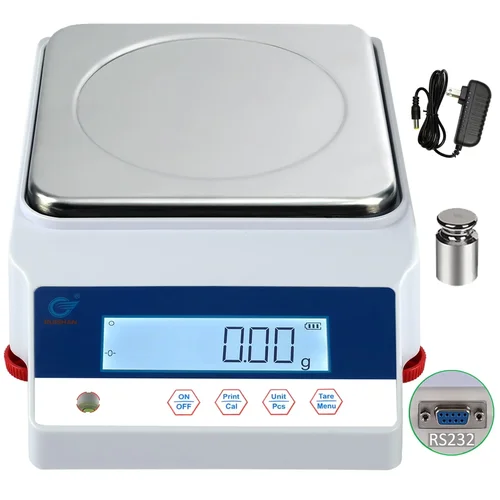
Calibration is another critical aspect. High-quality scales allow manual calibration using standard weights, ensuring long-term accuracy. Cheaper models often lack this feature, meaning drift over time can go unnoticed. If you’re serious about baking, invest in a scale that supports calibration.
2. Capacity and Range
Capacity refers to the maximum weight a scale can measure. Most home bakers don’t need industrial-level capacity, but it’s important to match the scale to your typical baking needs.
For everyday use—making cookies, cakes, or quick breads—a capacity of 5 to 11 pounds (2.2 to 5 kg) is usually sufficient. However, if you frequently bake large batches of dough, prepare holiday feasts, or work with heavy ingredients like whole chickens or large cuts of meat, consider a scale with a higher capacity, such as 15 or 22 pounds.
Also pay attention to the scale’s range. Some models perform best within a specific weight window. For example, a scale might be highly accurate between 1g and 5kg but lose precision at the extremes. Dual-range scales address this by switching resolution automatically—offering 0.1g up to 2kg and 1g beyond that. This ensures accuracy whether you’re measuring a pinch of salt or a 10-pound turkey.
3. Build Quality and Durability
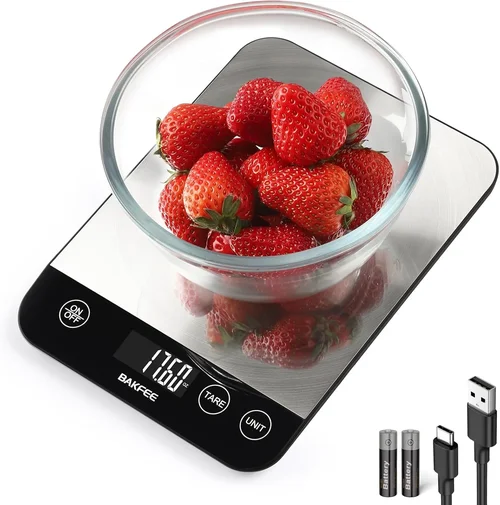
A kitchen scale is an investment, and like any tool, it should withstand daily use. Look for models made from sturdy materials like stainless steel, reinforced plastic, or tempered glass. These resist scratches, stains, and warping—especially important in humid or greasy kitchen environments.
The platform (where you place bowls or ingredients) should be easy to clean and resistant to corrosion. Stainless steel platforms are ideal because they’re non-porous and dishwasher-safe. Avoid scales with crevices or hard-to-reach areas where flour or sugar can accumulate.
Hinges, buttons, and display screens should feel solid and responsive. Flimsy construction leads to premature failure. Read user reviews to see how well a scale holds up after months or years of use. Brands like OXO and Escali are known for their durable designs, while ultra-cheap models often crack or malfunction within weeks.
4. Features and Functionality
Modern kitchen scales come packed with features, but not all are necessary for every user. Here are the most useful ones to consider:
– Tare Function: This allows you to zero out the weight of a bowl or container, so you only measure the ingredient itself. Essential for efficient baking—add flour, tare, add sugar, tare, and so on.
– Unit Conversion: The ability to switch between grams, ounces, pounds, milliliters, and fluid ounces is incredibly convenient, especially when following international recipes.
– Liquid Measurement: Some scales can estimate liquid volume based on weight (e.g., 250g of water = 250ml). This is helpful for soups, sauces, and batters.
– Timer and Clock: Built-in timers are great for proofing dough or monitoring bake times without reaching for your phone.
– Smart Connectivity: High-end models sync with apps via Bluetooth or Wi-Fi, allowing you to track nutrition, save recipes, or control the scale remotely. While not essential, these features appeal to tech enthusiasts.
– Auto-Off and Low Battery Indicator: These conserve battery life and prevent unexpected shutdowns mid-recipe.
Avoid scales with overly complex interfaces. Simplicity often leads to better usability. A clear, backlit display with large numbers is ideal, especially in low-light kitchens.
5. Ease of Use and Readability
No matter how accurate a scale is, it’s useless if it’s difficult to operate. Look for intuitive controls—typically just a few buttons for power, tare, and unit selection. Touch-sensitive buttons are sleek but can be frustrating if they don’t respond reliably.
The display should be easy to read from a distance and in various lighting conditions. LCD screens with blue or green backlighting are common and effective. Avoid models with tiny fonts or dim displays.
Consider the scale’s footprint. If you have limited counter space, a compact design is preferable. However, ensure the platform is large enough to accommodate standard mixing bowls (at least 7–8 inches in diameter).
Ergonomics matter too. A low-profile scale is easier to slide under cabinets and store in drawers. Some models include foldable legs or wall-mounting options for added convenience.
6. Power Source and Battery Life
Most kitchen scales run on AAA or AA batteries, though some premium models include rechargeable lithium-ion batteries. Battery-powered scales are convenient and portable, but frequent bakers may find themselves replacing batteries often.
Look for models with energy-efficient designs and auto-off features (typically after 2–5 minutes of inactivity). This extends battery life significantly. Rechargeable scales eliminate the need for constant battery replacements but require regular charging.
If you plan to use your scale near an outlet, consider a model with an optional AC adapter. This is especially useful in commercial kitchens where downtime isn’t an option.
7. Brand Reputation and Reliability
Not all kitchen scales are created equal—and brand matters. Established companies like OXO, Escali, My Weigh, and Breville have built reputations for quality, customer service, and innovation. They invest in research, testing, and user feedback to refine their products.
Cheaper, off-brand scales may look similar but often cut corners on components, calibration, and durability. While you can find decent budget options, be cautious of unknown brands with no reviews or support.
Research brands that specialize in scales. My Weigh, for example, focuses exclusively on precision weighing tools and offers models used by professional bakers and jewelers. Their customer service is highly rated, and many products come with lifetime warranties.
8. Warranty and Customer Support
A good warranty reflects a manufacturer’s confidence in their product. Most reputable brands offer at least a 1-year warranty, with some extending to 2 or even 5 years. My Weigh, for instance, provides a limited lifetime warranty on many of its scales.
Check what the warranty covers—typically defects in materials and workmanship, not accidental damage. Also verify if the company offers repair services or replacements, and how easy it is to contact support.
Read the fine print. Some warranties require registration within 30 days of purchase or proof of purchase. Keep your receipt and register your product promptly.
Different Types of Kitchen Scales

Common Buying Mistakes to Avoid
❌ Mistake: Prioritizing Price Over Accuracy
Why it’s bad: The cheapest scales often sacrifice precision and durability. A $12 model may seem like a bargain, but if it can’t measure accurately to 0.1g, it will undermine your baking efforts. Inconsistent measurements lead to failed recipes, wasted ingredients, and frustration.
What to do instead: Invest in a scale that offers at least 0.1g resolution and comes from a reputable brand. Even mid-range models ($40–$60) provide excellent accuracy and build quality. Think of it as a long-term tool—not a disposable gadget.
❌ Mistake: Ignoring Tare Functionality
Why it’s bad: Without a tare function, you’re forced to manually calculate net weights or use multiple bowls. This slows down your workflow and increases the risk of errors. For bakers who measure multiple ingredients in one bowl, tare is non-negotiable.
What to do instead: Ensure the scale has a responsive tare button. Test it in-store or read reviews to confirm it works reliably. Most modern digital scales include this feature, but it’s worth double-checking.
❌ Mistake: Overlooking Platform Size and Material
Why it’s bad: A small or poorly designed platform makes it hard to balance bowls, especially larger ones. Plastic platforms can stain or warp over time, affecting stability and hygiene.
What to do instead: Choose a scale with a stainless steel platform at least 7 inches in diameter. It should be easy to wipe clean and resistant to heat and moisture. Removable platforms are a bonus for deep cleaning.
❌ Mistake: Buying Based on Looks Alone
Why it’s bad: Sleek designs and colorful displays are appealing, but they don’t guarantee performance. Some stylish scales have tiny buttons, poor battery life, or inaccurate sensors.
What to do instead: Focus on functionality first. Read detailed reviews that discuss real-world performance, not just aesthetics. A plain-looking scale that works flawlessly is far better than a beautiful one that fails under pressure.
❌ Mistake: Not Checking Unit Options
Why it’s bad: Recipes from different countries use different units. If your scale only measures in ounces and pounds, you’ll struggle with European or Asian recipes that rely on grams and milliliters.
What to do instead: Select a scale that supports multiple units—grams, ounces, pounds, kilograms, milliliters, and fluid ounces. This flexibility saves time and reduces conversion errors.
❌ Mistake: Skipping Calibration Features
Why it’s bad: Scales can drift out of calibration over time due to temperature changes, drops, or regular use. Without the ability to recalibrate, your measurements become unreliable.
What to do instead: Choose a model that allows manual calibration using standard weights. Even if you don’t calibrate often, having the option ensures long-term accuracy.
❌ Mistake: Ignoring Warranty and Support
Why it’s bad: If your scale breaks after a few months and the manufacturer offers no support, you’re out of luck. Some brands have poor return policies or slow response times.
What to do instead: Research the brand’s customer service reputation. Look for at least a 1-year warranty and clear contact information. Register your product promptly to activate coverage.
Budget Guidelines: How Much Should You Spend?
– Entry-Level ($10 – $30): These scales are suitable for occasional use or basic cooking tasks. Expect 1g resolution, plastic construction, and limited features. Brands like Amazon Basics or generic imports fall here. While functional, they lack the precision and durability needed for serious baking.
– Mid-Range ($30 – $80): This is the sweet spot for most home bakers. Models like the OXO Good Grips or Escali Primo offer 0.1g accuracy, stainless steel platforms, tare function, and reliable performance. They balance cost, quality, and features perfectly.
– Premium ($80 – $150): Designed for enthusiasts and semi-professionals, these scales include advanced features like dual-range weighing, calibration, timers, and smart connectivity. The My Weigh KD8000 or Breville Control Grip are excellent examples. Ideal for those who bake frequently or follow complex recipes.
– Luxury ($150+): Top-tier scales used in commercial kitchens or by competitive bakers. They offer maximum capacity (up to 22 lbs), industrial-grade durability, and precision down to 0.01g. These are overkill for most home users but essential for high-volume or scientific baking.
Expert Tips for Getting the Best Deal
– Buy During Sales Events: Major retailers like Amazon, Williams Sonoma, and Bed Bath & Beyond often discount kitchen scales during Black Friday, Prime Day, or holiday sales. Sign up for newsletters to get early alerts.
– Compare Online and In-Store Prices: Sometimes in-store models are cheaper due to promotions or clearance. Use price-matching policies if available.
– Check Refurbished or Open-Box Options: Certified refurbished scales from reputable sellers (like Amazon Renewed or manufacturer outlets) offer significant savings with full warranties.
– Read Recent Reviews: Product quality can change over time. Look for reviews from the past 6–12 months to ensure you’re getting the current version.
– Test Before You Buy (If Possible): Visit a kitchen store and try the scale’s buttons, display, and tare function. Feel the weight and stability.
– Consider Long-Term Value: A $60 scale that lasts 10 years is a better investment than a $20 model that fails in 6 months.
– Look for Bundle Deals: Some brands offer scales with measuring cups, spoons, or recipe books. These can add value if you need the extras.
– Verify Return Policies: Ensure you can return the scale if it doesn’t meet expectations. Most retailers offer 30-day returns, but check the fine print.

Frequently Asked Questions
Q: Do I really need a kitchen scale for baking?
A: Yes—if you want consistent, reliable results. Volume measurements (cups, spoons) are inconsistent because ingredients settle and compress differently. Weight measurements are universal and precise, which is why professional bakers rely on scales.
Q: Can I use a kitchen scale for cooking, not just baking?
A: Absolutely! Scales are great for portioning meat, measuring spices, making sauces, or following international recipes. They’re also useful for meal prep and tracking nutrition.
Q: How often should I calibrate my scale?
A: It depends on usage. Heavy users should calibrate every 3–6 months. Occasional users can do it annually. Always calibrate after dropping the scale or moving it to a new location.
Q: Are smart scales worth the extra cost?
A: Only if you value app integration and data tracking. For most bakers, a traditional scale with high accuracy is sufficient. Smart features add cost and complexity without improving core functionality.
Q: Can I weigh liquids on a kitchen scale?
A: Yes, but only if the scale supports liquid measurement (usually in milliliters or fluid ounces). Water weighs 1g per ml, but other liquids vary by density. Always check the conversion.
Q: What’s the difference between readability and accuracy?
A: Readability is the smallest increment the scale can display (e.g., 0.1g). Accuracy is how close that reading is to the true weight. A scale can be readable but inaccurate if not calibrated.
Q: Should I buy a scale with a glass or stainless steel platform?
A: Stainless steel is more durable, easier to clean, and less likely to crack. Glass looks sleek but can shatter if dropped. For baking, stainless steel is the practical choice.
Q: How do I clean my kitchen scale?
A: Wipe the platform with a damp cloth and mild detergent. Avoid submerging the scale or using harsh chemicals. Remove batteries before deep cleaning.
Q: Can I use my scale for coffee brewing?
A: Yes! Many pour-over and espresso enthusiasts use scales to measure coffee and water for precise ratios. Look for a scale with fast response time and 0.1g resolution.
Q: What’s the best way to store a kitchen scale?
A: Keep it in a dry, cool place away from direct sunlight. Store it upright or in a drawer with the platform protected. Avoid stacking heavy items on top.
Our Final Recommendations
– Best for Budget-Conscious Buyers: Escali Primo Digital Scale ($35) – Reliable, accurate to 0.1g, stainless steel platform, and simple operation. A proven favorite among home bakers.
– Best Overall Value: OXO Good Grips Stainless Steel Scale ($50) – Combines durability, precision, and user-friendly design. Includes tare, multiple units, and a large, easy-to-read display.
– Best Premium Option: My Weigh KD8000 ($120) – Dual-range accuracy (0.1g up to 2kg, then 1g), calibration support, and commercial-grade build. Ideal for serious bakers and small businesses.
– Best for Beginners: Amazon Basics Digital Scale ($15) – Affordable and functional for those just starting out. Lacks advanced features but gets the job done for basic recipes.
– Best for Advanced Users: Breville Control Grip Scale ($150) – Features a built-in timer, liquid measurement, and sleek design. Perfect for tech-savvy bakers who want extra functionality.
Conclusion: Making the Right Choice
Choosing the right kitchen scale isn’t just about finding the cheapest or most feature-packed model—it’s about matching the tool to your baking habits, space, and goals. Whether you’re whipping up weekly cookies or mastering sourdough, a quality scale ensures every ingredient is measured with confidence. By focusing on accuracy, build quality, and essential features like tare and unit conversion, you’ll set yourself up for success in the kitchen.
Remember, the best scale is the one you’ll actually use. Don’t let complexity or price deter you. Start with a mid-range model that fits your budget, and upgrade later if needed. With the right scale in hand, you’ll bake with precision, consistency, and joy—just like the professionals.
Now that you’re equipped with expert knowledge, it’s time to make your purchase. Take your time, compare options, and prioritize what matters most to you. Your future baked goods will thank you.