
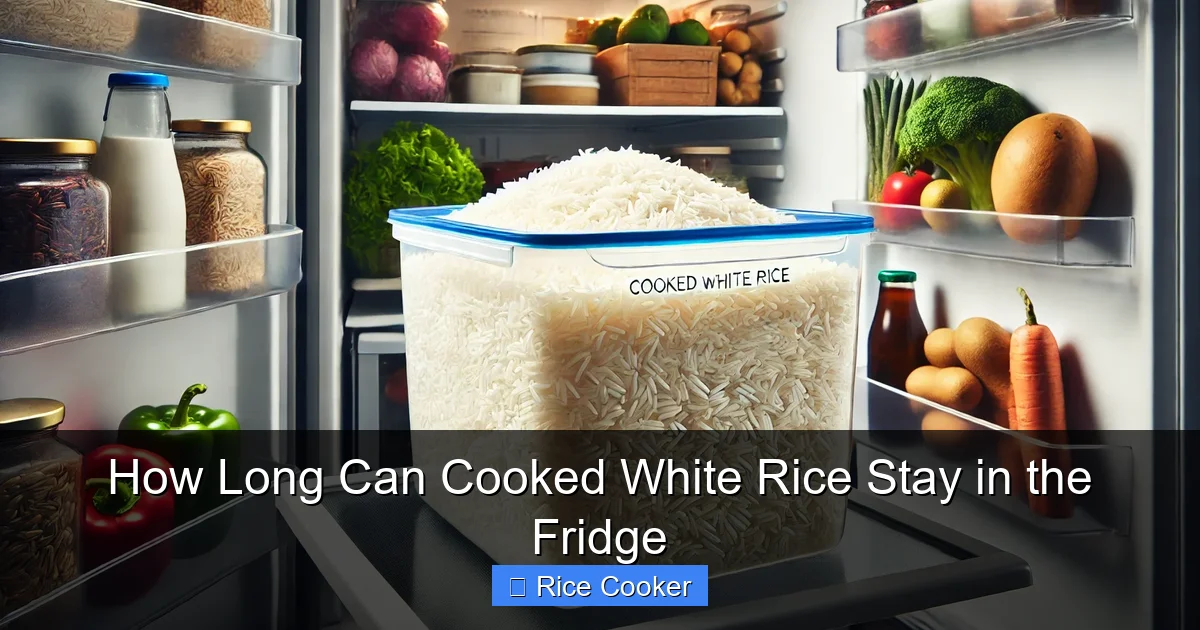
Cooked white rice can safely stay in the refrigerator for up to 7 days when stored properly. However, improper cooling or storage increases the risk of bacillus cereus growth, which causes food poisoning. To maximize safety and flavor, always cool rice quickly, store it in shallow containers, and reheat thoroughly before eating.
Have you ever wondered how long cooked white rice can stay in the fridge? It’s one of those everyday kitchen questions that seems simple but actually carries some important food safety implications. Whether you’re meal prepping for the week or just trying to use up leftovers, knowing how to store rice properly makes a big difference—not just for taste, but for your health.
White rice is a staple in many households around the world. From fried rice on weeknights to rice bowls packed with veggies and protein, it’s versatile, quick to cook, and satisfying. But because it’s starchy and often cooked in large batches, people frequently ask: “How long is too long?” The short answer is usually five to seven days in the refrigerator. But let’s dig deeper—because there’s more to this story than just a number on a calendar.
In this article, we’ll walk through everything you need to know about storing cooked white rice safely. We’ll talk about why certain bacteria love rice, how to cool it fast, best storage practices, signs of spoilage, and even how freezing can help you eat smarter. By the end, you’ll feel confident every time you scoop out a serving from your lunch container.
Key Takeaways
- Safe Refrigeration Window: Cooked white rice should be consumed within 5 to 7 days when refrigerated at or below 40°F (4°C).
- Bacillus Cereus Risk: This common bacteria thrives in starchy foods like rice if left at room temperature too long, producing toxins that survive normal cooking.
- Proper Cooling Is Critical: Never leave rice sitting out for more than 2 hours (or 1 hour in hot climates); divide large batches into shallow containers to speed cooling.
- Reheating Matters: Always reheat leftover rice to an internal temperature of at least 165°F (74°C) to kill potential pathogens.
- Freezing Extends Life: For longer storage, freeze cooked rice in airtight containers—it’s safe for up to 3 months.
- Smell and Texture Tell a Story: Spoiled rice may smell off, feel slimy, or have unusual colors—trust your senses as early warning signs.
- Portion Control Helps: Cooking only what you need reduces waste and minimizes the chance of having uneaten rice sit too long in the fridge.
Quick Answers to Common Questions
Can cooked white rice be eaten after 10 days in the fridge?
No, it’s not recommended. Most food safety guidelines advise consuming refrigerated cooked rice within 5–7 days. Beyond that, the risk of bacterial contamination—especially from Bacillus cereus—increases significantly, even under refrigeration.
Is it safe to reheat rice more than once?
Yes, but only if it’s cooled and stored properly between uses. Each time you reheat, ensure it reaches at least 165°F (74°C) to kill any potential bacteria. Never leave reheated rice sitting out again.
Does freezing ruin the texture of rice?
Not necessarily. Properly frozen rice can retain good texture for up to 3 months. Thaw it slowly in the fridge and add a bit of water when reheating to restore moisture.
Why does rice sometimes make me sick even when it looks fine?
Because Bacillus cereus produces toxins that don’t affect appearance or smell. These heat-stable toxins survive normal cooking and reheating, causing food poisoning if ingested.
Can I leave rice out if I’m going to eat it in 30 minutes?
Technically yes—but it’s risky. The danger zone (40°F–140°F) allows rapid bacterial growth. For best safety, always cool rice quickly and store it promptly, even if you plan to eat soon.
📑 Table of Contents
- Why Rice Is Special When It Comes to Food Safety
- How Long Can You Keep Cooked White Rice in the Fridge?
- Best Practices for Storing Cooked White Rice
- Signs Your Rice Has Gone Bad
- Can You Freeze Cooked White Rice?
- Common Mistakes People Make With Leftover Rice
- How to Reheat Rice Safely
- Special Considerations for Different Types of Rice
- Myths vs. Facts About Rice Storage
- Conclusion: Small Habits, Big Impact
Why Rice Is Special When It Comes to Food Safety
Unlike meat or dairy, which spoil quickly due to high moisture and protein content, rice is mostly carbohydrates—specifically starch. That might sound harmless, but here’s where things get interesting. White rice, especially when cooked and then cooled slowly, becomes a perfect breeding ground for *Bacillus cereus*, a type of bacteria commonly found in soil and dust.
When raw rice grains are harvested, they can carry these spores. Cooking destroys most of them—but here’s the catch: if the hot rice is left to cool at room temperature, those surviving spores can multiply rapidly. And unlike many other bacteria, *B. cereus* produces heat-stable toxins that don’t go away when you reheat your food. So even if you boil your leftovers until steaming hot, you could still get sick from improperly stored rice.
This isn’t just theoretical—food safety agencies worldwide warn against leaving cooked rice out for more than two hours. In temperatures above 90°F (32°C), that drops to just one hour. That’s because bacterial growth accelerates in what’s called the “danger zone” between 40°F and 140°F (4°C to 60°C).
How Long Can You Keep Cooked White Rice in the Fridge?

Visual guide about How Long Can Cooked White Rice Stay in the Fridge
Image source: housevivid.com
So, back to your original question: how long can cooked white rice stay in the fridge? Under ideal conditions—meaning it was cooled quickly, stored in clean, shallow containers, and kept consistently at 40°F or below—you can safely keep it for **up to 7 days**.
Most food safety experts, including the USDA and FDA, recommend consuming refrigerated cooked rice within **5 to 7 days**. Some studies suggest that well-stored rice may last slightly longer—some say up to 10 days—but erring on the side of caution is always smart, especially if you have a compromised immune system or young children in the house.
It’s worth noting that not all rice is created equal. Instant rice, brown rice, and basmati rice may have slightly different shelf lives due to variations in starch structure and oil content (especially with brown rice). But for standard long-grain or medium-grain white rice cooked traditionally or using a rice cooker, the 5–7 day rule holds strong.
The Science Behind the Shelf Life
Let’s break down what happens inside your fridge over those days:
– **Days 1–3**: Rice remains fresh, with minimal microbial activity if stored correctly. Flavor and texture stay close to original.
– **Days 4–5**: Slow increase in moisture loss or slight drying out; some flavor degradation begins.
– **Day 6–7**: Peak of safe consumption window. Any longer, and you enter the gray area where bacterial counts begin rising again.
– **Beyond 7 days**: Risk of *B. cereus* reactivation or mold formation increases significantly, even under refrigeration.
Refrigeration slows bacterial growth dramatically, but it doesn’t stop it entirely—especially for spore-forming bacteria like *B. cereus*. That’s why timing matters.
Best Practices for Storing Cooked White Rice
Visual guide about How Long Can Cooked White Rice Stay in the Fridge
Image source: mascolombia.com
Storing rice properly is just as important as how you cook it. Follow these steps to keep your rice safe and tasty:
Cool It Fast—Really Fast
Never let hot rice sit uncovered on the counter for more than 2 hours. Instead, transfer it to several shallow airtight containers or freezer bags right after cooking. The goal is to reduce its temperature from 140°F down to below 40°F within two hours.
If you’re making a big batch for the week, spread it across multiple trays first, then move to smaller containers once it starts cooling. Using ice baths or placing containers in cold water (changing the water every 15 minutes) can also speed things up.
Use Airtight Containers
Glass or BPA-free plastic containers with tight-fitting lids work best. Avoid open bowls or foil-covered dishes—they expose rice to air and contaminants. Label each container with the date so you know exactly when it went into the fridge.
Keep It Cold—Consistently
Make sure your refrigerator is set no higher than 40°F (4°C). If your fridge is older or frequently opened, check the temperature occasionally with an appliance thermometer. Also, avoid stacking containers too tightly; good airflow helps maintain consistent cold temperatures throughout.
Don’t Overcrowd the Fridge
Leave space around containers so cold air circulates freely. Putting warm items near your rice can raise the local temperature enough to slow bacterial control.
Signs Your Rice Has Gone Bad
Even if your rice passed the 7-day mark, don’t automatically assume it’s unsafe. But there are telltale signs to watch for:
– **Off odor**: Sour, musty, or ammonia-like smells are red flags.
– **Unusual texture**: Sliminess, stickiness, or clumping suggests bacterial or fungal growth.
– **Discoloration**: Grayish, green, or black spots mean mold.
– **Mold growth**: Visible fuzzy patches anywhere on the surface.
– **Hardness or dryness**: While not dangerous, extremely dry rice may indicate freezer burn if frozen improperly.
If any of these appear, toss it immediately—even if you’re unsure. When in doubt, throw it out.
Can You Freeze Cooked White Rice?
Absolutely! Freezing extends the life of cooked white rice to **up to 3 months**—and it’s one of the safest ways to preserve it long-term. Here’s how to do it right:
1. **Cool completely** before freezing (within 2 hours).
2. **Portion appropriately**—freeze in small servings so you only thaw what you need.
3. Use **airtight freezer-safe containers** or heavy-duty zip-top bags. Squeeze out excess air to prevent freezer burn.
4. **Label and date** everything clearly.
5. Thaw overnight in the fridge or use the defrost setting on your microwave.
Frozen rice retains its quality better than refrigerated rice over time. Just remember to reheat it thoroughly after thawing.
Tips for Meal Preppers
If you love meal prepping, consider batch-cooking rice on Sunday and dividing it into individual portions for the week. Store some in the fridge (for days 1–5), some in the freezer (for later weeks), and keep a small batch ready-to-eat for quick meals.
You can also mix cooled rice with sauces, spices, or proteins while it’s still warm to make future stir-fries or burrito bowls even faster.
Common Mistakes People Make With Leftover Rice
Despite knowing the basics, many folks still mishandle rice. Here are frequent errors—and how to avoid them:
– **Leaving rice out overnight**: Even if you plan to eat it tomorrow, leaving it out creates ideal conditions for toxin production.
– **Reusing old containers without washing**: Bacteria can hide in cracks or residue from previous uses.
– **Thawing frozen rice at room temperature**: Always thaw in the fridge or microwave, never on the counter.
– **Skipping the reheat step**: Simply microwaving without ensuring internal heat kills bacteria is risky.
– **Assuming “if it looks fine, it’s fine”**: Visual cues aren’t reliable—smell and texture matter more.
Real-Life Example: What Happens When You Get It Wrong
Imagine you cook a pot of jasmine rice for dinner, serve half, and leave the rest on the stove overnight. By morning, the rice has cooled slowly, allowing *B. cereus* spores to activate and produce enterotoxins. You reheat it for lunch, but the toxins remain. Within hours, you develop nausea, vomiting, or diarrhea—classic symptoms of rice poisoning.
This scenario plays out more often than you think. In fact, *B. cereus* is a leading cause of foodborne illness linked to restaurant meals involving rice dishes.
How to Reheat Rice Safely
Reheating is your last line of defense against harmful bacteria. Follow these steps:
1. **Place rice in a microwave-safe dish** or saucepan.
2. **Add a splash of water**—this prevents drying and ensures even heating.
3. **Cover loosely** to trap steam and promote uniform temperature.
4. **Heat in short intervals** (30 seconds to 1 minute), stirring between bursts.
5. **Check internal temperature** with a food thermometer—it should reach at least **165°F (74°C)**.
6. **Let it stand covered for 1–2 minutes** after heating to allow residual heat to distribute evenly.
For stovetop reheating, bring to a rolling boil while stirring constantly until hot throughout.
What About Fried Rice?
Fried rice made with previously cooked rice is generally safer because the high heat during frying kills bacteria. But if you’re adding raw ingredients (like eggs or vegetables) and the final product isn’t cooked through, you risk cross-contamination or undercooked centers.
Still, even fried rice should be eaten within 3–4 days of preparation if stored in the fridge.
Special Considerations for Different Types of Rice
While we’ve focused on white rice, other varieties behave differently:
– **Brown rice**: Higher in fiber and oils, so it spoils faster. Best used within 3–4 days in the fridge, or frozen for up to 2 months.
– **Instant rice**: Often pre-cooked and dried, so it has a shorter shelf life. Check package instructions.
– **Glutinous (sticky) rice**: More prone to sticking and moisture retention; cool and store carefully to avoid sogginess.
Regardless of type, always follow the same core principles: cool fast, store sealed, consume soon.
Myths vs. Facts About Rice Storage
There’s a lot of misinformation floating around. Let’s clear some up:
– **Myth**: “Rice can last forever in the fridge if vacuum-sealed.”
**Fact**: No food lasts forever. Vacuum sealing slows spoilage but doesn’t eliminate bacterial risks entirely.
– **Myth**: “If I freeze rice, it loses all nutrients.”
**Fact**: Freezing preserves most vitamins and minerals. Nutrient loss is minimal compared to prolonged refrigeration.
– **Myth**: “I can leave rice out if I eat it quickly.”
**Fact**: Toxin production begins within hours of cooling, regardless of when you plan to eat it.
– **Myth**: “Cooking rice twice makes it safe.”
**Fact**: Repeated reheating doesn’t destroy *B. cereus* toxins—only proper initial cooling and storage do.
Stick to science-backed guidelines, and you’ll stay safe.
Conclusion: Small Habits, Big Impact
Knowing how long cooked white rice can stay in the fridge isn’t just about following rules—it’s about protecting your family’s health and reducing food waste. By cooling rice quickly, storing it properly, and trusting your senses, you create a routine that’s both smart and simple.
Whether you use a rice cooker, stovetop, or microwave, the principles remain the same. Plan ahead, portion wisely, and treat leftovers like precious resources—because every bowl of rice deserves to be enjoyed safely and deliciously.
Next time you cook a pot of white rice, take a moment to cool it right, label it clearly, and pop it in the fridge. Those small actions can save you from unnecessary stomach upset and keep your meals stress-free. After all, great food starts with great habits.
Frequently Asked Questions
How should I cool cooked white rice before refrigerating?
Transfer hot rice to shallow airtight containers immediately after cooking. Spread it thin to cool faster—ideally reducing temperature below 40°F within 2 hours. Avoid leaving it uncovered on the counter.
Can I reuse the same container for multiple batches of rice?
Only if it’s thoroughly washed and sanitized between uses. Dirty or cracked containers can harbor bacteria, increasing the risk of contamination.
What temperature should my refrigerator be set to for safe rice storage?
Your fridge should be at or below 40°F (4°C). Use a thermometer to verify, especially if your unit frequently opens or is older.
How do I know if my rice is spoiled without tasting it?
Look for off odors (sour, musty), slimy texture, unusual color changes, or visible mold. If any of these are present, discard the rice immediately.
Is it okay to store rice next to strong-smelling foods?
Not ideal. Strong odors like onions, fish, or spices can seep into rice through porous containers. Store rice separately to preserve its natural flavor.
Can I eat rice that’s been in the fridge for exactly 7 days?
Possibly—but only if it was stored properly and shows no signs of spoilage. When in doubt, it’s safer to use it within 5–6 days for optimal freshness and safety.